
China is the world’s largest producer of power and industrial cables, supplying a significant share of global B2B demand across construction, energy, mining, and infrastructure sectors. For importers, EPC contractors, and project procurement teams, sourcing cables from Chinese manufacturers offers competitive pricing and broad product range — but also requires a structured approach to specification, supplier selection, and quality verification.
This guide walks through the sourcing process from initial specification to shipment, covering the practical steps that separate a successful procurement from one that results in quality disputes, delayed projects, or customs complications.
Step 1: Define Your Cable Specification Before Contacting Suppliers
The most common cause of misquotation and supply errors in cable procurement is an incomplete or ambiguous specification. Chinese manufacturers produce cables to multiple international standards and in a wide range of configurations — without a clear specification, suppliers will quote the product that is easiest or most profitable for them to supply, which may not be what the project requires.
A complete cable specification for B2B procurement includes:
- Cable type and application (power cable, control cable, instrumentation cable, data cable)
- Voltage grade in U0/U format (e.g. 0.6/1kV, 6/10kV)
- Number of cores
- Conductor material: copper (Cu) or aluminum (Al)
- Conductor cross-sectional area in mm²
- Insulation type: XLPE or PVC
- Armoring requirement: SWA, AWA, or unarmored
- Outer sheath color (where locally mandated)
- Applicable standard: IEC 60502-1/2, BS 6622, AS/NZS 1429, or other
- Quantity: total meters and/or number of drums with drum length
- Delivery destination and Incoterms (FOB, CIF, DAP)
Key Point: Providing the applicable standard is not optional — it defines the insulation wall thickness, conductor construction, and test requirements. A cable described only as ’10kV 3-core 95mm² XLPE’ without a standard reference could be manufactured to at least three different specifications with meaningfully different construction and performance.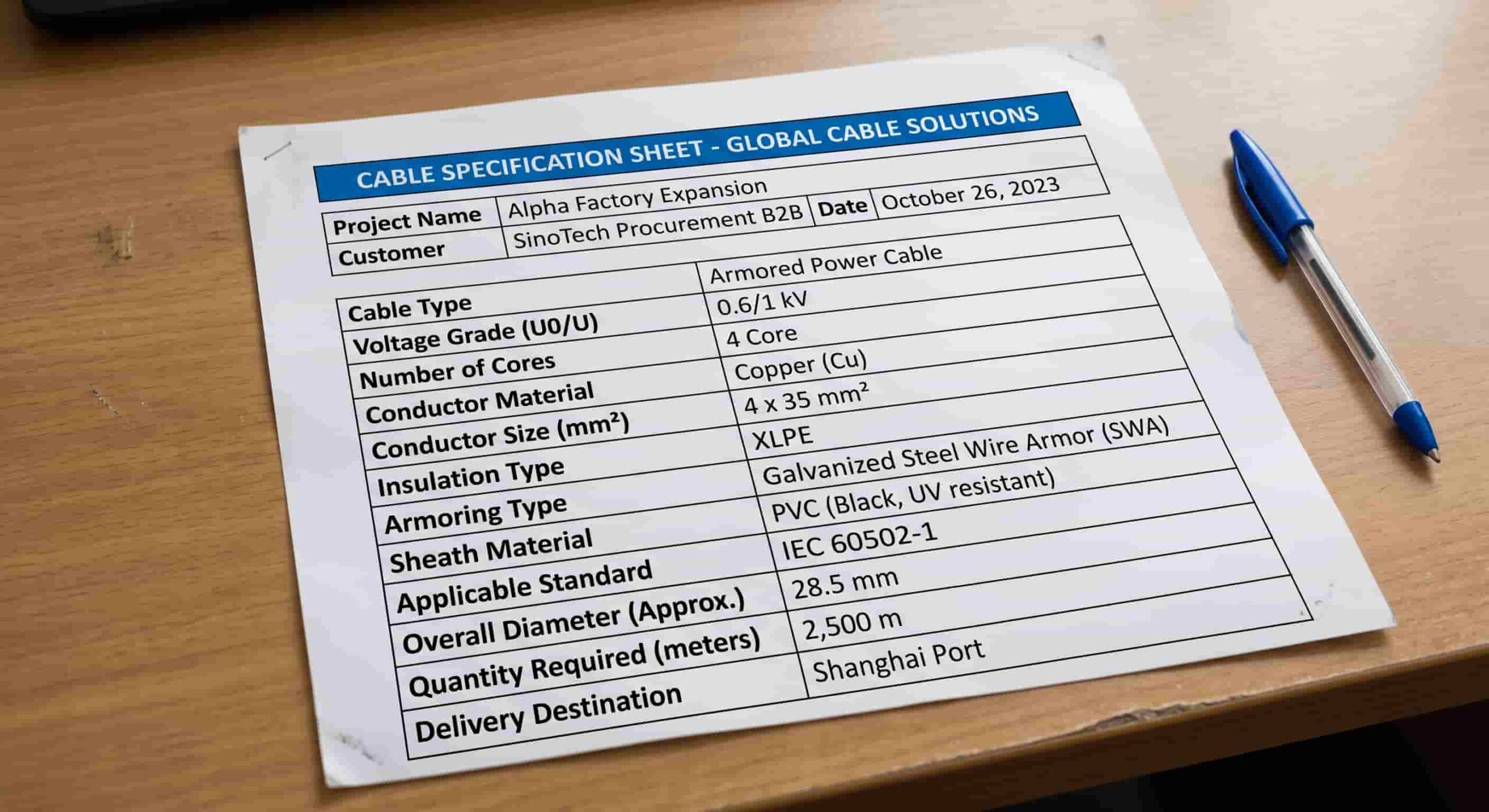
For a detailed breakdown of voltage grade designations and what they mean for cable construction, see Low Voltage vs Medium Voltage Cable: A Procurement Guide.
Step 2: Understand the Chinese Cable Manufacturing Landscape
China’s cable industry includes manufacturers across a wide range of scale and capability — from large state-owned enterprises producing IEC-certified cables for utility and infrastructure projects, to smaller factories producing commodity cables for domestic construction. For B2B export procurement, understanding where a supplier sits in this landscape is important.
Large integrated manufacturers
Produce the full range of low and medium voltage cables, hold multiple international certifications, operate internal test laboratories, and regularly supply to utility, industrial, and EPC clients globally. Lead times are longer, MOQs may be higher, but quality control is systematic and traceable.
Mid-size export-focused manufacturers
Focus on B2B export markets, typically hold ISO 9001 and key product certifications, have established relationships with international freight forwarders, and are experienced with export documentation requirements. This tier is where most B2B importers find their long-term suppliers.
Small or trading companies
May not manufacture cable directly but source from factories and resell. Can be flexible on small quantities and mixed orders but traceability of the actual production source is harder to verify. Not recommended for project-critical supply without factory audit.
Note: When a supplier presents itself as a manufacturer, ask for the factory business license and production license for cable products. Trading companies sometimes present factory images and claim direct manufacturing capability. For IEC-certified product, ask for the certification body audit report — it will list the actual manufacturing facility address.
Step 3: How to Evaluate a Chinese Cable Supplier
Supplier evaluation for cable procurement should cover five areas: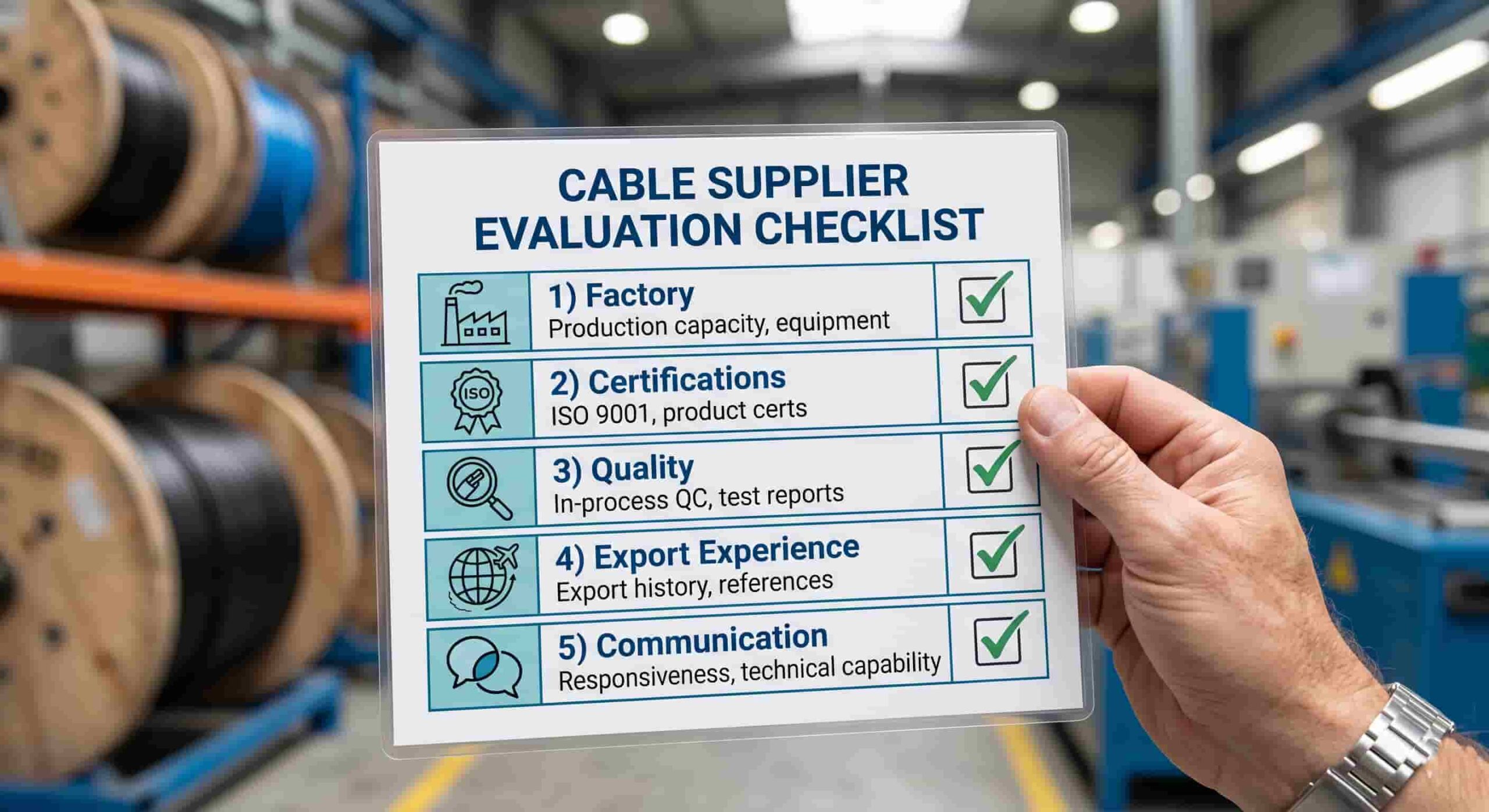
1. Production capability
Confirm that the factory produces the specific cable type you require — not all cable manufacturers produce the full product range. A factory specializing in low-voltage building wire may not have the equipment or process capability for medium voltage armored cable. Ask specifically: do you manufacture this product in your own facility, and what is your annual production capacity for this cable type?
2. Certifications and quality system
ISO 9001 certification is a baseline indicator of a documented quality management system but does not guarantee product quality. For product-specific quality assurance, ask for:
- IEC or equivalent product test reports for the specific cable type (not a generic certificate)
- Third-party type test reports from an accredited laboratory (CNAS, ILAC-accredited)
- Internal quality control procedures for the production stage you are procuring
3. Export experience and references
Ask how many years the supplier has been exporting to your target market, and request references from buyers in similar industries or geographies. A supplier with a track record of exporting to the Middle East, Southeast Asia, or Australia — depending on your market — will be more familiar with the documentation, packaging, and certification requirements relevant to your procurement.
4. Sample order and pre-production sample
For new supplier relationships involving significant volume, request a pre-production sample (PPS) of the cable before confirming the full order. The PPS should be tested against the specification — at minimum: conductor resistance, insulation thickness (cross-section measurement), and voltage withstand test. Third-party inspection of the PPS at the factory is possible through services such as SGS, Bureau Veritas, or Intertek.
5. Communication and technical responsiveness
A supplier’s ability to respond accurately to technical questions — voltage grade, standard, conductor construction, test requirements — before the order is placed is a reliable indicator of their capability during production. A supplier who cannot explain the difference between IEC 60502-1 and IEC 60502-2, or who confirms everything without asking clarifying questions, is a risk regardless of price.
Step 4: Understanding Test Reports and Certificates
Cable quality documentation falls into three tiers, each serving a different purpose in procurement verification: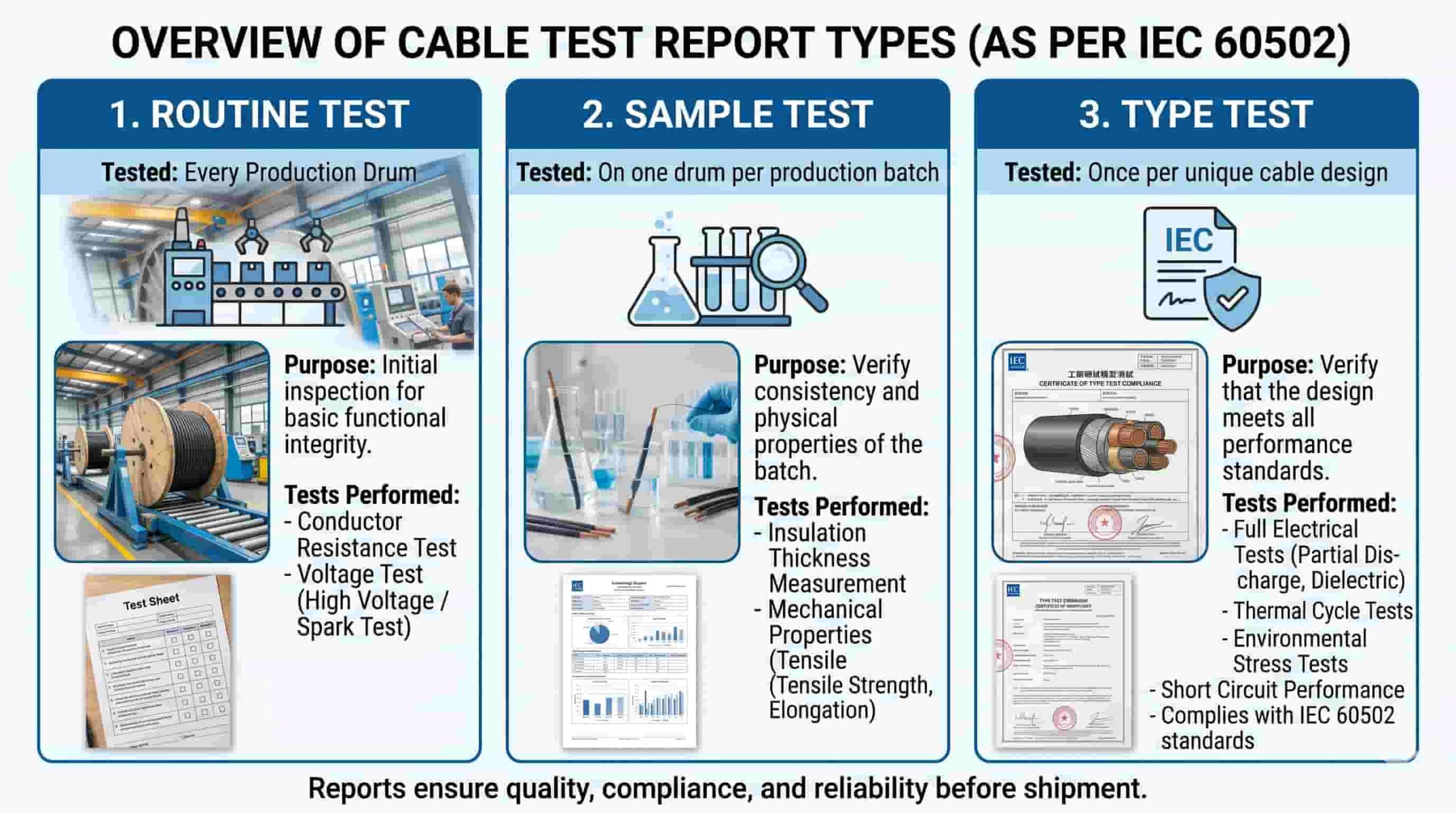
When comparing quotations from multiple suppliers for the same specification, the most common sources of price difference are:
- Conductor purity: standard commercial-grade copper (99.9% Cu) vs. oxygen-free copper (OFC) — confirm which is quoted
- Insulation wall thickness: some suppliers quote to the minimum permissible wall thickness under the standard; confirm the nominal thickness is to standard, not reduced
- Drum length: shorter drums per the same total quantity increase per-meter cost and may create more site waste — confirm standard drum lengths
- Armoring wire diameter: SWA wire gauge affects both mechanical performance and weight — confirm to standard
Tip: Request that all suppliers quote against the same specification document. If you allow suppliers to quote ‘equivalent’ products, you will receive prices for different cables that are not directly comparable. A locked specification — listing standard, voltage grade, conductor, insulation, armoring, and drum length — is the only basis for a valid price comparison.
Step 6: Packaging, Shipping, and Lead Time
Cable exported from China is supplied on wooden or steel drums, or in coils for smaller cross-sections and shorter lengths. The packaging specification affects both shipping cost and site usability.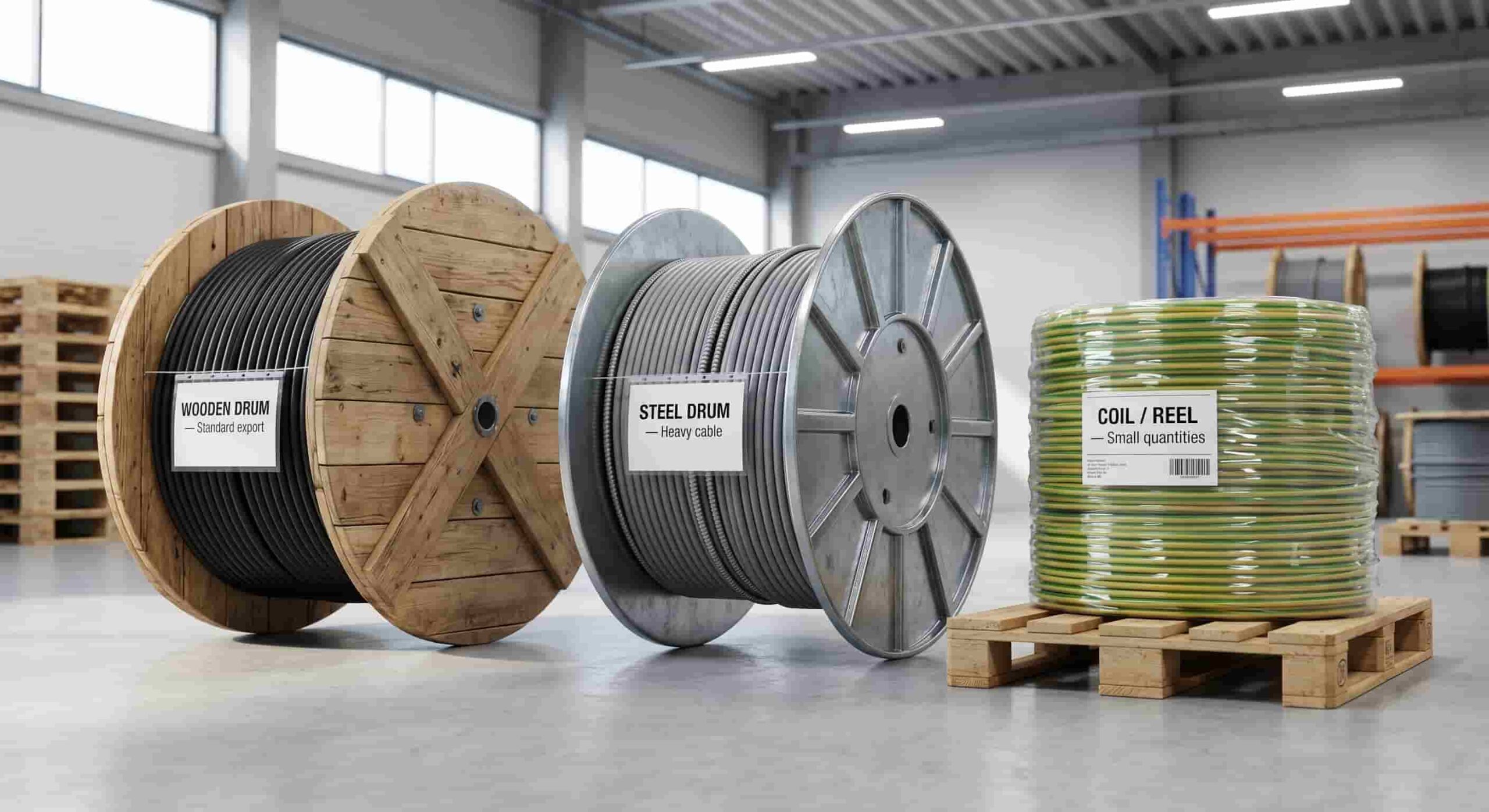
Drum types
- Wooden drums: standard for most export cable, available in a range of flange diameters. Confirm drum dimensions if container space is constrained.
- Steel drums: used for heavier cables where drum rigidity is required. Higher packaging cost but reusable.
- Coils / plastic reels: used for smaller cross-section cables in shorter lengths. Lower cost but not suitable for site pulling of long runs.
Shipping considerations
- 20ft container: typically accommodates 4–8 large cable drums depending on drum diameter and height
- 40ft container: standard for larger cable orders with multiple drum sizes
- LCL (less than container load): available for small orders but higher per-unit freight cost and greater handling risk for drums
- Lead time from Chinese cable manufacturers: typically 15–35 working days for standard products; 45–60 days for non-standard or large-diameter MV cables
Note: Wooden cable drums are classified as wood packaging material (WPM) and must be ISPM 15 heat-treated and marked for import into most countries including Australia, the EU, and the US. Confirm with your supplier that drums carry the IPPC stamp before shipment.
Step 7: Export Documentation Checklist
A complete cable shipment from China should be accompanied by the following documents: