Data Center Power Infrastructure: Complete Cable and Electrical Supply Checklist for Project Buyers

A structured procurement reference for B2B buyers sourcing power cables, switchgear, UPS systems, PDUs, and ELV cabling for data center construction and fit-out projects.

Table of Contents

Data center construction and fit-out projects involve one of the most demanding electrical procurement requirements in the B2B market. The power infrastructure must deliver continuous, redundant, and precisely conditioned power to IT loads — while also supporting the mechanical, safety, security, and monitoring systems that keep the facility operational.

For project buyers, procurement managers, and EPC contractors sourcing electrical products from China for data center projects, this guide provides a structured checklist covering every major product category — from the medium voltage entry point to the rack-level power distribution and ELV systems.


Data Center Power Architecture Overview

Before specifying individual products, understanding the power distribution hierarchy is essential. A typical data center power path follows this sequence:Diagram showing data center power flow from utility grid through transformer, UPS, PDU to server rack loads
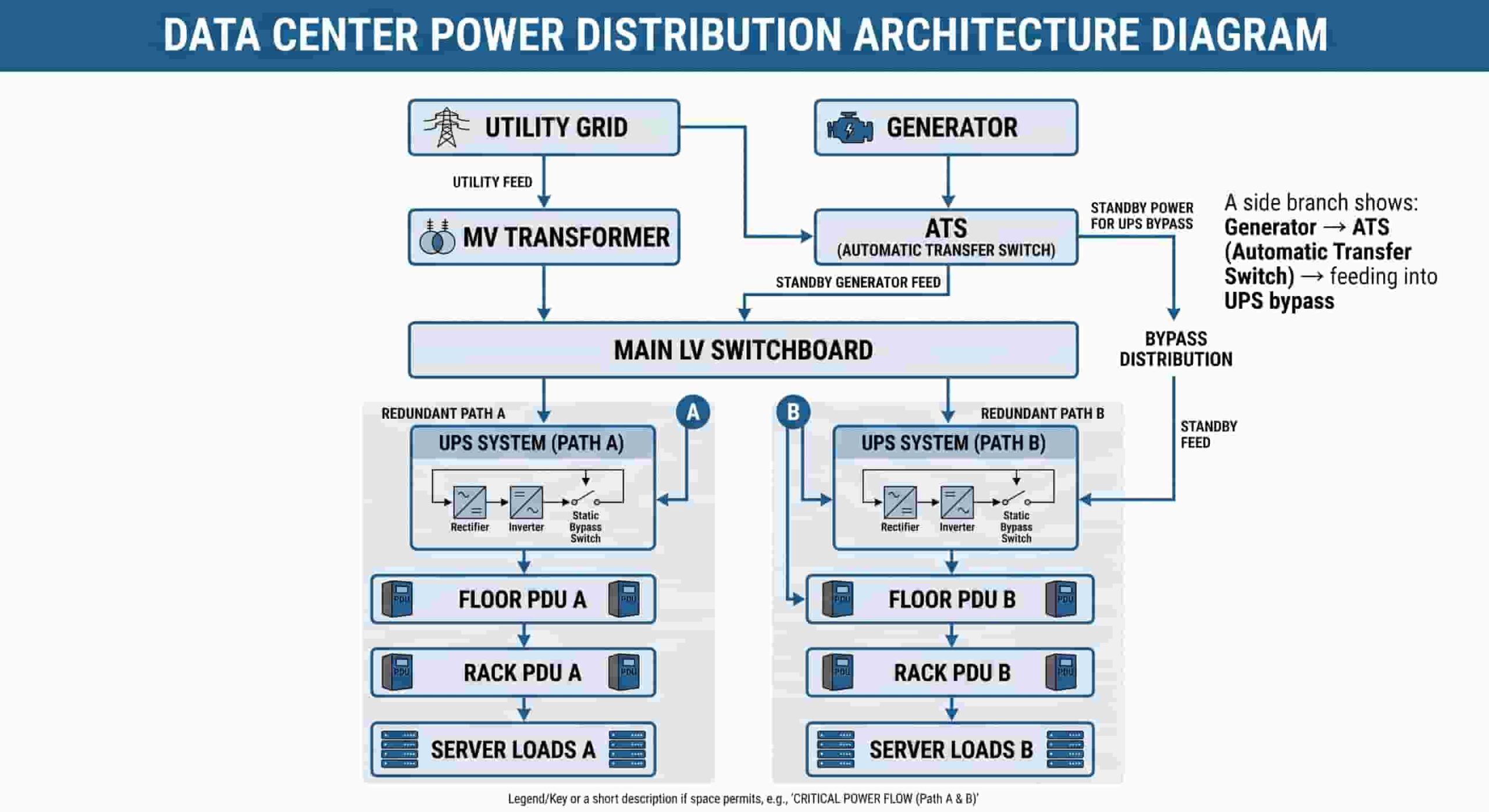
  • Utility grid connection at medium voltage (typically 6kV, 10kV, or 33kV depending on location and facility scale)
  • MV/LV transformer stepping voltage down to 400V AC three-phase for distribution
  • Main low voltage switchboard (MLVS) distributing power to UPS systems, mechanical plant, and lighting
  • Uninterruptible power supply (UPS) systems providing conditioned, battery-backed power to IT loads
  • Floor-level power distribution units (PDUs) distributing UPS output to rack PDUs
  • Rack-mounted PDUs supplying individual servers and network equipment

    Enterprise and hyperscale data centers typically operate with an N+1 or 2N redundancy architecture — meaning every critical power path has at least one fully redundant backup system. This redundancy requirement doubles or triples the cable and equipment quantities compared to a single-path installation.

    Key Point: For data center procurement, always confirm the redundancy tier (Tier I through Tier IV per the Uptime Institute standard) with the project engineer before finalizing quantities. A Tier III facility requires concurrent maintainability — every power path must be maintainable without shutting down the IT load — which significantly affects cable routing, switchgear configuration, and UPS topology.


    Power Cables: Specification Requirements by Zone

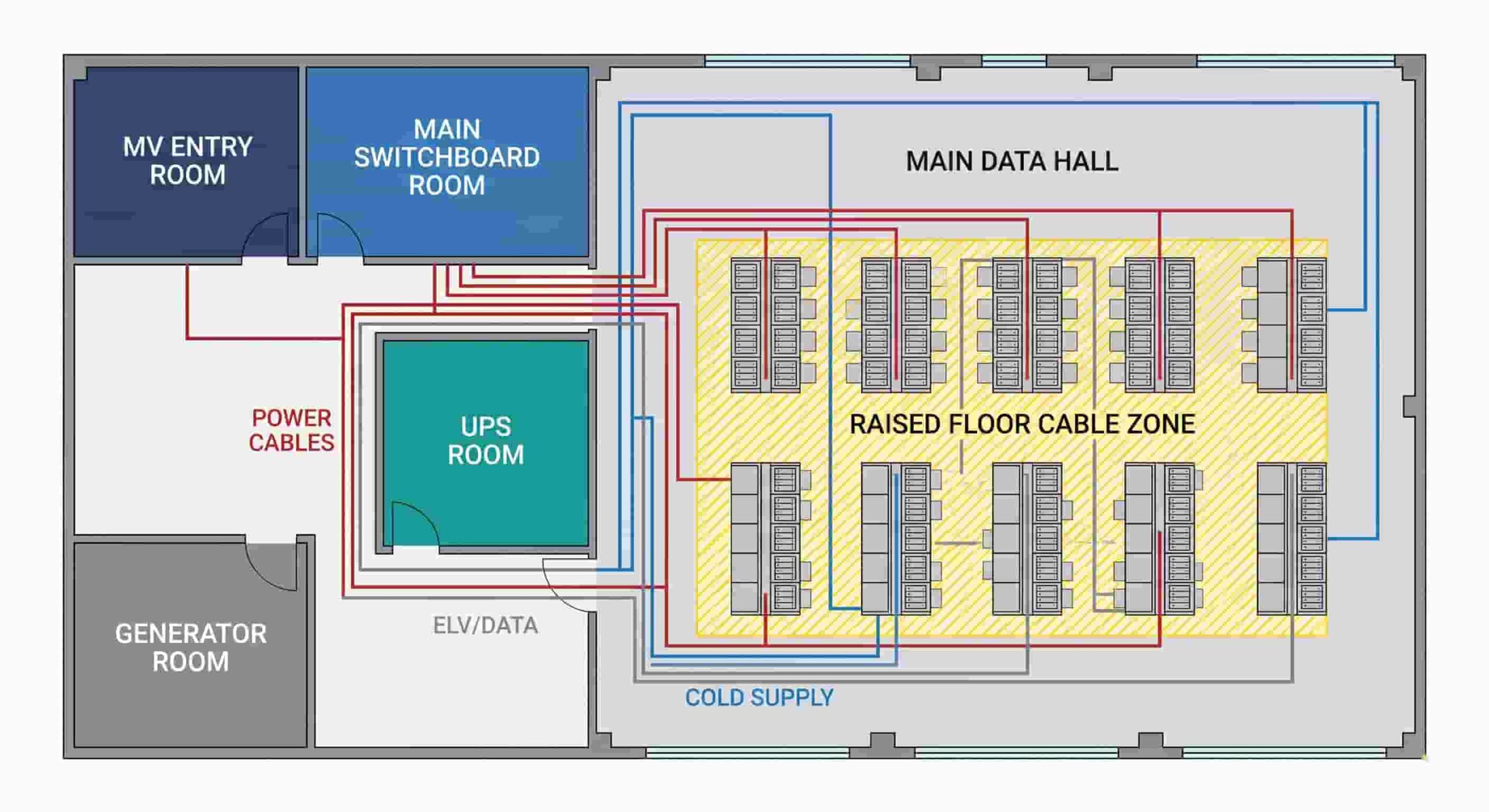
    Data center power cable procurement spans multiple voltage levels and installation zones, each with distinct specification requirements.Floor plan diagram showing data center cable routing zones: MV entry, LV distribution, UPS room, and raised floor cable paths

    Zone 1: MV Entry and Transformer Feeders

    The medium voltage cable from the utility supply point to the on-site transformer is typically specified by the local utility authority and must comply with their approved cable list. For project procurement, the common specification is:

    • Voltage grade: 6/10kV, 8.7/15kV, or 19/33kV depending on supply voltage
    • Conductor: copper, cross-section determined by transformer kVA rating and cable run length
    • Insulation: XLPE with semi-conductive screens and copper tape metallic screen
    • Armoring: SWA or AWA for direct burial entry routes; unarmored for conduit installations
    • Standard: IEC 60502-2 or local utility specification


    Zone 2: LV Distribution — Transformer to Main Switchboard

    The low voltage feeders between the transformer LV terminals and the main switchboard carry the full facility load current and are typically the largest conductor cross-sections in the installation:

    • Voltage grade: 0.6/1kV
    • Conductor: copper or aluminum, 300mm² to 630mm² per phase for large facilities
    • Configuration: single-core cables in sets of three phases plus neutral, or multi-core for smaller feeders
    • Insulation: XLPE preferred for thermal performance at high current density
    • Installation: cable tray, trefoil formation for single-core, or in duct
    • Standard: IEC 60502-1


    Zone 3: UPS Feeders and Output Circuits

    Cables between the main switchboard and UPS systems, and between UPS output and floor PDUs, are sized for the UPS rating with appropriate derating for bundling and installation temperature:

    • Voltage grade: 0.6/1kV
    • Conductor: copper, cross-section based on UPS kVA rating and circuit length
    • Flame retardance: LSZH (Low Smoke Zero Halogen) sheath strongly recommended for enclosed cable tray in occupied data halls — reduces toxic smoke in fire events
    • Standard: IEC 60502-1 with IEC 60332-3 flame retardance for LSZH cables


    Zone 4: Raised Floor and Overhead Cable Tray Runs

    In-hall cable runs distributing power from floor PDUs to rack PDUs, and ELV cables for structured cabling and monitoring:

    • Power cables: LSZH insulated and sheathed, flexible construction for routing around equipment
    • Data cables: Cat6A F/UTP or S/FTP for 10GbE structured cabling; OM4 or OS2 fiber for backbone
    • Fire alarm cables: fire-resistant construction to IEC 60702 or BS 7629
    • All cables in raised floor or overhead tray should carry IEC 60332-1 or -3 flame retardance rating


Zone Voltage Grade Cable Type Key Requirement Standard
Zone 1: MV Entry6/10kV – 19/33kVXLPE MV, Cu screen, SWAUtility authority approved listIEC 60502-2
Zone 2: LV Main Feeders0.6/1kVXLPE, single-core Cu, large x-sectionTrefoil formation, 300–630mm²IEC 60502-1
Zone 3: UPS Feeders0.6/1kVXLPE or LSZH, Cu, multi-coreLSZH sheath in enclosed trayIEC 60502-1 + IEC 60332-3
Zone 4: In-Hall Power0.6/1kVLSZH flexible, CuLSZH mandatory, IEC 60332-1IEC 60502-1 + IEC 60332-1
Zone 4: Structured CablingELVCat6A F/UTP or S/FTP; OS2 / OM4 fiberLSZH sheath, 10GbE capableISO/IEC 11801 Ed.3 / TIA-568
Zone 4: Fire AlarmELVFire-resistant, mineral insulated or enhanced fire performanceCircuit integrity at 830°C / 120 minIEC 60702-1 or BS 7629

LV Switchgear and Distribution Equipment

The main low voltage switchboard and downstream distribution boards are the nerve center of the data center power system. Key procurement specifications:

Main Low Voltage Switchboard (MLVS)

  • Rated current: sized to full facility load plus growth allowance (typically 125% of calculated load)
  • Busbar system: copper busbar rated for continuous current, short-circuit withstand to IEC 61439-1/2
  • Protection: ACB (Air Circuit Breakers) for incoming and main distribution, MCCB for sub-circuits
  • Metering: energy metering on incoming and major outgoing circuits for PUE monitoring
  • Form of separation: Form 4 Type 7 (fully compartmentalized) recommended for maintainability
  • IP rating: IP31 minimum for indoor installation in a clean switchroom


UPS Input and Output Distribution Boards

  • Rated current to match UPS kVA output
  • Dual-bus configuration for A/B power path redundancy
  • STS (Static Transfer Switch) where A/B path transfer is required
  • Surge protection device (SPD) on UPS output boards


Floor PDUs

  • Input: three-phase from UPS output, rated to match branch circuit loading
  • Output: single-phase or three-phase circuits to rack PDUs, typically 16A or 32A MCB protected
  • Metering: per-outlet or per-phase metering for power monitoring
  • Form factor: vertical rack-mount or freestanding floor unit


Note: For data centers targeting PUE (Power Usage Effectiveness) certification or sustainability reporting, energy metering at the PDU level is increasingly specified by facility operators. Confirm metering requirements with the client before specifying PDU models.


UPS System Specification

The UPS system is the most critical single electrical product in a data center procurement package. Key specification parameters:

Parameter Specification Notes for B2B Procurement
TopologyDouble-conversion online (VFI)IEC 62040-3 class VFI-SS-111 — mandatory for data center
Rated power (kVA / kW)Per IT load + 25% headroomPower factor: specify kW (active) not just kVA
Input voltage3-phase 400V AC (±20% tolerance)Wide input range reduces bypass frequency
Battery runtime5–15 min internal; extendable via EBCRuntime covers generator start + transfer time
Battery typeVRLA standard; LiFePO4 optionalLFP: longer life, higher density, higher upfront cost
Efficiency≥95% at full load (double conversion)ECO mode ≥99% — for lower-criticality circuits only
CommunicationSNMP card, dry contacts, ModbusRequired for BMS and DCIM integration
CertificationIEC 62040-1, -2, -3CE marking required for European projects

For data center applications, double-conversion (online) UPS topology is the standard — it provides complete electrical isolation between the utility supply and the IT load, eliminating voltage disturbances, frequency variations, and transients from reaching the servers.

  • Topology: double-conversion online (IEC 62040-3 classification VFI-SS-111)
  • Efficiency: 95%+ at full load; ECO mode available for energy efficiency when redundancy allows
  • Runtime: typically 5–15 minutes at full load from internal batteries, with external battery cabinet provision for extended runtime
  • Scalability: modular UPS architecture allows capacity addition without system replacement
  • Battery type: VRLA (sealed lead-acid) standard; lithium-ion (LiFePO4) increasingly specified for higher energy density and longer cycle life
  • Communication: SNMP card for network management integration, dry contact outputs for BMS
  • Certification: IEC 62040-1 (safety), IEC 62040-2 (EMC), IEC 62040-3 (performance)


Generator and ATS Requirements

The standby generator and automatic transfer switch (ATS) provide backup power during extended utility outages. For data center procurement, the generator interfaces with the UPS system via the ATS:

  • Generator rating: sized to cover full UPS input load plus mechanical (HVAC) load plus lighting — typically 125% of total electrical load
  • Fuel type: diesel is standard for data centers; natural gas and HVO (hydrotreated vegetable oil) increasingly considered for sustainability
  • ATS: open or closed transition depending on UPS bypass requirements; rated for full generator output current
  • Generator cable: flexible power cable from generator terminals to ATS, sized for full rated current, LSZH sheathed
  • Fuel system: day tank, bulk storage, and fuel transfer pump supply typically within scope of generator procurement


Note: Generator cables are often overlooked in data center procurement packages. Confirm the cable route length from the generator room to the ATS and size the conductor accordingly — long runs may require upsizing from the generator manufacturer’s terminal specification to stay within voltage drop limits.


ELV and Weak Current Systems

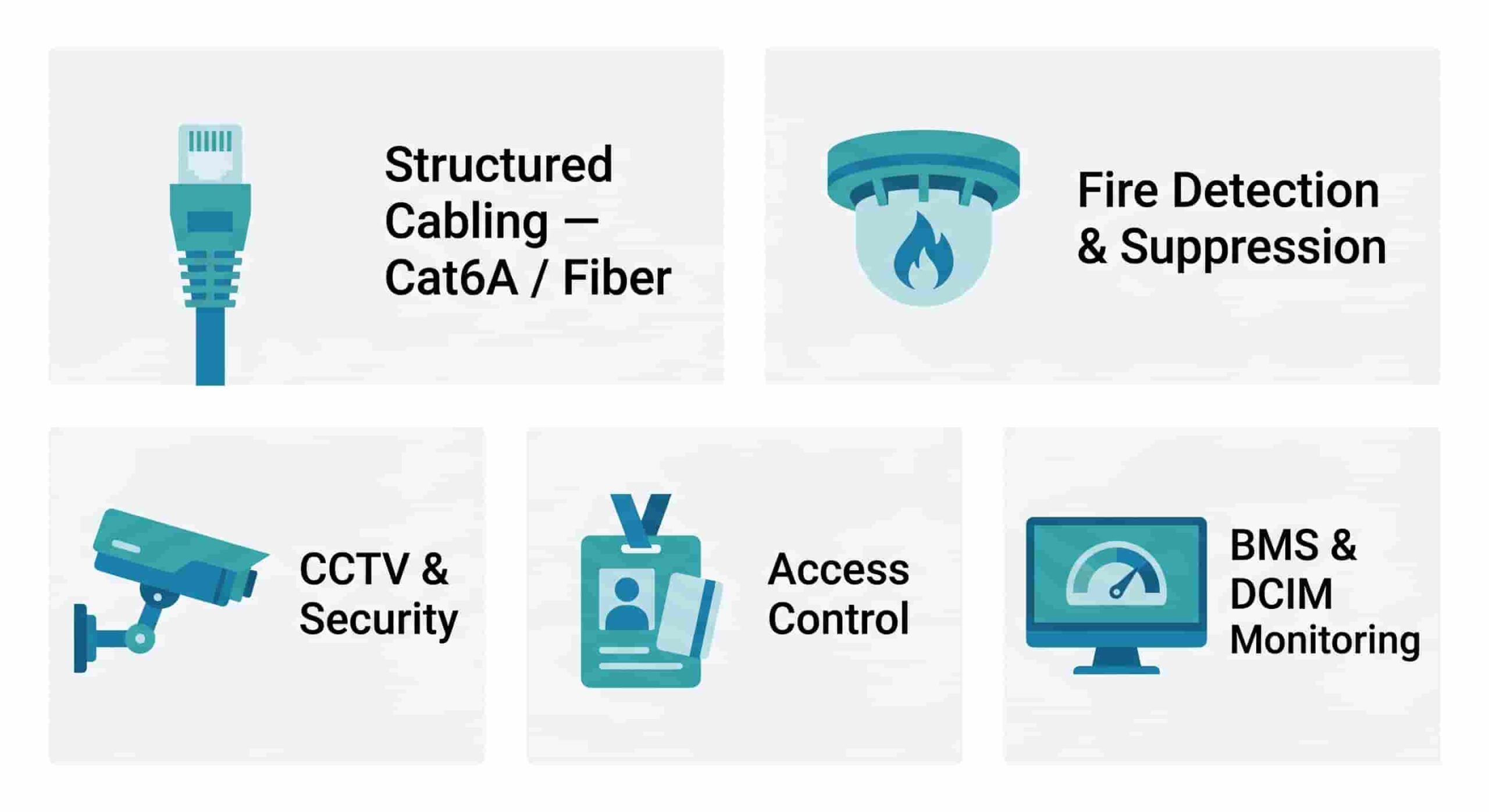
Extra low voltage (ELV) and weak current systems in a data center cover a broad range of subsystems, each with distinct cable and equipment requirements.Infographic showing data center ELV systems: structured cabling, fire detection, CCTV, access control and BMS
ELV System Cable Type Key Equipment Standard
Structured cabling (copper)Cat6A F/UTP or S/FTP, LSZHPatch panels, keystone jacksISO/IEC 11801 Ed.3
Fiber backboneOS2 SMF / OM4 MMF, LSZHFiber distribution frames, cassettesISO/IEC 11801 Ed.3
Fire detectionFire-resistant, IEC 60702 or BS 7629VESDA ASD, detectors, panelIEC 60702-1 / EN 54
Gas suppressionFire-resistant circuit cableRelease panel, solenoid valves, cylindersISO 14520 / NFPA 2001
CCTVCat6 UTP or fiber (IP cameras), LSZHIP cameras, NVR, monitorsProject specification
Access controlSTP or UTP, LSZHCard readers, door controllers, panelsProject specification
BMS / DCIMShielded twisted pair (Modbus/BACnet), LSZHSensors, controllers, DCIM software gatewayModbus RTU / BACnet MS/TP

Structured Cabling

The structured cabling system carries data between servers, network switches, and storage systems. For new data center construction:

  • Horizontal cabling: Cat6A F/UTP or S/FTP to TIA-568-C.2-1 or ISO/IEC 11801 Ed.3, supporting 10GBASE-T to 100m
  • Backbone cabling: OS2 single-mode fiber for inter-rack and inter-room backbone; OM4 multimode for shorter distances
  • Patch panels: high-density angled patch panels for cable management in structured cabling zones
  • Cable management: cable trays, containment, and Velcro ties — no plastic cable ties in data hall


Fire Detection and Suppression

Data center fire systems require specialist cable types:

  • Fire alarm cable: fire-resistant to IEC 60702-1 (mineral insulated) or BS 7629 (enhanced fire performance), circuit integrity maintained at 830°C for 120 minutes
  • Gas suppression system: inert gas (IG-541, IG-55) or clean agent (FK-5-1-12) — cable to detection and release panel must be fire-resistant circuit
  • Aspirating smoke detection (ASD): VESDA or equivalent, with sampling pipe network in raised floor and above ceiling — requires specialist installation


CCTV and Access Control

  • CCTV: Cat6 or fiber for IP cameras; coaxial (RG59) for legacy analog systems
  • Access control: shielded twisted pair for door controllers; power over data cable where PoE readers are used
  • All ELV cables in data hall: LSZH sheathed to minimize smoke in fire events


Earthing and Bonding

The earthing system in a data center serves both safety and signal reference functions. IT equipment is sensitive to earth potential differences — a poor earthing system causes equipment damage and data errors.

  • Main earth bar (MEB): copper bar connected to building structural earth and utility earth terminal
  • Equipment earth conductors: sized to IEC 60364-5-54, copper preferred for low impedance
  • Signal reference ground (SRG): equipotential bonding grid under raised floor, typically 25mm² bare copper mesh or conductors bonded to structural steel at regular intervals
  • Rack bonding: all server racks bonded to SRG at each rack with 16mm² green/yellow insulated conductor
  • Earth conductor specification: IEC 60228 Class 2 stranded copper, green/yellow PVC insulation


Key Point: The signal reference ground (SRG) is a data center-specific earthing requirement not found in standard commercial buildings. It prevents earth loops and potential differences that cause network equipment ground faults. Confirm SRG specification with the IT infrastructure designer before the earthing procurement is finalized.

Complete Procurement Checklist
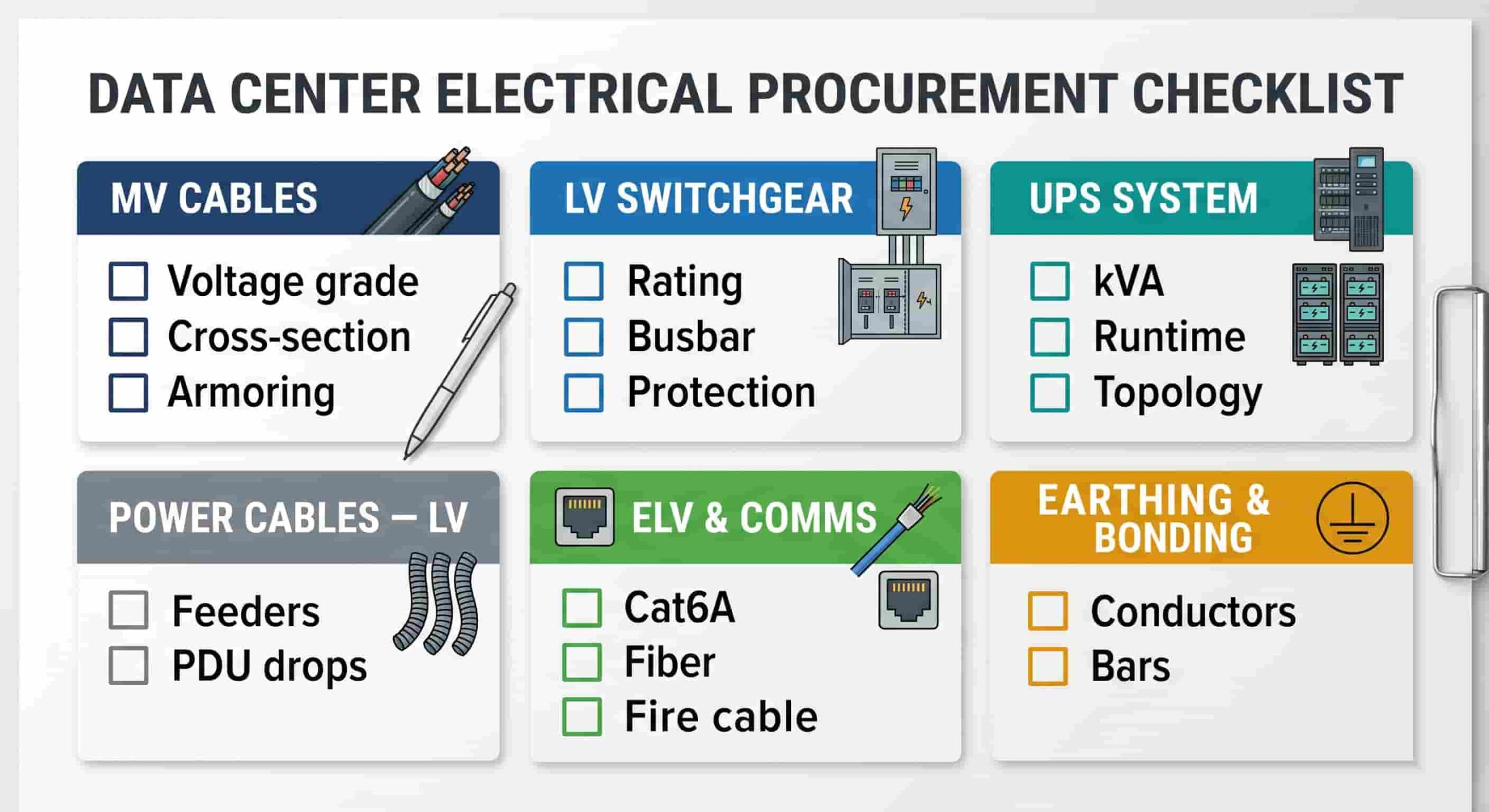
Procurement checklist for data center power infrastructure including MV cables, LV switchgear, UPS, PDUs, and ELV systems

The following checklist covers the major electrical and ELV product categories for a data center project. Use it as a starting point for developing a complete cable schedule and equipment list.


Category Key Products Key Specification to Confirm
MV cablesXLPE MV armored cable, termination kitsVoltage grade, utility authority approval, conductor x-section
MV transformerDry-type or oil-filled distribution transformerkVA rating, voltage ratio, impedance, tap changer
LV switchgearMLVS, ACBs, MCCBs, MCBs, SPDsRated current, short-circuit withstand, Form 4 separation
LV power cables0.6/1kV XLPE and LSZH power cableLSZH zones, conductor x-section, flame retardance rating
UPS systemsDouble-conversion UPS, external battery cabinetskVA/kW, topology, battery type, runtime, SNMP
Generator and ATSDiesel genset, ATS panel, generator cableskVA rating, fuel tank, ATS transition type, cable length
PDUsFloor PDUs, rack PDUs, metered outletsInput rating, outlet count, metering level, form factor
ELV cablingCat6A, fiber, fire-resistant, control cableLSZH, fire circuit integrity rating, Category rating
Earthing systemEarth bars, bonding conductors, SRG meshConductor x-section, SRG grid spacing, connection method

Tip: For large data center projects, prepare a cable schedule in spreadsheet format listing each cable run by reference number, from/to location, cable type, cross-section, voltage grade, length, and quantity. Submitting a cable schedule to suppliers allows itemized quotation and simplifies procurement tracking across multiple supply packages.


Quotation Requirements

RichingPower supplies power cables, ELV cables, switchgear, UPS systems, and related electrical products for data center construction and fit-out projects. To prepare an accurate quotation, please provide:

  • Project scope: new build, fit-out, or expansion; data hall size (kW IT load or m²)
  • Redundancy tier: Tier I, II, III, or IV (Uptime Institute) or equivalent specification
  • Cable schedule or product list by category (MV cables, LV feeders, UPS cables, ELV)
  • Applicable standards: IEC, BS, AS/NZS, or local utility specification
  • LSZH requirement: confirm if LSZH cables are required throughout or only in specific zones
  • Delivery destination, Incoterms, and target delivery date


Submit your data center project specification via the RichingPower contact page. For projects with a complete cable schedule or equipment list, attach the file directly — our team will review and provide an itemized quotation.


Conclusion

Data center power infrastructure procurement is more complex than standard industrial or commercial electrical supply — it spans multiple voltage levels, redundancy requirements, specialist cable types (LSZH, fire-resistant), and a broad range of ELV subsystems that must all be coordinated with the mechanical and IT infrastructure design.

The most effective procurement approach is to organize the supply by zone and system — MV entry, LV distribution, UPS and backup, in-hall power, and ELV — with a complete cable schedule for each zone. This allows suppliers to provide accurate, itemized quotations and simplifies tracking across what is typically a multi-package procurement.

View RichingPower’s data center power infrastructure product range, including power cables, UPS systems, switchgear, and ELV cabling for project supply.

Frequently Asked Questions

QWhat cables are required for a data center power infrastructure project?
+
AData center power cabling spans multiple zones: medium voltage XLPE armored cable for the utility entry, large cross-section LV XLPE feeders from the transformer to the main switchboard, LSZH insulated cables for UPS feeders and in-hall distribution, fire-resistant cables for fire alarm circuits, and Cat6A or fiber for structured cabling. LSZH sheathing is mandatory in enclosed cable trays within the data hall.
QWhat UPS topology is required for a data center?
+
ADouble-conversion online UPS (IEC 62040-3 class VFI-SS-111) is the standard for data center applications. It provides complete electrical isolation between the utility supply and the IT load, eliminating voltage disturbances, frequency variations, and power transients. Line-interactive or standby UPS topologies are not suitable for data center IT loads.
QWhat does LSZH mean and why is it required in data centers?
+
ALSZH stands for Low Smoke Zero Halogen. In data centers, where cables run in high density through enclosed trays above occupied areas, LSZH cables reduce the risk of toxic smoke inhalation and corrosive gas damage to sensitive IT equipment in the event of a fire.
QWhat is a signal reference ground (SRG) in a data center?
+
AA signal reference ground (SRG) is an equipotential bonding grid installed under the raised floor, typically using bare copper conductors bonded to structural steel at regular intervals. It prevents earth potential differences between IT equipment that cause ground faults and data errors. The SRG is a data center-specific earthing requirement not found in standard commercial buildings.
QHow does data center redundancy tier affect cable and equipment quantities?
+
AHigher redundancy tiers require more parallel power paths and therefore more cable and equipment. A Tier III facility requires concurrent maintainability — every power path must be maintainable without shutting down the IT load — which typically results in 2N (fully duplicated) UPS, switchgear, and cabling. Always confirm the target redundancy tier before finalizing procurement quantities.
QWhat information should I provide to get a quotation for data center electrical supply?
+
AProvide: project scope, data hall IT load in kW, redundancy tier, cable schedule or product list by category (MV, LV, UPS, ELV), applicable standards, LSZH requirements, and delivery destination. For projects with a complete cable schedule or equipment list, attaching the file allows itemized quotation across all supply categories.

Ready to source cables or electrical equipment for your project?

Send your specification below — or message us directly on WhatsApp.


    Leave a Comment

    Your email address will not be published. Required fields are marked *

    Scroll to Top