
A cable specification sheet — whether from a manufacturer, a project engineer, or a procurement document — contains a compressed set of technical parameters that define exactly what cable is required. For buyers who are not electrical engineers, these parameters can look like a dense string of abbreviations and numbers with no clear meaning.
This guide walks through each field of a cable specification sheet in plain language: what it means, why it matters for procurement, and what questions to ask if the value is unclear or missing. Understanding these fields is the difference between placing an order that delivers the right cable and receiving a shipment that does not meet project requirements.
The Cable Type Code: What the Name Actually Means
The cable type is usually expressed as a shorthand code that encodes the key construction features in a fixed sequence. A typical example for a standard low voltage armored power cable:
3 × 95mm² CU/XLPE/SWA/PVC 0.6/1kV
Reading left to right, this code tells you:
- 3 × — number of cores (three conductors)
- 95mm² — conductor cross-sectional area per core
- CU — conductor material (copper; AL = aluminum)
- XLPE — insulation type (cross-linked polyethylene)
- SWA — armoring type (steel wire armoring)
- PVC — outer sheath material (polyvinyl chloride)
- 6/1kV — voltage grade (U0/U format)
Not all cable specifications follow this exact sequence, and some add or omit fields depending on the standard and cable type. But the core elements — cores, cross-section, conductor material, insulation, armoring, sheath, voltage — are always present in a complete specification.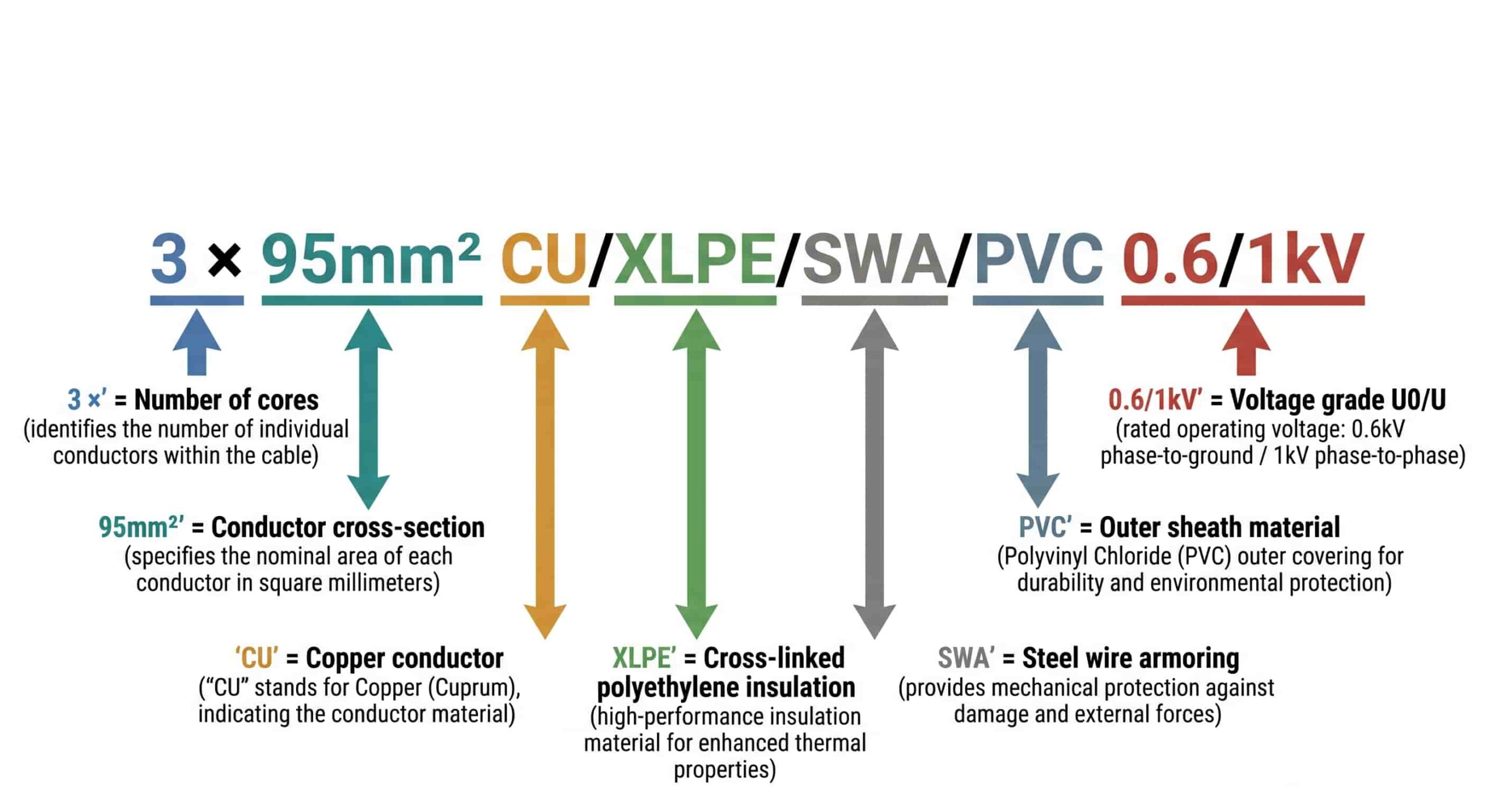
Key Point: If a cable specification sheet gives you a type name but no further detail, ask the supplier to confirm each field explicitly. Cable type names are not standardized across manufacturers — ‘armored power cable’ means different things to different factories until the full specification is written out.
Number of Cores
The number of cores specifies how many individual conductors are bundled inside the cable. For power cables, the core count determines the electrical circuit configuration:
- Single-core: one conductor per cable — used for high-current feeders where multiple single-core cables are laid in trefoil or flat formation
- 2-core: live and neutral — for single-phase circuits without a separate earth conductor in the cable
- 3-core: three phases — for three-phase systems without neutral in the cable (e.g. motor feeders, MV distribution)
- 3-core + earth (3+E or 3½-core): three phases plus a reduced neutral/earth conductor
- 4-core: three phases plus neutral — the standard for most LV three-phase distribution with neutral
- 5-core: three phases, neutral, and earth — used where all five conductors are required in one cable
For control cables, core counts are higher — 7-core, 12-core, 19-core, and upward — with smaller conductor cross-sections for signal and control circuits.
Note: For three-phase LV distribution, 4-core cable (3 phases + neutral) is the most common. If the project specification calls for 3-core, confirm with the engineer whether a separate earth conductor will be installed alongside — omitting earth in the installation is a safety issue, not a cable procurement issue, but it affects the cable schedule quantity.
Conductor Material: Copper vs Aluminum
The conductor material field — CU for copper, AL for aluminum — is one of the most commercially significant parameters in a cable specification because it directly affects price, weight, and installation requirements.
For most B2B project procurement, copper conductor is the default unless the project engineer has explicitly specified aluminum. Aluminum is common in large-cross-section LV main feeders (185mm² and above) where the weight and cost savings are significant, and where the larger conductor size compensates for aluminum’s lower conductivity.
Key Point: Never substitute aluminum for copper (or vice versa) without confirming with the project engineer. The cross-sectional area required changes — an aluminum conductor needs approximately 1.6× the cross-section of copper to carry the same current. A direct substitution of AL for CU at the same mm² will result in an undersized feeder.
Cross-Section and Current Capacity
The conductor cross-sectional area — expressed in square millimeters (mm²) — is the primary determinant of how much current a cable can carry continuously without overheating. The relationship between cross-section and current capacity is not linear: doubling the cross-section does not double the current capacity.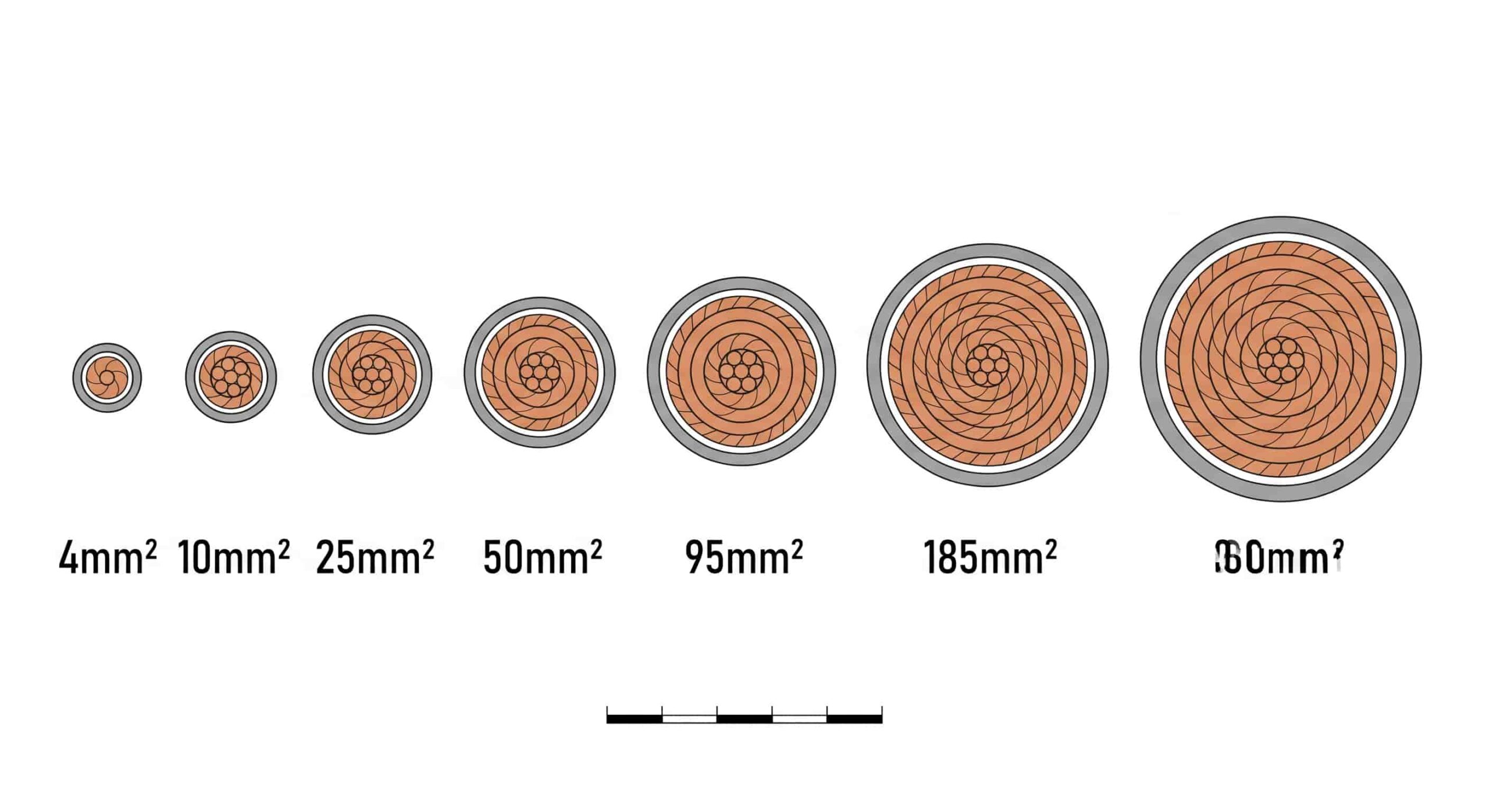
Current ratings in the table above are approximate reference values for copper XLPE cable in free air at 30°C ambient. Actual current capacity depends on installation method (buried, in duct, on tray, in conduit), ambient temperature, and number of cables bundled together. For project-critical sizing, always refer to IEC 60364-5-52 tables or request a derating calculation from the engineer.
Tip: When a supplier quotes a cable at a significantly lower price than competitors for the same mm², one of the first things to check is the conductor cross-section tolerance. IEC standards allow a -1% tolerance on conductor resistance — some manufacturers optimize to the minimum, producing a conductor that measures slightly under the nominal mm². Request the conductor resistance test report (DC resistance at 20°C) and verify it against the IEC 60228 maximum resistance value for that cross-section.
The Voltage Grade Field: U0/U Explained
The voltage grade is expressed in the format U0/U (kV), where:
- U0 = the rated voltage between any conductor and the cable’s metallic screen or earth
- U = the rated voltage between any two conductors
This two-number format is essential because it defines both the insulation wall thickness required between conductor and earth, and between conductors. A cable rated 0.6/1kV has 0.6kV conductor-to-earth and 1kV conductor-to-conductor ratings — this is the standard low voltage rating for most distribution and industrial cables.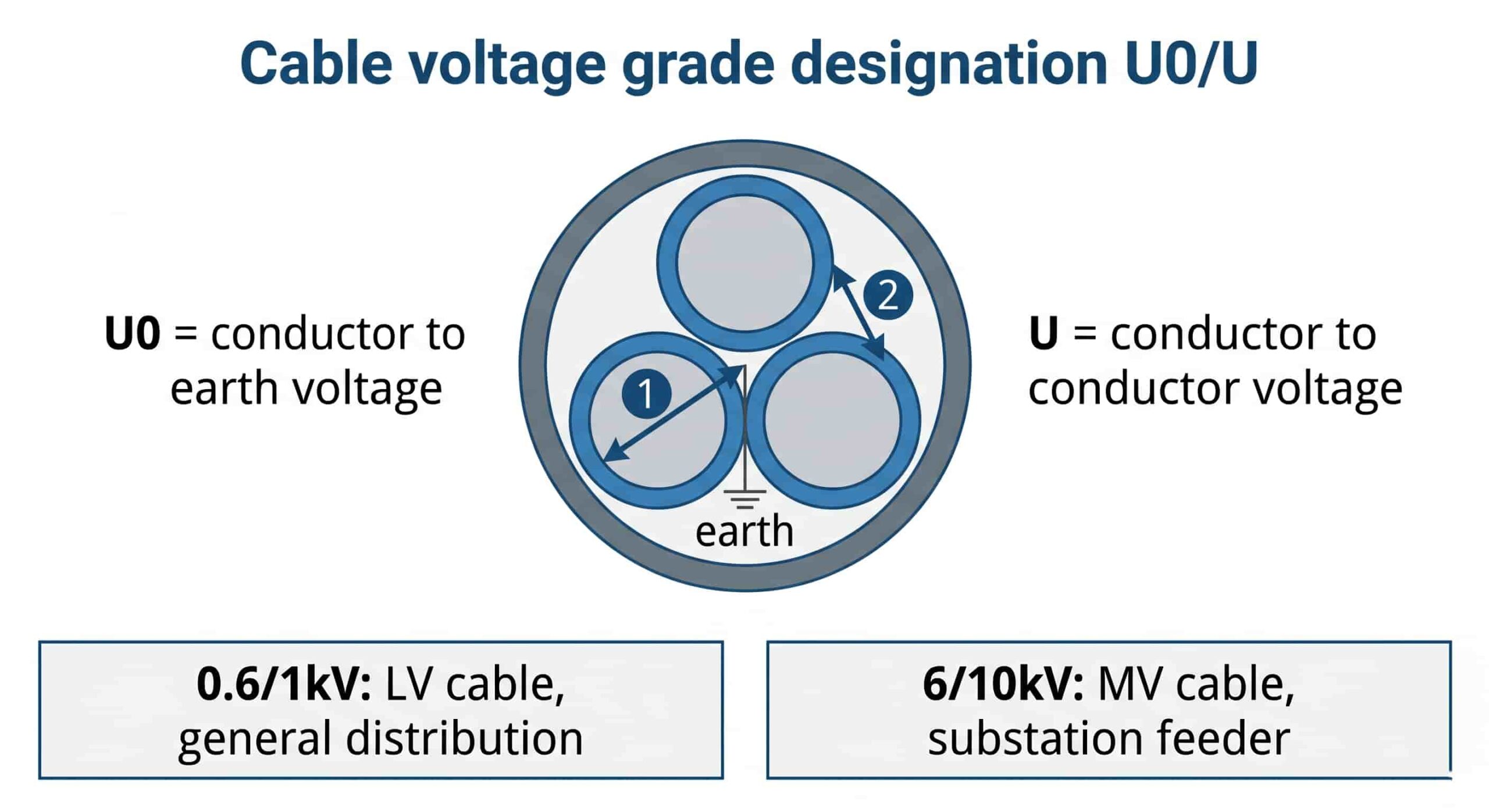
Common voltage grades and their applications:
- 6/1kV — low voltage: building distribution, industrial plant, general commercial
- 6/6kV — medium voltage: small industrial feeders, older urban distribution
- 6/10kV — medium voltage: utility distribution, wind and solar farm collection
- 7/15kV — medium voltage: regional grid, campus primary distribution
- 12/20kV — medium voltage: European utility distribution
- 18/30kV or 19/33kV — medium voltage: high-load industrial, national grid trunk
Key Point: Always specify voltage grade in the full U0/U format when writing a procurement specification or sending an inquiry. Specifying only ’10kV cable’ is ambiguous — it could mean 6/10kV or 8.7/15kV, which have different insulation wall thicknesses and are not interchangeable. Suppliers will quote whichever is cheaper to produce unless the grade is specified explicitly.
Insulation Type: XLPE, PVC, and Variants
The insulation type defines the material surrounding each conductor. The most common insulation materials in B2B power cable procurement are:
XLPE — Cross-Linked Polyethylene
The standard insulation for medium voltage cables and increasingly for low voltage cables. XLPE offers:
- Maximum continuous operating temperature: 90°C (versus 70°C for PVC)
- Better electrical properties at higher voltages — lower dielectric loss
- Suitable for both LV and MV cables
- Higher cost than PVC but recommended for long service life and elevated operating temperatures
PVC — Polyvinyl Chloride
Lower-cost alternative suitable for low voltage cables in general applications:
- Maximum continuous operating temperature: 70°C
- Not suitable as primary insulation for medium voltage cables
- Adequate for LV circuits in non-demanding environments
- Widely available, lower upfront cost
LSZH / LS0H — Low Smoke Zero Halogen
A specialist insulation and sheath material required in enclosed spaces where toxic smoke is a hazard:
- Emits minimal smoke and no halogenic gases when exposed to fire
- Required in data centers, tunnels, public buildings, and marine applications
- Higher cost than PVC; check if LSZH is specified in the project requirements before substituting
EPR — Ethylene Propylene Rubber
Flexible insulation used in flexible cables, mining cables, and marine applications where mechanical flexibility is required at elevated temperatures. Less common in standard B2B power distribution procurement.
Note: The insulation type in the spec sheet refers to the material surrounding each individual conductor. The outer sheath — which protects the entire cable assembly — is a separate field, usually PVC, HDPE, or LSZH. Both must be specified.
Armoring: SWA, AWA, and Unarmored
The armoring field specifies whether the cable has mechanical protection and what type. This is determined by the installation environment:
SWA — Steel Wire Armoring
Galvanized steel wires applied helically over the cable core, providing mechanical protection against impact, crushing, and rodent damage. SWA is the standard armoring for:
- Direct burial in soil
- Exposed runs subject to mechanical damage
- Multi-core cables at any voltage
- Note: SWA is a magnetic armor — use for multi-core cables only. For single-core MV cables, see AWA below
AWA — Aluminum Wire Armoring
Aluminum wires applied in the same pattern as SWA. AWA is specified for single-core medium voltage cables because steel armor would cause unacceptable induced current losses in a single-core AC circuit. If a spec sheet specifies SWA on a single-core MV cable, this is an error — query it with the supplier or engineer.
Unarmored
Cables without armoring are suitable for installation in conduit, cable duct, or cable tray where the installation itself provides mechanical protection. Unarmored cables are lighter and lower cost but must not be direct buried without conduit protection.
Key Point: For direct burial installations, always specify armored cable. Unarmored cables buried directly without conduit will fail due to soil pressure, moisture ingress, and mechanical damage within the service life of the installation — this is one of the most common and costly cable installation mistakes in B2B projects.
The Standard Reference Field
The applicable standard defines the complete technical requirements the cable must meet — insulation wall thickness, conductor construction, test requirements, marking, and drum lengths. It is not a formality; it is the binding technical reference for the procurement.
When a project specification references a specific standard, the cable supplied must comply with that standard — not a similar or ‘equivalent’ standard unless the engineer explicitly accepts an alternative. Deviations from the specified standard require written approval from the project engineer before ordering.
Note: In China, most cable manufacturers produce to GB/T standards (GB/T 12706 for power cables). For export, they can produce to IEC or BS on request — but this must be confirmed explicitly. A factory-marked cable showing ‘GB/T 12706’ does not automatically meet IEC 60502-1 to the letter, even though the two standards are largely harmonized. For project-critical supply, request the IEC type test report from an accredited laboratory.
Quantity, Drum Length, and Packing
The quantity field in a cable specification should include three pieces of information:
- Total length in meters
- Standard drum length (the length wound on each individual drum)
- Number of drums (total length ÷ drum length, rounded up)
Drum length matters for two reasons. First, it affects shipping logistics — larger drums require more space and may not fit standard container dimensions. Second, it affects site waste — if the installation run lengths do not align with the drum length, the remainder on each drum may be too short for use elsewhere and becomes scrap.
Common standard drum lengths by cable size:
- Small cross-sections (4–25mm²): 500m or 1000m per drum
- Medium cross-sections (35–150mm²): 250m or 500m per drum
- Large cross-sections (185–300mm²): 100m or 200m per drum
- MV cables: 200m to 500m per drum depending on drum capacity and cable weight
Tip: For projects where run lengths are known, request that the supplier cut drums to specific lengths to minimize site waste. Most manufacturers will accommodate custom drum lengths on order quantities above a minimum threshold — ask during the quotation stage, not after production has started.
Common Mistakes When Reading Cable Spec Sheets
Based on recurring issues in B2B cable procurement, these are the most common errors buyers make when interpreting or writing cable specifications: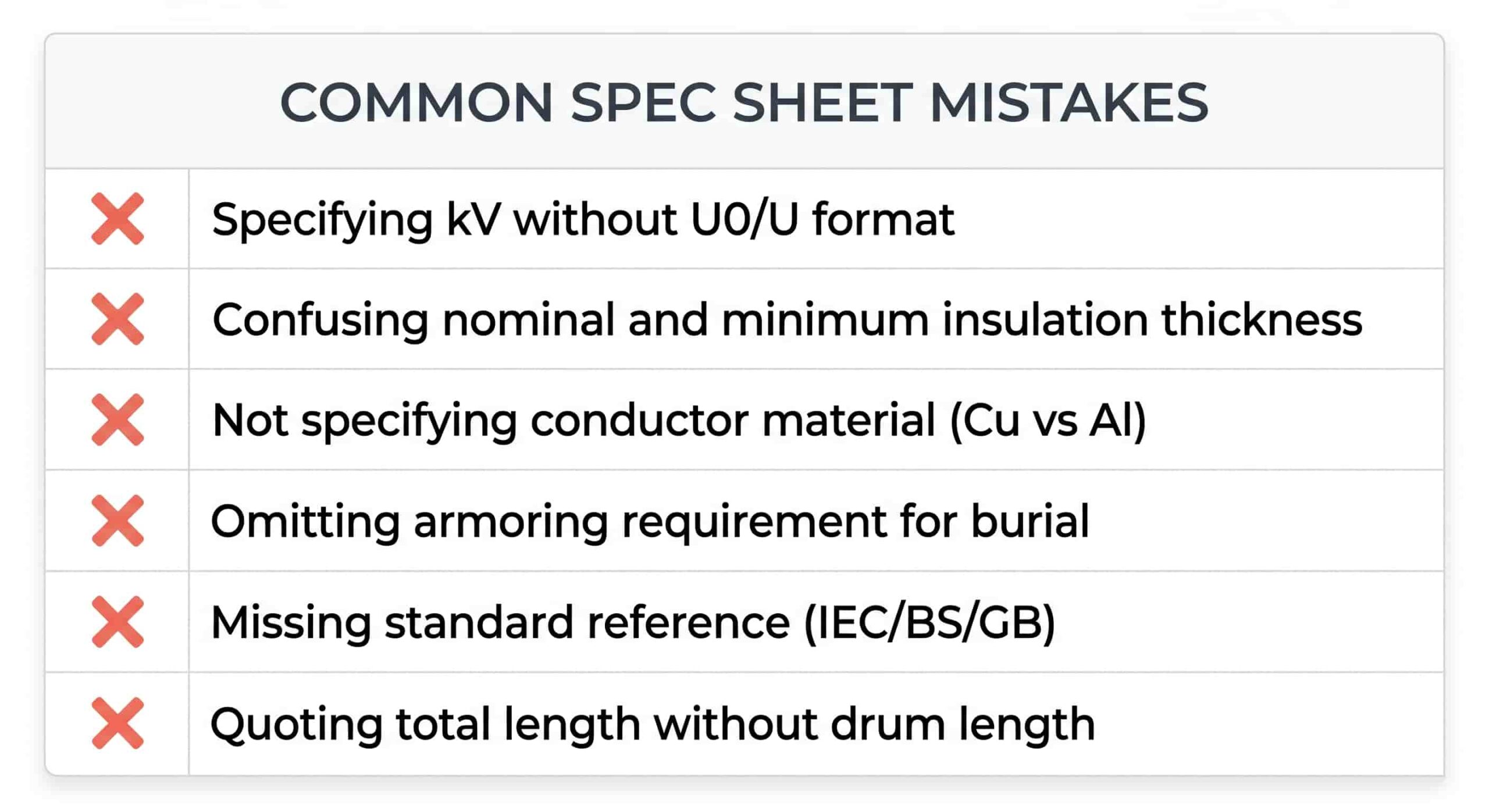
- Specifying voltage in kV without the U0/U format: ’10kV cable’ is ambiguous; ‘6/10kV’ is not
- Confusing nominal insulation thickness with minimum thickness: IEC standards specify minimum values — nominal is higher. A supplier quoting to minimum is technically compliant but delivers thinner insulation than expected
- Not specifying conductor material: failing to write CU or AL leaves the supplier to choose — and they will choose the cheaper option
- Omitting armoring for buried installations: ‘power cable’ without specifying SWA will result in an unarmored cable quote
- Missing the standard reference: without a standard, there is no binding technical requirement and no basis for rejection if quality falls short
- Quoting total length without drum length: a 10,000m order quoted without drum length may arrive in non-standard cut lengths that create site logistics problems
- Accepting a ‘similar’ cable without written approval: substitutions made without engineer sign-off create liability and compliance risk
Quotation Requirements
RichingPower manufactures and exports industrial power cables to IEC, BS, and GB/T standards. To receive an accurate, specification-matched quotation, please provide:
- Number of cores and conductor cross-sectional area (mm²)
- Conductor material: copper (CU) or aluminum (AL)
- Voltage grade in U0/U format (e.g. 0.6/1kV or 6/10kV)
- Insulation type: XLPE, PVC, or LSZH
- Armoring requirement: SWA, AWA, or unarmored
- Applicable standard: IEC 60502-1, IEC 60502-2, BS 6622, or other
- Total quantity (meters), preferred drum length, and number of drums
- Delivery destination and Incoterms
Submit your cable specification via the RichingPower contact page. You can also upload your specification sheet or cable schedule directly using the file upload field — our technical team will review and confirm the specification before preparing a quotation.
Conclusion
A cable specification sheet is not a bureaucratic formality — it is the technical contract between the buyer and the supplier. Every field defines a performance or safety requirement that the cable must meet. Buyers who understand these fields can write better specifications, compare quotations on a like-for-like basis, and identify quality shortcuts before they become project problems.
The most important fields to verify in any cable specification are the voltage grade (in U0/U format), the conductor material and cross-section, the insulation type, the armoring requirement, and the applicable standard. If any of these are missing or ambiguous in a supplier quotation, request clarification before confirming the order.
For further guidance on voltage grade selection, see Low Voltage vs Medium Voltage Cable: A Procurement Guide. To explore RichingPower’s full cable product range,
visit our power cable product pages or contact us with your specification for a quotation.