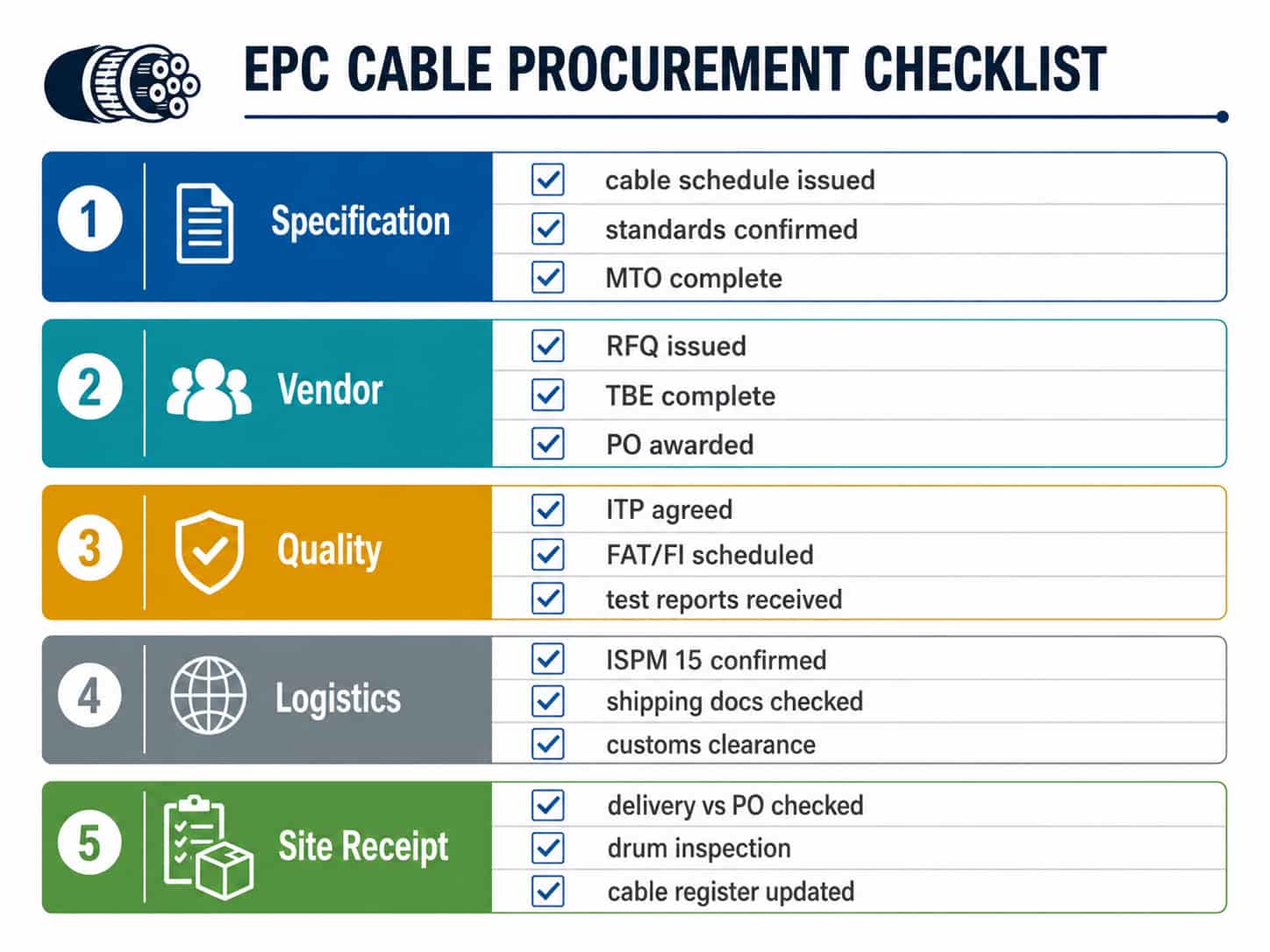
Large infrastructure and EPC (Engineering, Procurement, and Construction) projects — power plants, desalination facilities, airports, highways, urban metro systems, and industrial complexes — involve cable procurement at a scale and complexity that differs fundamentally from routine industrial supply. A single EPC project may require hundreds of cable types across dozens of supply packages, with delivery sequenced to match the construction programme and with quality documentation requirements that exceed those of standard commercial orders.
This guide covers the key elements of cable procurement management for EPC and infrastructure projects: how to build and use a cable schedule, how to manage the material take-off process, how to select and qualify vendors for project supply, what inspection and test requirements to specify, and how to manage logistics for large-volume cable deliveries from Chinese manufacturers.
How EPC Cable Procurement Differs from Standard Industrial Supply
EPC and infrastructure project cable procurement has several characteristics that distinguish it from routine B2B cable purchasing: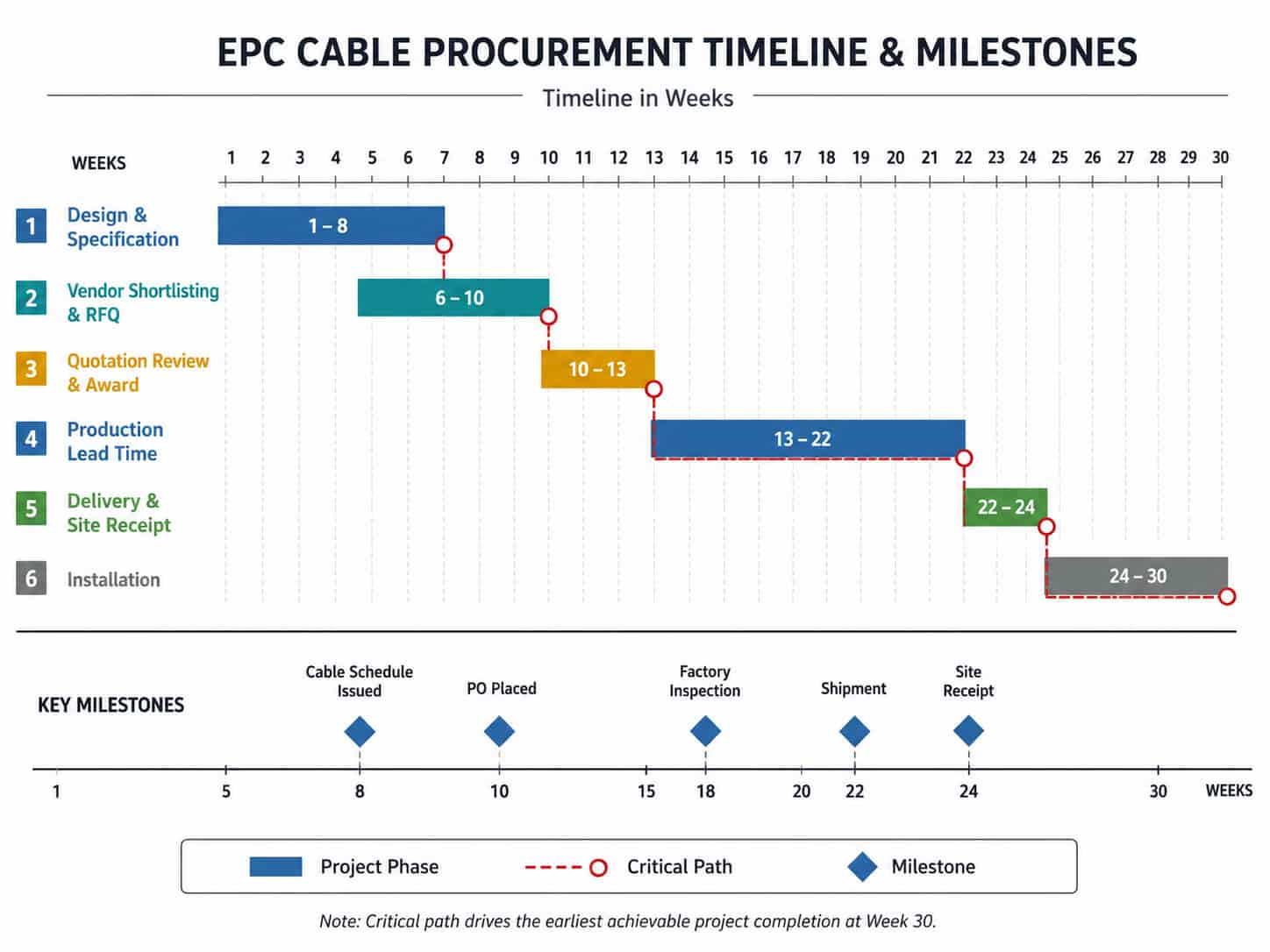
Volume and Variety
A medium-sized EPC project — a 200MW power plant or a 50km highway — may require 50,000 to 500,000 metres of cable across 100 to 500 individual cable types. Managing this volume requires systematic documentation, not just a purchase order list. Each cable type must be tracked from specification through delivery and installation.
Sequenced Delivery
Construction programmes require cable to arrive at site at specific times aligned with the installation sequence — not all at once. Cables for civil works and underground duct installation are needed first; cables for equipment connections are needed later when the equipment is commissioned. A cable supplier who delivers everything in week 8 of a 52-week project creates a storage and handling problem rather than solving a procurement problem.
Strict Documentation Requirements
EPC contracts typically impose documentation requirements on cable supply that go beyond standard commercial practice:
- Material traceability: each drum must be traceable to its production batch, heat number, and test report
- Third-party inspection: independent pre-shipment inspection by SGS, Bureau Veritas, or Intertek is often specified in the contract
- Submittal approval: the cable manufacturer’s data sheet and test reports must be submitted to and approved by the engineer before production commences
- Material certificates: conductor purity certificates, insulation compound certificates, and armor wire galvanization certificates may all be required
Long Lead Times
Large-volume cable orders from Chinese manufacturers typically require 6–16 weeks production lead time depending on the cable type and quantity. Non-standard cable types — high-voltage, special insulation compounds, large cross-sections above 400mm² — may require 20–30 weeks. EPC procurement managers must place cable orders significantly ahead of the installation programme to account for production, shipping, customs clearance, and site delivery.
Key Point: EPC cable procurement should begin at the detailed design stage — not when construction is already underway. The most common cause of cable delivery delays on EPC projects is late issue of the cable schedule to suppliers, leaving insufficient time for production. Cable orders for a project starting construction in month 6 should ideally be placed by month 2 or 3.
Cable Schedule: The Central Procurement Document
The cable schedule is the definitive document for EPC cable procurement. It lists every cable on the project — individually, by reference number — with sufficient technical detail to allow accurate quotation, manufacture, delivery tracking, and installation.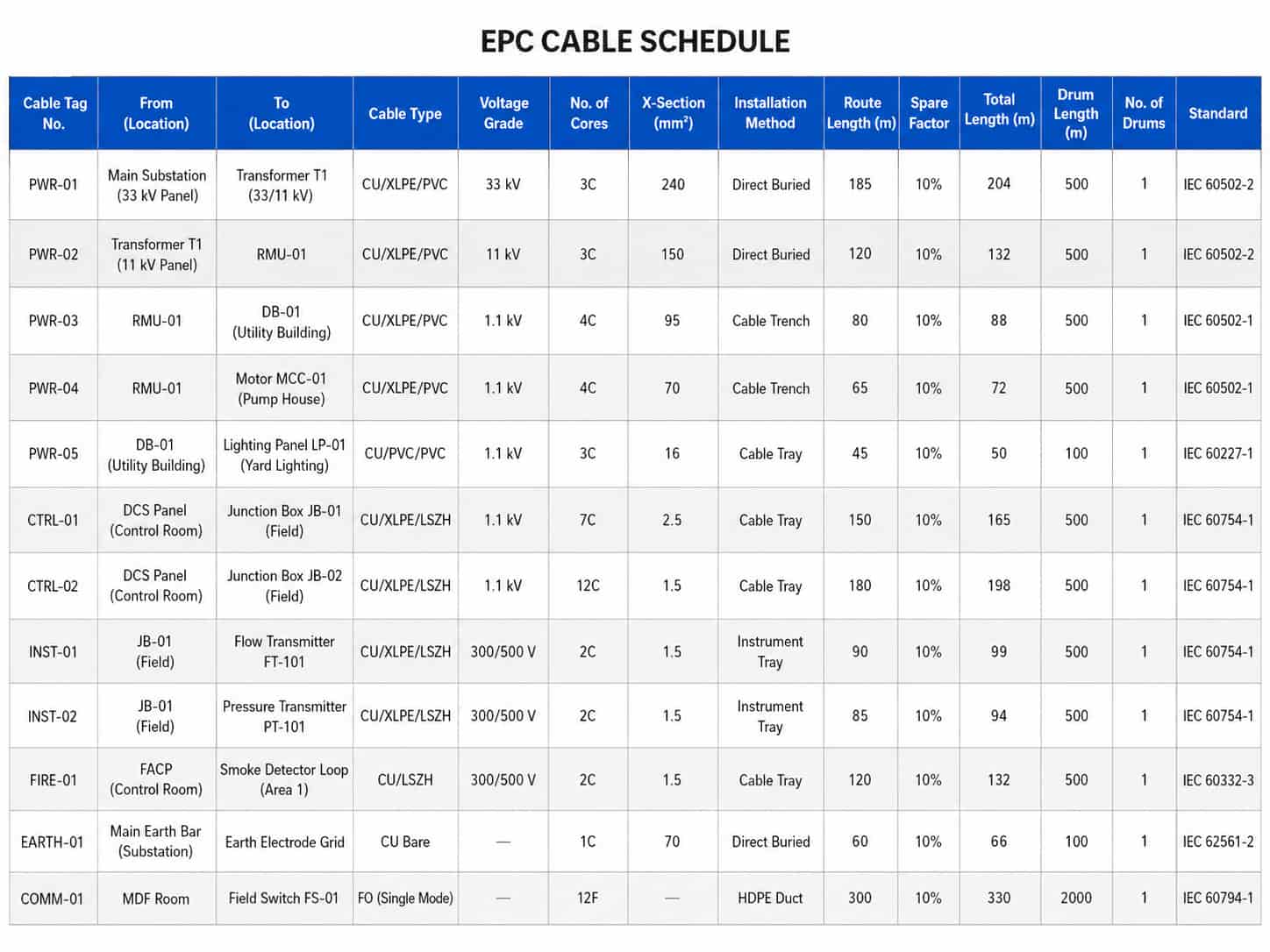
A complete cable schedule contains the following information for each cable:
- Cable tag number: unique project reference for each cable run (e.g. KAB-LV-001, KAB-MV-045)
- From location: the source equipment or panel (e.g. MCC-A, Switchboard LV-1)
- To location: the destination equipment (e.g. Motor P-101, JB-Field-03)
- Cable type: full technical designation (e.g. 4-core 95mm² Cu XLPE SWA PVC 0.6/1kV IEC 60502-1)
- Voltage grade (U0/U format)
- Number of cores and conductor cross-section (mm²)
- Installation method: direct burial, cable tray, conduit, aerial
- Route length (m): the measured cable route from source to destination
- Spare factor: typically 10–15% added to route length for slack, bends, and termination tails
- Total ordered length (m): route length × (1 + spare factor)
- Preferred drum length (m): determines number of drums and whether joints are required
- Number of drums: total length ÷ drum length, rounded up
- Applicable standard: IEC, BS, AS/NZS, or other
Key Point: The cable schedule is a living document on an EPC project — it is revised as the design develops and as field conditions change. Establish a revision control process for the cable schedule and ensure that all cable orders reference the approved revision of the schedule. Ordering against an superseded cable schedule revision is a common and costly error on large projects.
Material Take-Off (MTO): From Cable Schedule to Order Quantities
The material take-off (MTO) converts the cable schedule into purchase quantities for each cable type. For a project with hundreds of cable types, this is a non-trivial calculation that must account for:
- Grouping: cables of the same type (same voltage grade, core count, cross-section, standard, and construction) are grouped and ordered together to achieve competitive pricing and minimize the number of purchase orders
- Drum length optimization: for each cable type group, the total ordered length is divided into drum lengths that minimize the number of short offcuts — a drum length that produces many small unusable remnants increases effective cost per metre
- Minimum order quantities: some cable types — particularly non-standard constructions — have manufacturer minimum order quantities that must be met even if the calculated quantity is lower
- Contingency allowance: a project-level contingency of 5–10% is typically added to the calculated MTO quantity to cover measurement errors, installation damage, and design changes during construction
For large EPC projects, the MTO process is typically performed in a dedicated project procurement spreadsheet or ERP system. The output is a consolidated bill of materials (BOM) by cable type, which forms the basis for the request for quotation (RFQ) issued to cable vendors.
Vendor Selection for EPC Cable Supply
EPC projects impose more rigorous vendor selection requirements than routine B2B purchasing. A vendor who can supply standard cable reliably may not have the production capacity, documentation capability, or quality management system required for a large EPC project. The vendor selection process for EPC cable supply typically involves: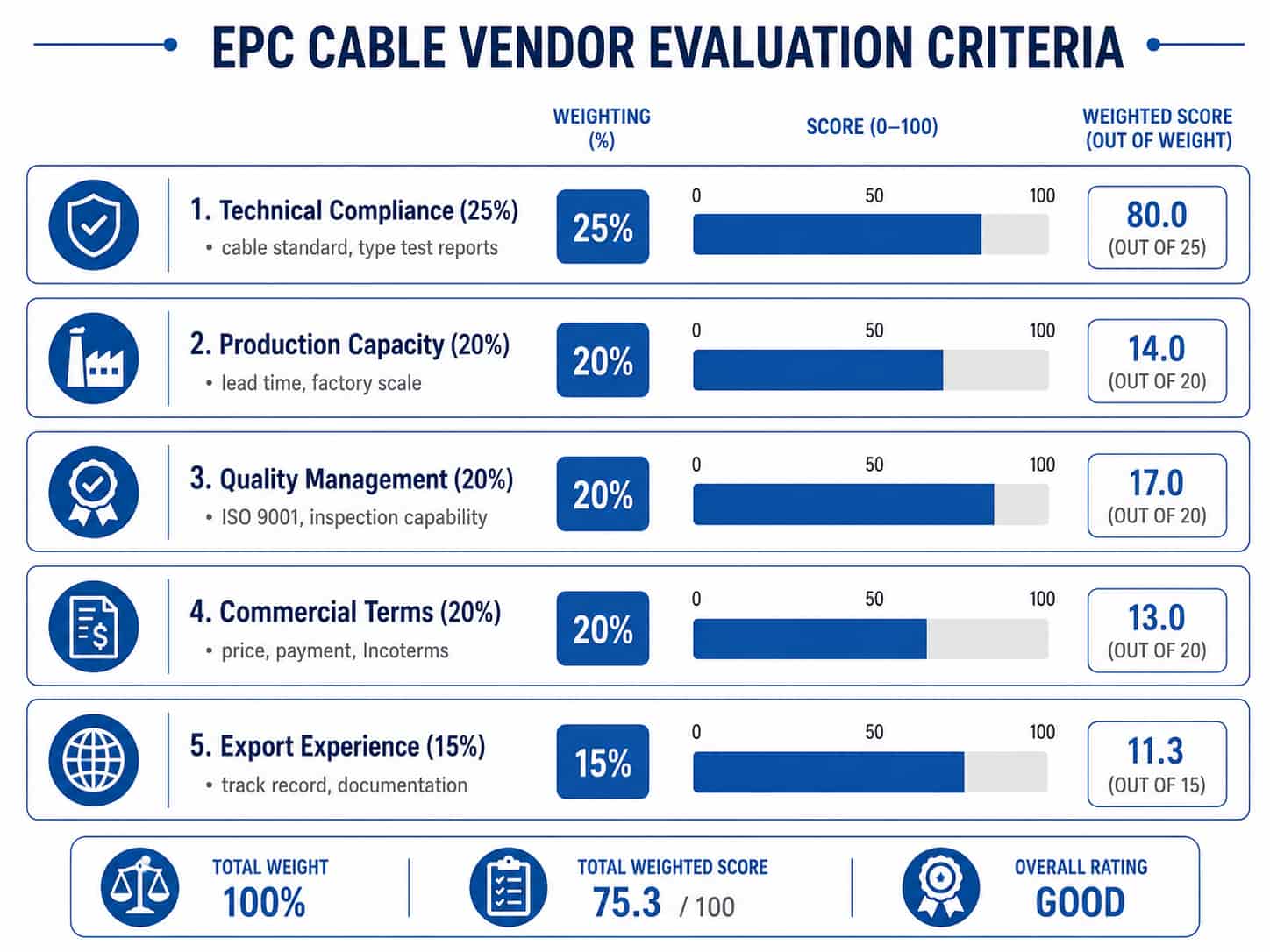
Vendor Pre-Qualification
Before issuing an RFQ, EPC procurement teams pre-qualify vendors against minimum criteria:
- Production capacity: can the vendor manufacture the required quantity within the project’s lead time? Request the vendor’s monthly production capacity for the relevant cable types.
- Quality management system: ISO 9001 certification is the minimum baseline; confirm the scope covers the specific cable types being procured
- Type test reports: accredited type test reports (CNAS or ILAC laboratory) for the cable constructions required — not generic certification
- Export track record: documented experience exporting to the project’s destination country, including familiarity with the required standards, documentation, and customs clearance requirements
- Financial stability: for large orders requiring production advance payments, confirm the vendor has the financial capacity to fund production
Technical Bid Evaluation (TBE)
After receiving quotations, the TBE process evaluates each vendor’s technical compliance with the cable specification:
- Confirm each cable type offered complies with the specified standard, voltage grade, conductor construction, insulation, and armoring
- Review the vendor’s submitted data sheets against the cable schedule specification line by line — accept no deviations without engineer approval
- Confirm the vendor’s type test reports cover the specific cable constructions in the MTO — a type test for 4-core 95mm² does not automatically cover 4-core 70mm² or 3-core 95mm²
- Assess the vendor’s proposed inspection and test plan (ITP) against the project’s inspection requirements
Note: On EPC projects, the cable specification is typically held by the engineer (not the contractor) and any technical deviation from the specification requires engineer approval — not just commercial negotiation. A cable vendor’s proposal to supply a ‘technically equivalent’ cable to a different standard must go through the engineer’s deviation review process. This takes time — factor it into the procurement schedule.
Inspection and Test Requirements for EPC Cable Supply
EPC projects typically impose more extensive inspection and testing requirements than standard commercial cable orders. The inspection and test plan (ITP) for EPC cable supply generally includes:
Factory Acceptance Test (FAT) / Factory Inspection (FI)
For high-value or project-critical cable orders, a witness inspection at the cable factory before shipment is specified. The inspection covers:
- Review of production records and batch test results against the contract specification
- Dimensional inspection: outer diameter, insulation wall thickness, armor wire diameter — spot-checked against IEC standard requirements
- Electrical tests: conductor resistance measurement and high-voltage test witnessed on selected drums
- Marking inspection: drum marking, cable surface marking, and packing list verification
- ISPM 15 compliance: wooden drum heat treatment certification
Third-Party Inspection
Where the EPC contract requires independent third-party inspection, SGS, Bureau Veritas, Intertek, or another approved inspection body is engaged to witness the factory inspection and issue an independent inspection report. This report is submitted to the engineer as part of the material approval documentation.
Site Incoming Inspection
On delivery to site, cables are inspected against the packing list and purchase order:
- Drum count and tag number verification
- Visual inspection of drum and cable sheath condition after transport
- Conductor resistance spot-check on a sample of drums using a calibrated resistance bridge
- Cable register update: each drum recorded in the project cable register with drum number, cable type, length, and receipt date
Tip: For large cable deliveries arriving at remote construction sites, insist that the delivery is made during normal working hours with the site electrical engineer or inspector present to conduct the incoming inspection. Cables accepted at site without inspection and found to be damaged or non-conforming after the supplier has left create difficult warranty claims and construction delays.
Logistics Management for Large-Volume Cable Deliveries
Managing the logistics of large-volume cable deliveries from China to an infrastructure construction site involves several considerations beyond standard freight:
Container Planning
Large cable drums are heavy and have specific dimensional requirements that affect container loading:
- 20ft container: suitable for 4–6 large drums (600–800mm flange diameter) or 8–12 medium drums
- 40ft container: standard for multi-drum shipments — typically 10–16 large drums or up to 30 medium drums
- Open-top or flat-rack container: required for very large drums (flange diameter above 2m) that exceed standard container height limits
- Drum stacking: not all cable drums can be stacked — confirm with the supplier whether drums in the consignment can be stacked and what the maximum stack height is
Sequenced Delivery Planning
For projects with a phased construction programme, coordinate with the cable supplier to schedule production and shipping in batches aligned with the installation programme:
- Identify early-need cables: underground distribution, duct installation, and main feeder cables are typically needed first — prioritize these in the production schedule
- Phase shipments: agree with the supplier on 2–4 separate shipments over the project duration rather than a single bulk delivery that creates on-site storage problems
- Confirm on-site storage conditions with the construction team — cable drums stored outdoors in tropical climates or near saltwater require UV-resistant sheath and periodic inspection
Import and Customs Documentation
For international EPC projects, confirm the required import documentation well before shipment:
- Certificate of Origin: for projects in markets with preferential tariff arrangements (ASEAN FTA, Belt and Road infrastructure preferences), the correct Form E or Form B certificate of origin reduces import duty
- ISPM 15: wooden cable drums must carry the IPPC heat treatment stamp — non-compliant drums are quarantined at destination
- Project import exemption: some infrastructure projects have government-negotiated import duty exemptions for project materials — confirm with the project legal team whether this applies and what documentation the supplier must provide
- End-use certificate: some destination countries require an end-use certificate confirming the cable is for a specific project, not for general resale