
One of the most frequent specification errors in B2B cable procurement is specifying unarmored cable for an installation that requires mechanical protection, or specifying armored cable for an installation where the conduit or tray already provides adequate protection. Both errors have consequences: under-specification leads to cable damage and premature failure; over-specification adds unnecessary cost.
This guide explains what armoring does, the main armoring types available, how installation method determines the armoring requirement, and the specific cases where standard armoring guidance does not apply.
What Is Cable Armoring and What Does It Do?
Cable armoring is a layer of metallic material — steel wires, aluminum wires, steel tape, or aluminum tape — applied between the cable’s inner assembly and its outer sheath. Its primary function is mechanical protection: it prevents crushing, impact, rodent attack, and the stresses of direct burial from reaching the insulated conductors inside.
Secondary functions of armoring include:
- Earth fault protection path: in some installations, the cable armor provides an earth return path for fault current — this must be confirmed with the protection engineer before relying on armor for earth continuity
- EMI shielding (limited): steel wire armor provides some shielding against electromagnetic interference, though it is not as effective as a dedicated copper braid screen
- Pulling strength: armored cable has higher tensile strength than unarmored, which is relevant when pulling cables through long duct runs or over rollers
Key Point: Armoring protects the cable from the installation environment — it does not improve the cable’s electrical performance. The insulation type (XLPE or PVC), voltage grade, and conductor cross-section determine electrical performance. Armoring is purely a mechanical and environmental protection decision.
What Is Steel Wire Armoring (SWA)?
Steel wire armoring (SWA) is the most common armoring type for industrial and infrastructure power cables. It consists of galvanized steel wires applied helically over the cable’s bedding layer, covering the full circumference of the cable.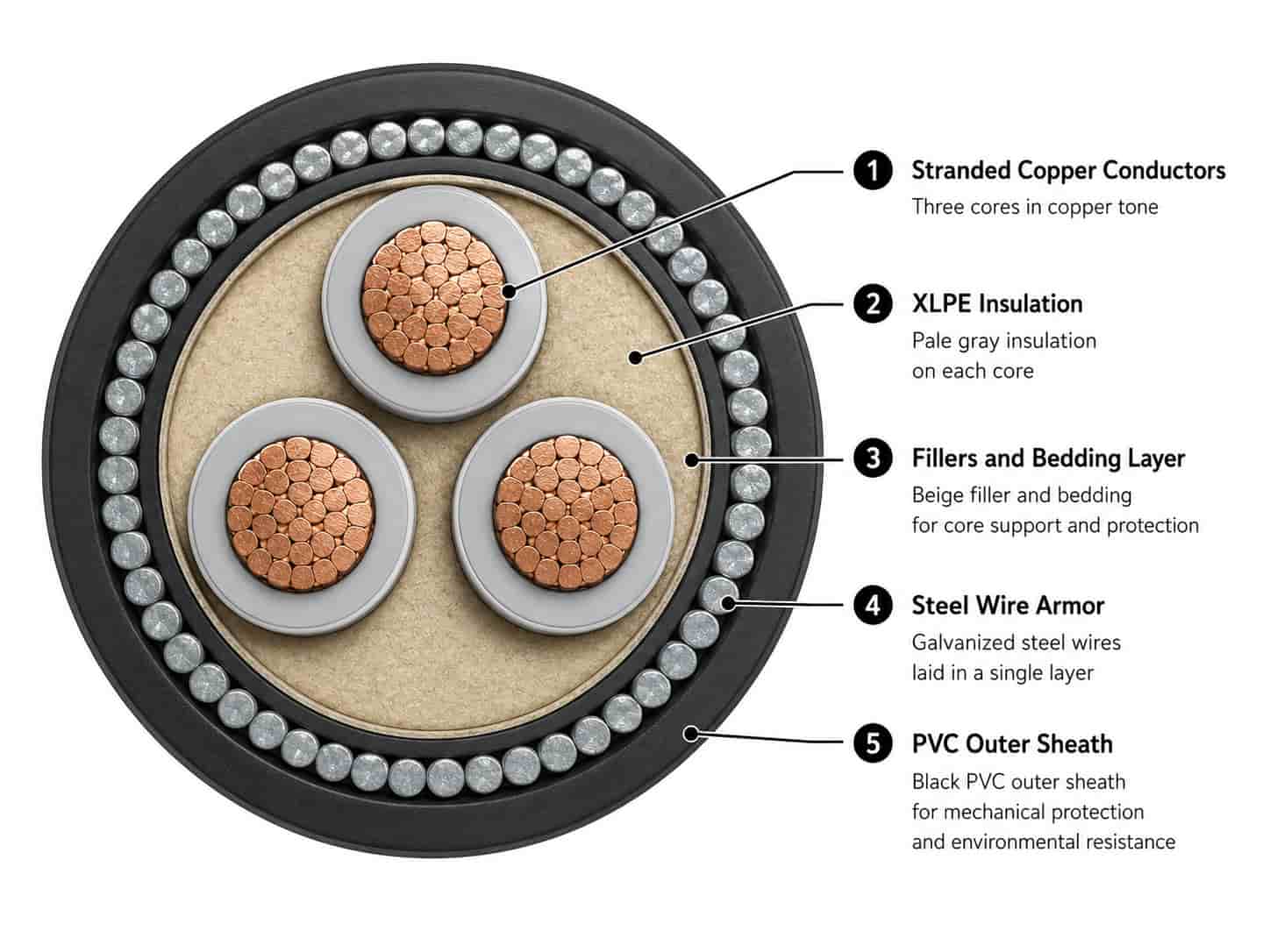
Key properties of SWA armoring:
- Mechanical strength: the steel wires provide excellent resistance to crushing, impact, and soil pressure in direct burial applications
- Rodent resistance: steel wire armor prevents gnawing damage from rats and other rodents — a significant cause of cable failure in underground installations in many regions
- Tensile strength: the helical steel wire layer gives the cable significant tensile strength, useful for pulling through conduit and for vertical riser installations where the cable must support its own weight
- Corrosion protection: galvanized steel wires are corrosion-resistant under the outer PVC sheath — the sheath must remain intact to prevent moisture reaching the armor
- Magnetic material: steel is ferromagnetic — this creates induced currents in single-core AC cables running in trefoil or flat formation. SWA is therefore not suitable for single-core MV or large-cross-section LV cables (see AWA below)
SWA cable is specified to IEC 60502-1 (LV) or IEC 60502-2 (MV). The steel wire diameter and coverage are defined in the standard for each cable size. Suppliers should be able to confirm the nominal wire diameter and coverage percentage from the cable’s type test report.
Note: When requesting a quotation for SWA cable, confirm that the armor wires are galvanized steel — not ungalvanized black wire. Ungalvanized armor corrodes rapidly when moisture reaches it through a damaged sheath, causing armor failure and progressive damage to the insulated cores. This is one of the quality shortcuts that cheaper cable manufacturers sometimes employ.
AWA: When Steel Wire Armoring Is Not Suitable
Aluminum wire armoring (AWA) uses aluminum wires in place of steel wires. The construction is identical in concept, but the non-magnetic nature of aluminum makes it the correct armoring material for specific applications.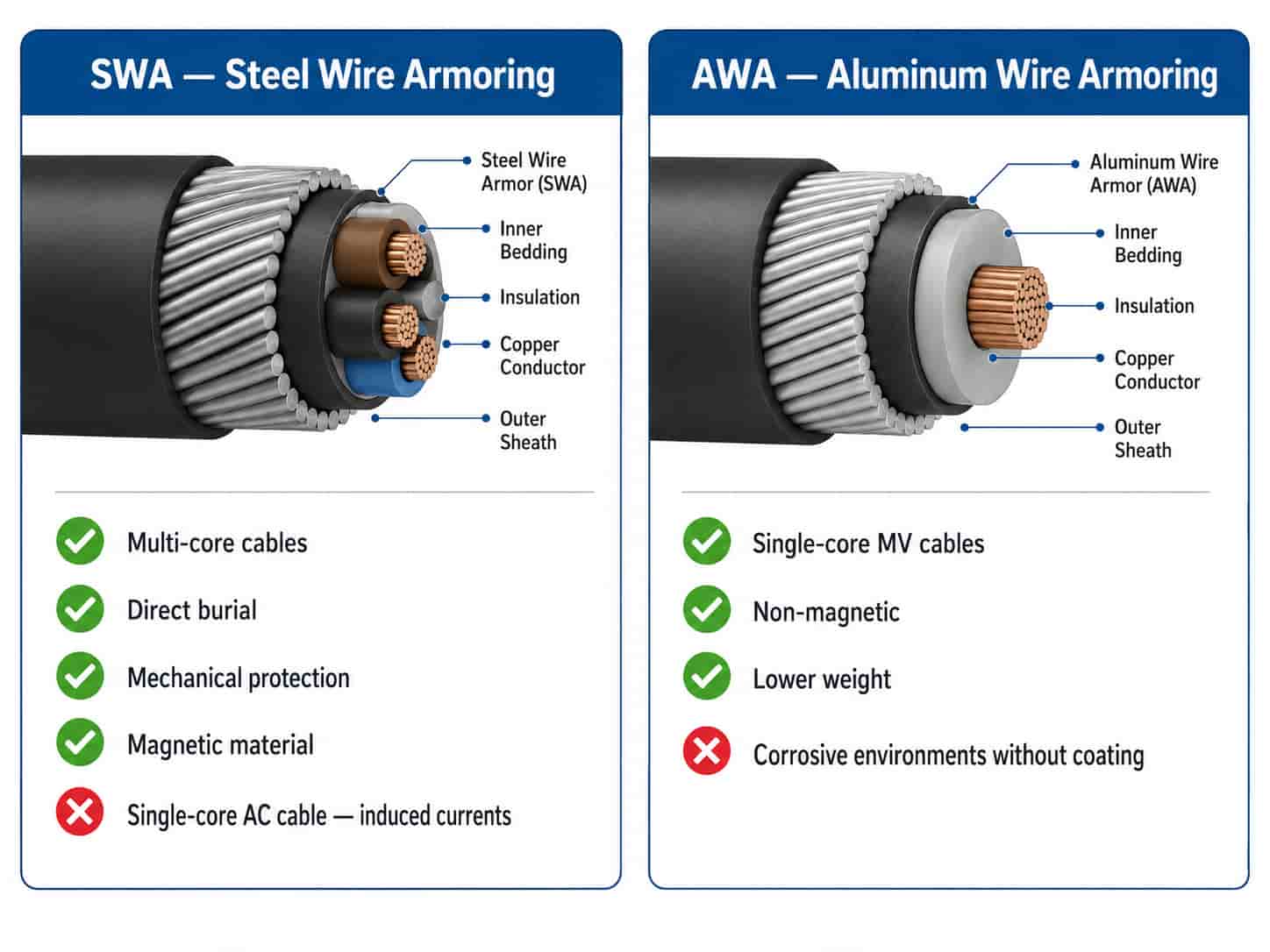
Why Single-Core Cables Cannot Use SWA
In a three-phase AC system, each of the three single-core cables carries current 120° out of phase with the others. When three single-core cables run in trefoil or flat formation, the magnetic fields from each cable largely cancel each other — net magnetic field around the group is low.
In a single-core cable with steel wire armor, the alternating magnetic field from the conductor induces a voltage in the closed steel wire loop surrounding the conductor. This induced voltage drives a circulating current through the armor — called armor loss or induced armor current. In large single-core cables, this induced current can be comparable in magnitude to the conductor current, causing significant power loss and armor overheating.
Aluminum wire armor eliminates this problem because aluminum is not ferromagnetic — it has very low magnetic permeability and does not sustain significant induced currents under the alternating magnetic field of a single-core AC cable.
- Use SWA: all multi-core cables (2-core, 3-core, 4-core, 5-core) at any voltage
- Use AWA: all single-core cables where armoring is required — particularly single-core MV cables and large single-core LV feeders above approximately 150mm²
Key Point: If a supplier quotes SWA on a single-core MV cable, or on a large single-core LV cable above 150mm², this is a specification error. Query it. Some suppliers default to SWA without distinguishing single-core from multi-core applications — the cost difference between SWA and AWA is small but the technical implication is significant.
AWA Limitations
- Lower tensile strength than SWA — aluminum wire is softer than steel
- Slightly lower corrosion resistance than galvanized steel — but adequate under an intact PVC outer sheath
- AWA on single-core cables must be bonded and earthed at one end only (single-point bonding) to prevent circulating currents in the armor loop — this is an installation requirement, not a cable defect
Steel Tape Armoring (STA) and Double Steel Tape Armoring (DSTA)
Steel tape armoring applies one or two helically wound steel tapes instead of individual wires. STA and DSTA are used primarily on cables where the mechanical protection requirement is different from SWA:
- STA: one steel tape layer — used on some MV cables and on cables where longitudinal water blocking is required (the tape provides an additional moisture barrier when combined with a laminated tape)
- DSTA: two steel tape layers applied in opposite directions — provides better crush resistance than STA and is used in some submarine and direct-burial applications
- STA and DSTA are less common than SWA in standard industrial cable procurement — most B2B buyers will encounter SWA and AWA. Specify STA/DSTA only when the project specification explicitly requires it
Unarmored Cable: When It Is the Correct Specification
Unarmored cable — sometimes described as ‘screened’ or simply as XLPE/PVC cable without armoring — is the correct specification when the installation environment provides adequate mechanical protection without armoring:
In Conduit or Enclosed Duct
Cables installed in rigid PVC, HDPE, or steel conduit, or in enclosed cable ducts, are protected by the conduit against mechanical damage. Armoring adds cost and increases cable diameter (which may affect conduit fill calculations) without adding protection benefit. Unarmored cable in conduit is the standard specification for most internal building wiring, panel connections, and protected industrial runs.
On Cable Tray or Ladder Rack
Cable tray and ladder rack provide the cable with support and, in many cases, adequate protection from incidental mechanical contact. Unarmored cable on cable tray is acceptable in most industrial and commercial installations where:
- The tray is in a controlled indoor environment without significant impact risk
- The tray is not in a traffic area where vehicles or equipment could contact the cables
- The tray is above head height or otherwise protected from physical access
In areas with higher mechanical risk — tray at floor level, in active maintenance areas, in outdoor exposed locations — armored cable on tray may still be appropriate. The judgment is the installation engineer’s; the procurement specification should reflect the decision.
Short Exposed Runs with Mechanical Guards
Where cable must cross an exposed area — a short overhead run, a machine connection, a pit crossing — a conduit guard or cable protection cover can substitute for armoring on short runs. This is sometimes more economical than specifying armored cable for an otherwise unarmored cable schedule.
Note: Unarmored cable must never be directly buried in soil without conduit or duct protection. Even in soft soil, direct-buried unarmored cable is subject to soil settlement, rodent damage, and mechanical disturbance during future ground works. The failure of a direct-buried unarmored cable typically requires complete excavation and replacement of the cable run — a cost many times greater than the original saving on cable type.
Installation Method Decision Guide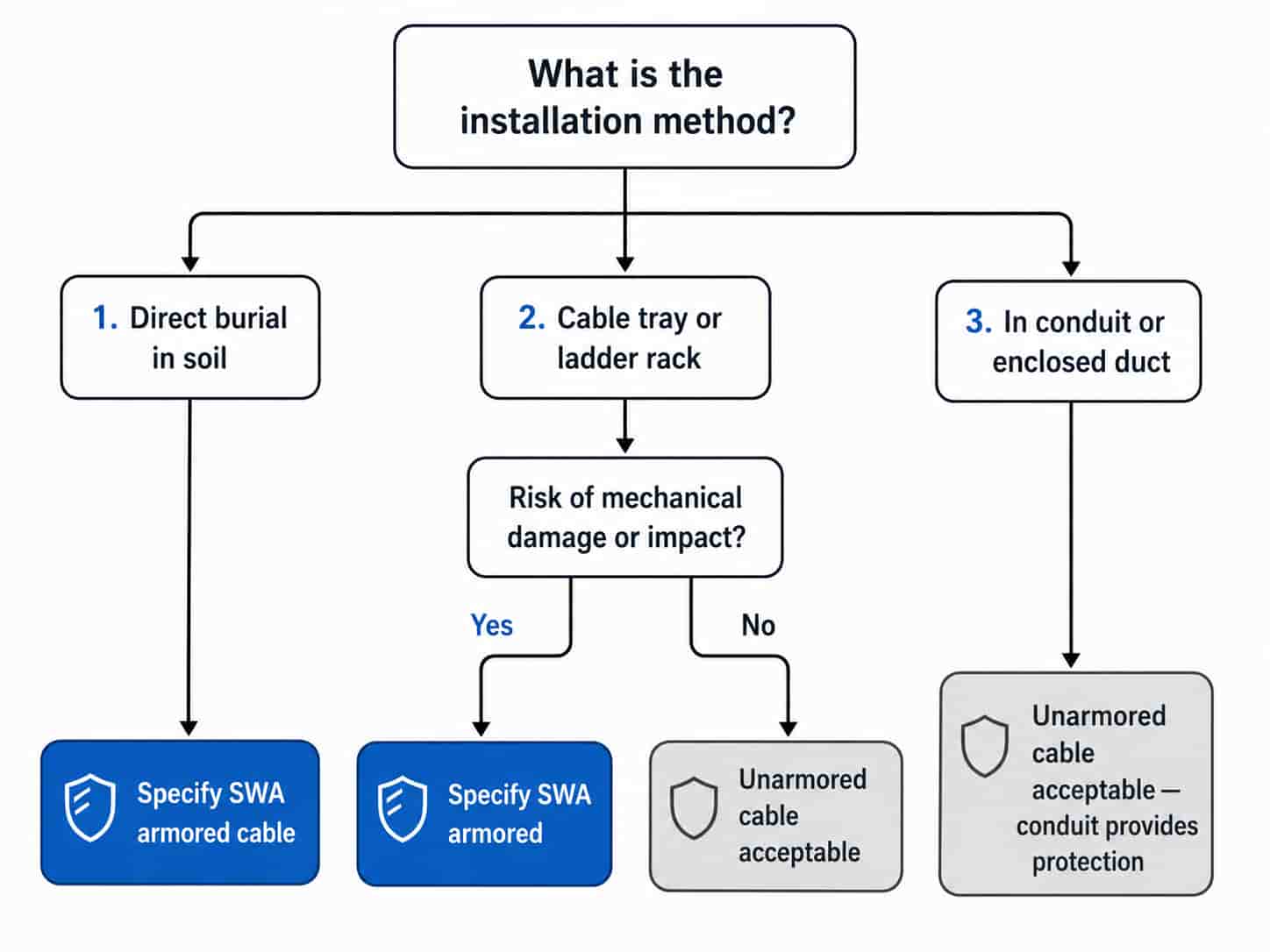
For large cable schedules with many armored cables, the additional weight of armoring can affect cable tray structural loading, particularly on overhead trays. If the tray is close to its rated load capacity, replacing armored cable with unarmored cable in conduit may be a more economical solution than upgrading the tray structure.
Armoring in Medium Voltage Cables
Medium voltage cables (above 1kV) have specific armoring requirements that differ from LV cables:
- Single-core MV cables: must use AWA (not SWA) — as explained in the AWA section above
- Multi-core MV cables: SWA is standard; the armor is applied over the metallic screen and bedding
- MV cable armor bonding: MV cable armor must be bonded and earthed at each end (solid bonding) or at one end (single-point bonding for single-core) — the bonding arrangement affects armor current and must be confirmed with the protection engineer
- MV cable armor as earth return: in some distribution systems, the cable armor is used as the earth fault return path — the armor cross-section must be verified against the fault level for this arrangement
For a detailed explanation of MV cable construction including the metallic screen and semi-conductive layers, see Low Voltage vs Medium Voltage Cable: A Procurement Guide.
Common Specification Errors and How to Avoid Them
These are the most frequent armoring-related errors encountered in B2B cable procurement:
- Specifying SWA on single-core cables: technically incorrect — substitute AWA and flag to the engineer
- Direct-burying unarmored cable: installation error — always specify SWA for direct burial regardless of project budget pressure
- Specifying armored cable for conduit runs: adds unnecessary cost and may cause conduit fill issues — unarmored is correct in conduit
- Accepting a cable with non-galvanized steel armor: will corrode if the sheath is damaged — always confirm galvanized wire in the specification
- Not confirming armor wire diameter against the standard: undersized armor wires reduce crush resistance — request the type test report confirming armor wire diameter to IEC 60502
- Omitting armor bonding requirements from the installation specification: armor that is not properly bonded can carry dangerous induced voltages — confirm bonding arrangement before handover
Procurement Checklist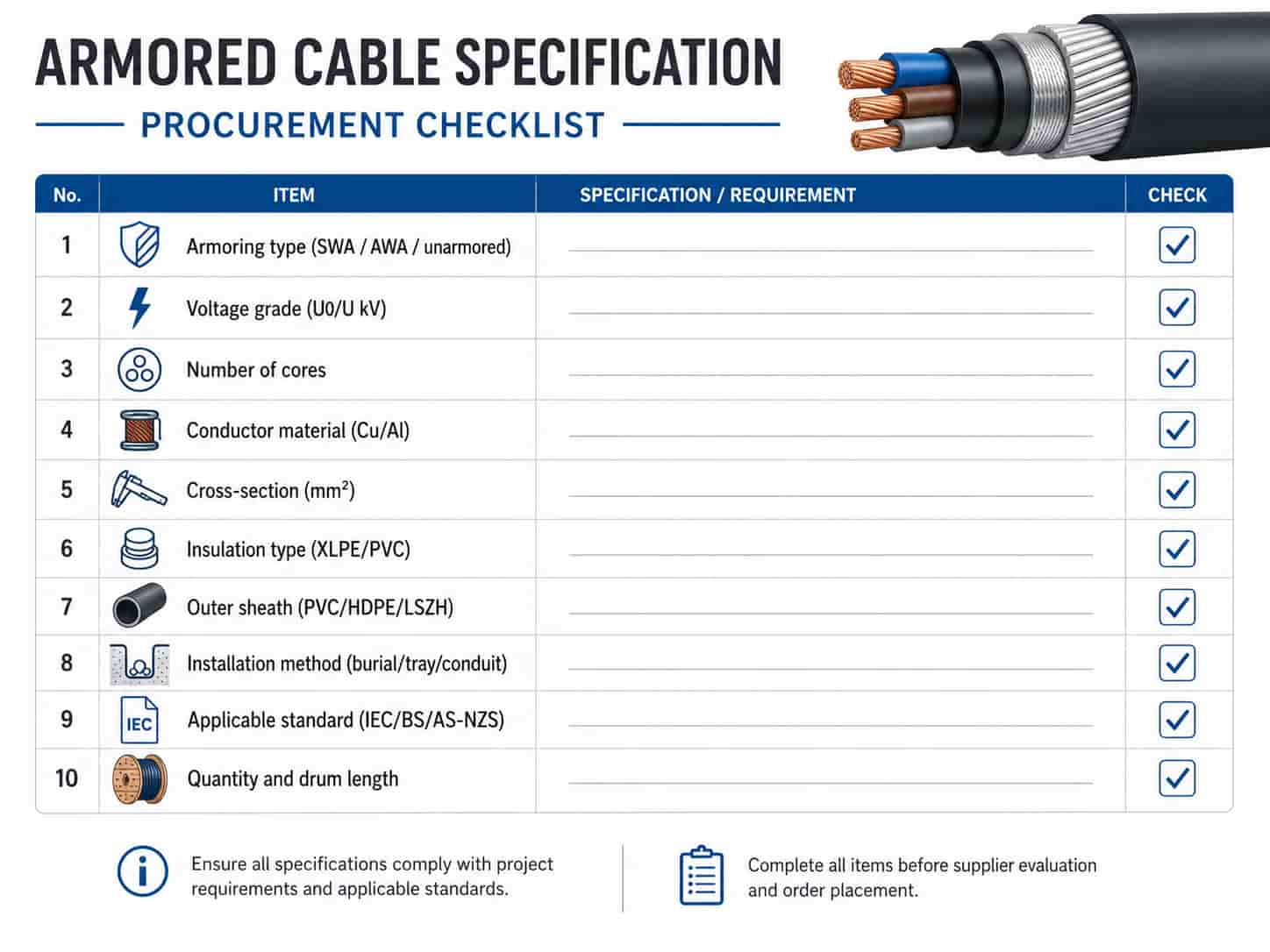
When specifying armored or unarmored cable for a B2B inquiry, provide the following:
- Armoring requirement: SWA, AWA, or unarmored — and the reason (direct burial, tray, conduit)
- Voltage grade (U0/U format) and number of cores
- Conductor material (Cu or Al) and cross-section (mm²)
- Insulation type: XLPE or PVC
- Outer sheath: PVC, HDPE, or LSZH
- Applicable standard: IEC 60502-1/2, BS 6622, AS/NZS 1429, or other
- Single-core or multi-core: if single-core, confirm AWA is required
- Total quantity (meters), drum length, and delivery destination
Quotation Requirements
RichingPower supplies SWA armored, AWA armored, and unarmored power cables in LV and MV configurations for industrial, infrastructure, and project supply. To receive an accurate quotation, please provide:
- Armoring type (SWA, AWA, or unarmored) and installation method
- Voltage grade, core count, conductor material, and cross-section
- Insulation and sheath specification
- Applicable standard and certification requirements
- Total quantity, drum length, and delivery destination
Submit your cable specification via the RichingPower contact page. For projects with a mixed cable schedule combining armored and unarmored cables, attaching a cable schedule allows itemized quotation across all cable types.
Conclusion
The armoring decision for a cable specification is driven by the installation method and mechanical environment — not by cable voltage, conductor size, or project budget. Direct burial always requires armored cable; conduit and enclosed duct installations do not. The type of armoring — SWA for multi-core cables, AWA for single-core cables — is determined by the number of cores and the risk of induced armor currents in AC systems.
Confirming the installation method for every cable run before writing the specification avoids the most common armoring errors in B2B procurement. For project schedules with dozens of cable types, a cable schedule that records the installation method alongside the electrical specification is the most effective way to ensure consistent armoring specification across all runs.
For guidance on other cable specification fields, see How to Read a Cable Specification Sheet. For information on XLPE vs PVC insulation selection, see
XLPE vs PVC Cable Insulation: A Practical Selection Guide. Contact RichingPower with your project specification for a quotation.