For B2B buyers specifying or reviewing cable specifications, XLPE and PVC are the two insulation materials that appear in almost every power cable quotation. They are not interchangeable — each has distinct thermal, electrical, and environmental properties that make it suitable for certain applications and unsuitable for others.
This guide explains what XLPE and PVC are, how they differ in performance, and how to decide which insulation type to specify for a given installation. It also clarifies a common source of confusion: in a cable specification, XLPE and PVC can refer to different layers — the conductor insulation and the outer sheath — and these are separate procurement decisions.
What Is XLPE Insulation?
XLPE stands for cross-linked polyethylene. It is manufactured by chemically or physically cross-linking the polymer chains of standard polyethylene (PE), creating a three-dimensional network structure that gives the material fundamentally different properties from uncrosslinked PE.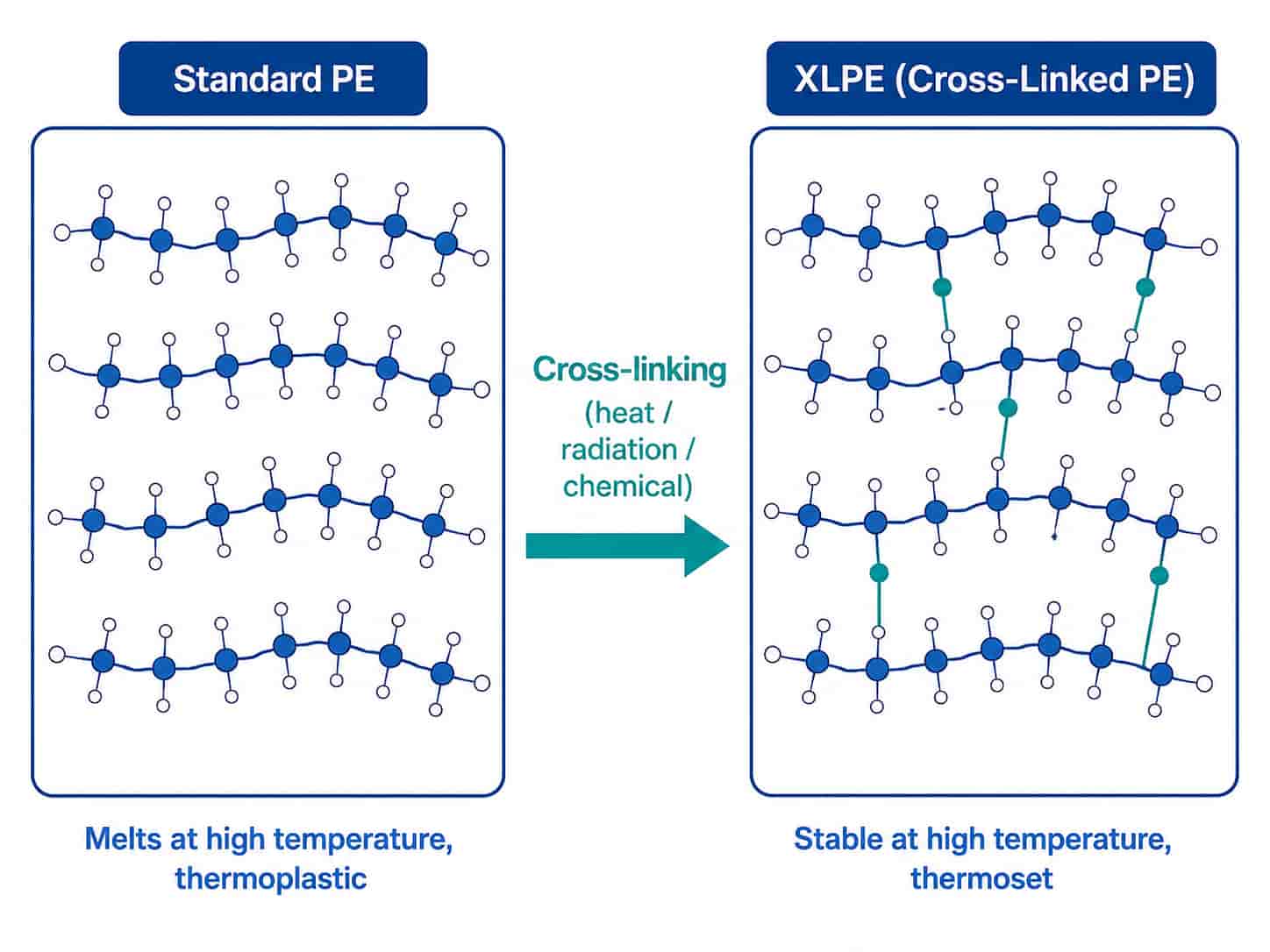
The cross-linking process — achieved through peroxide curing, electron beam irradiation, or silane moisture cure — converts the thermoplastic PE into a thermoset material. Unlike PVC or standard PE, XLPE does not soften or flow when heated to its operating temperature. This property is the foundation of its superior thermal performance.
Key properties of XLPE insulation:
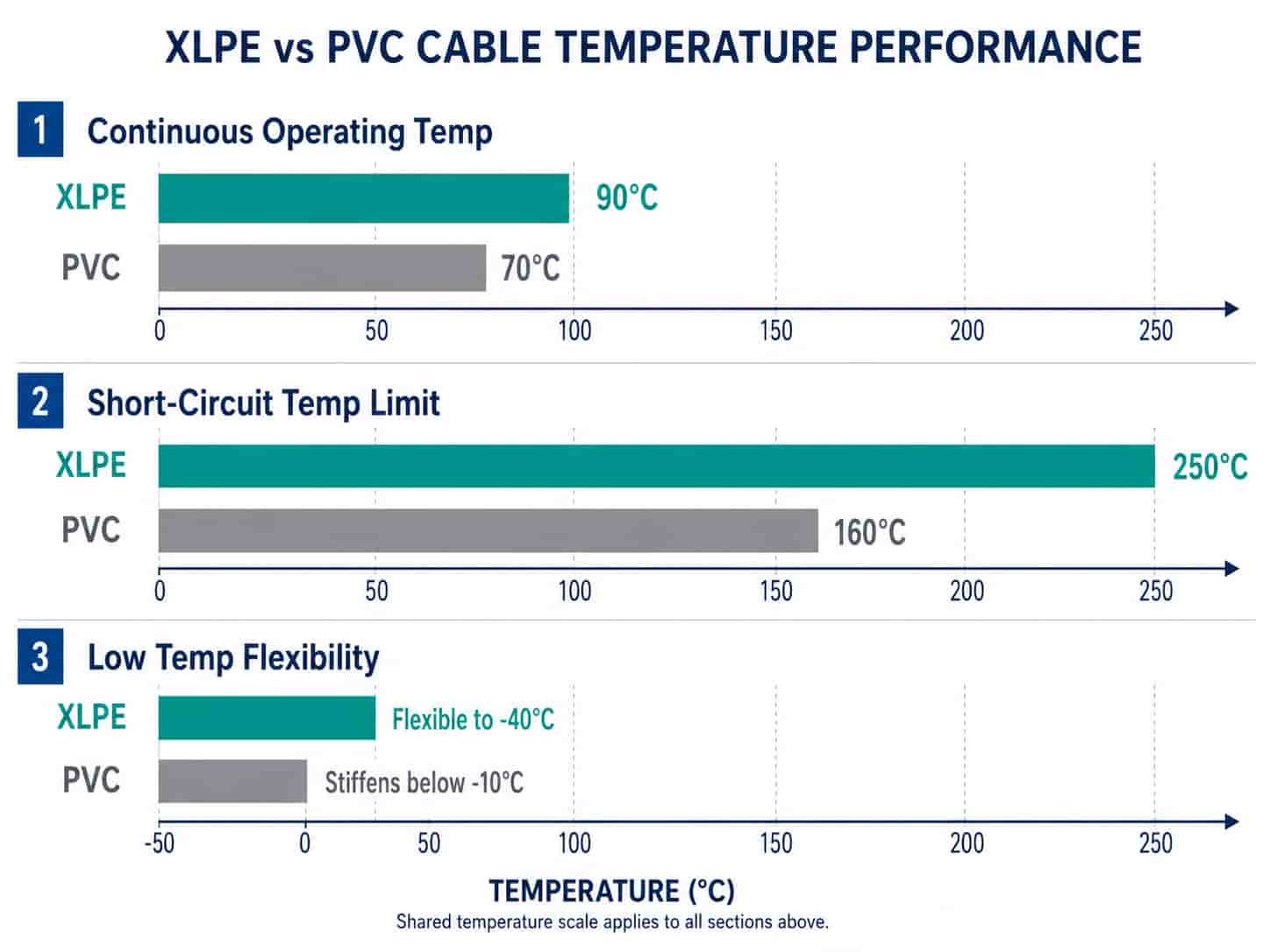
- Maximum continuous operating temperature: 90°C — significantly higher than PVC’s 70°C limit
- Short-circuit temperature limit: 250°C — allows the cable to survive fault conditions without immediate insulation failure
- Low dielectric loss: XLPE has lower capacitance and power factor than PVC, making it more suitable for medium and high voltage applications where dielectric losses are significant
- Chemical resistance: resistant to most oils, solvents, and acids encountered in industrial environments
- Low-temperature flexibility: remains flexible at temperatures as low as -40°C, unlike PVC which becomes brittle in cold conditions
- Moisture resistance: low water absorption, making XLPE suitable for wet and direct-buried installations
- UV resistance: standard XLPE has limited UV resistance; black-compounded or UV-stabilized XLPE grades are available for outdoor exposure
Key Point: XLPE is the only insulation material suitable for medium voltage cables. The lower dielectric constant of XLPE allows thinner insulation walls for the same voltage rating compared to PVC, and its superior electrical stability at higher field strengths is essential for MV cable performance over a 30–40 year service life.
What Is PVC Insulation?
PVC stands for polyvinyl chloride. It is a thermoplastic polymer widely used as both conductor insulation and outer sheath material in low voltage cables. PVC is the most widely produced cable insulation material globally due to its low cost, ease of processing, and acceptable performance for general LV applications.
Key properties of PVC insulation:
- Maximum continuous operating temperature: 70°C for standard grades; 90°C for high-temperature (HT) grades used in some specialist applications
- Short-circuit temperature limit: 160°C — lower than XLPE, meaning PVC-insulated cables must be larger in cross-section to withstand the same fault current
- Higher dielectric loss: PVC has higher capacitance and dielectric loss than XLPE — acceptable for LV applications but a material limitation for MV use
- Cold temperature performance: standard PVC becomes brittle and may crack below approximately -10°C — cold-flexible PVC grades extend this to -20°C or -30°C
- Flame propagation: standard PVC will propagate flame; flame-retardant (FR) PVC grades are available and widely used in buildings
- Halogen content: standard PVC contains chlorine — releases HCl gas when burned. LSZH (Low Smoke Zero Halogen) materials replace PVC in enclosed spaces where toxic combustion products are a concern
- Chemical resistance: PVC is resistant to many acids and alkalis but may swell or deteriorate in contact with certain organic solvents and oils
Note: PVC insulation is not suitable as the primary insulation material for medium voltage cables (above 1kV). At MV field strengths, PVC’s higher dielectric loss generates excessive heat within the insulation layer, leading to thermal runaway and premature failure. All medium voltage cables use XLPE (or EPR for dynamic applications) as the conductor insulation.
Head-to-Head Comparison: XLPE vs PVC
The table below summarizes the key performance differences between XLPE and PVC insulation across the parameters most relevant to B2B cable procurement.
When to Choose XLPE Insulation
XLPE is the correct insulation specification in the following situations:
All Medium Voltage Applications
Any cable operating above 1kV must use XLPE insulation. This is not a preference — it is a technical requirement. PVC insulation is not certified or suitable for MV voltage grades. If a cable specification shows PVC insulation on a cable rated above 1kV, it is an error.
High Ambient Temperature Installations
Installations where the ambient temperature around the cable exceeds 30°C — common in tropical climates, engine rooms, furnace areas, and underground mines — benefit from XLPE’s 90°C continuous rating. PVC cables in high-ambient environments must be significantly derated, often requiring a larger cross-section to carry the same current.
Long Service Life Requirements
XLPE has a longer thermal ageing life than PVC at equivalent operating temperatures. For infrastructure projects where cables are expected to remain in service for 30–40 years without replacement — underground power networks, substation feeders, industrial plant mains — XLPE is the preferred insulation for lower total lifecycle cost.
Direct Burial in Wet or Chemically Active Soil
XLPE’s low water absorption and chemical resistance make it the better choice for cables buried in waterlogged soil, near chemical plants, or in environments where soil chemicals may attack the insulation over time.
Large Cross-Section Cables
For cables above 95mm², the higher current rating of XLPE at 90°C versus PVC at 70°C means that a smaller conductor cross-section is required to carry the same current. On large-cross-section feeders, the material cost difference between XLPE and PVC is typically less than the conductor material saving from specifying a smaller cross-section.
Key Point: For most B2B industrial and infrastructure cable procurement in 2025, XLPE is the default insulation choice for power cables. PVC retains its place only in specific low-cost, low-risk, short-life applications where its lower price is a genuine advantage and its thermal limitations are not a constraint.
When to Choose PVC Insulation
PVC remains a valid and cost-effective choice in the following situations: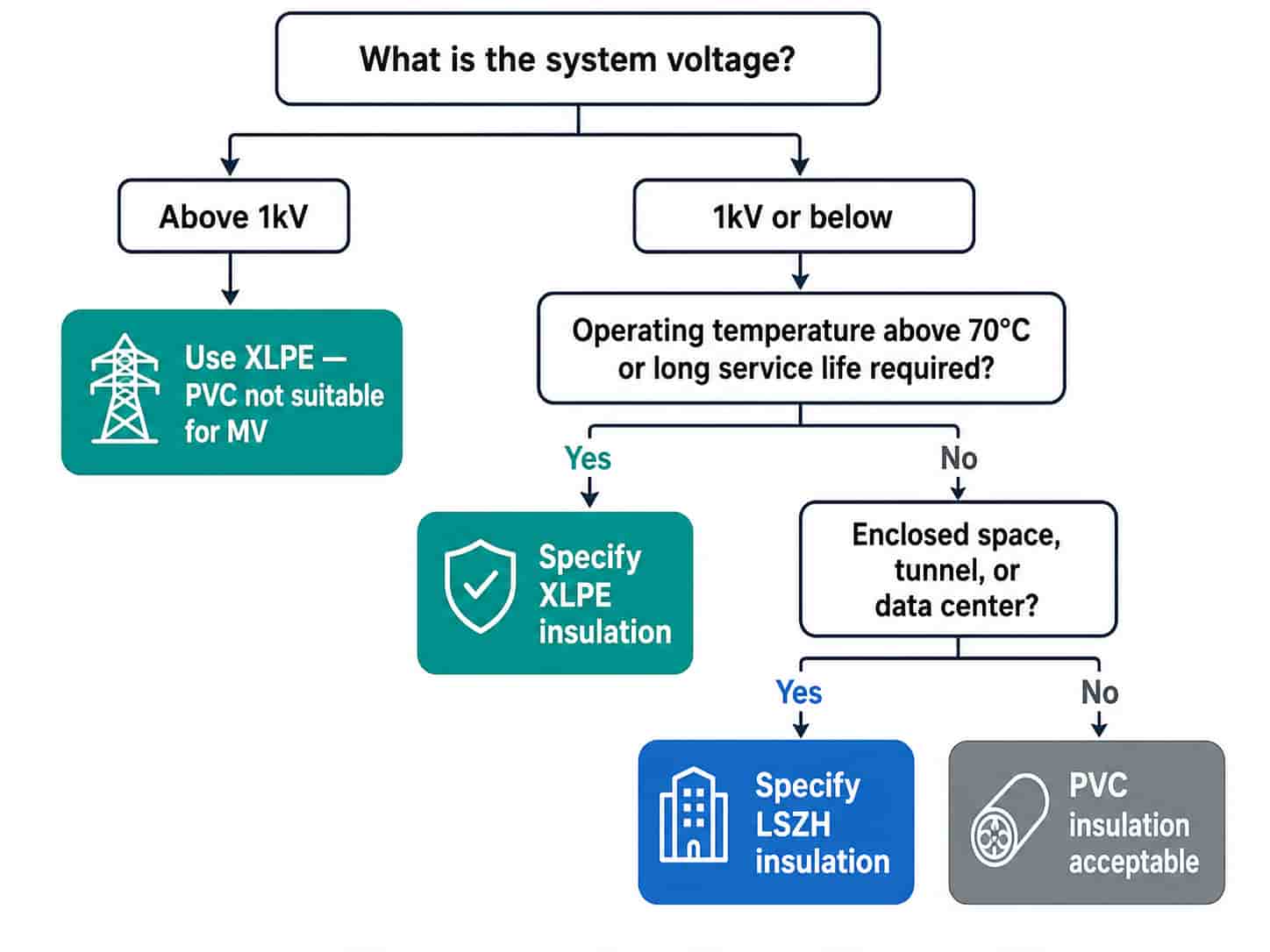
Low-Voltage General Wiring in Controlled Environments
For internal building wiring, panel wiring, and branch circuits in air-conditioned or temperature-controlled environments where ambient temperatures remain below 30°C and service life requirements are 15–20 years, PVC-insulated cable at 0.6/1kV is a cost-effective and widely accepted specification.
Short-Run Branch Circuits and Control Wiring
Control cables, instrumentation cables, and short branch circuits where current-carrying capacity is not the primary constraint and replacement is feasible within the facility’s maintenance cycle — PVC insulation at 300/500V or 0.6/1kV is the standard and cost-appropriate specification.
Budget-Constrained Projects with Lower Load Density
In applications where total cable run lengths are short, ambient temperatures are moderate, and the project budget is the primary driver, PVC-insulated LV cables offer acceptable performance at lower material cost than XLPE. The trade-off is a smaller cross-section current allowance and shorter thermal life.
Temporary or Short-Life Installations
Temporary power supplies for construction sites, events, or installations with a defined short operating life where long-term thermal ageing is not a concern — PVC-insulated flexible cables are the standard and appropriate specification.
LSZH: The Third Option for Enclosed Spaces
A third insulation and sheath material relevant to B2B cable procurement is LSZH — Low Smoke Zero Halogen. LSZH is not a replacement for XLPE or PVC as a dielectric material; rather, it defines a fire performance requirement that can apply to either the insulation or sheath compound:
- LSZH insulation: the conductor insulation compound emits minimal smoke and no halogenic gases when exposed to fire — required in data centers, tunnels, public buildings, marine applications
- LSZH sheath: the outer sheath of the cable meets low smoke and halogen-free requirements — often combined with XLPE insulation
- XLPE + LSZH sheath: the most common combination for data center, tunnel, and public infrastructure power cables — XLPE provides thermal and electrical performance, LSZH sheath provides fire safety
- Standard: IEC 60754 (halogen content), IEC 61034 (smoke density), IEC 60332-3 (flame propagation)
Note: LSZH and flame-retardant (FR) are not the same property. FR cables resist flame propagation but may still release halogenic gases and dense smoke when burning. LSZH cables restrict both smoke density and halogen gas emission. In enclosed spaces — data centers, tunnels, ships, hospitals — LSZH is specified because of the smoke and toxic gas hazard to people, not just the flame propagation risk.
XLPE and PVC in the Cable Specification Sheet
A common source of confusion for B2B buyers reading cable specifications is that XLPE and PVC can appear in two different positions in a cable type code — and refer to different layers: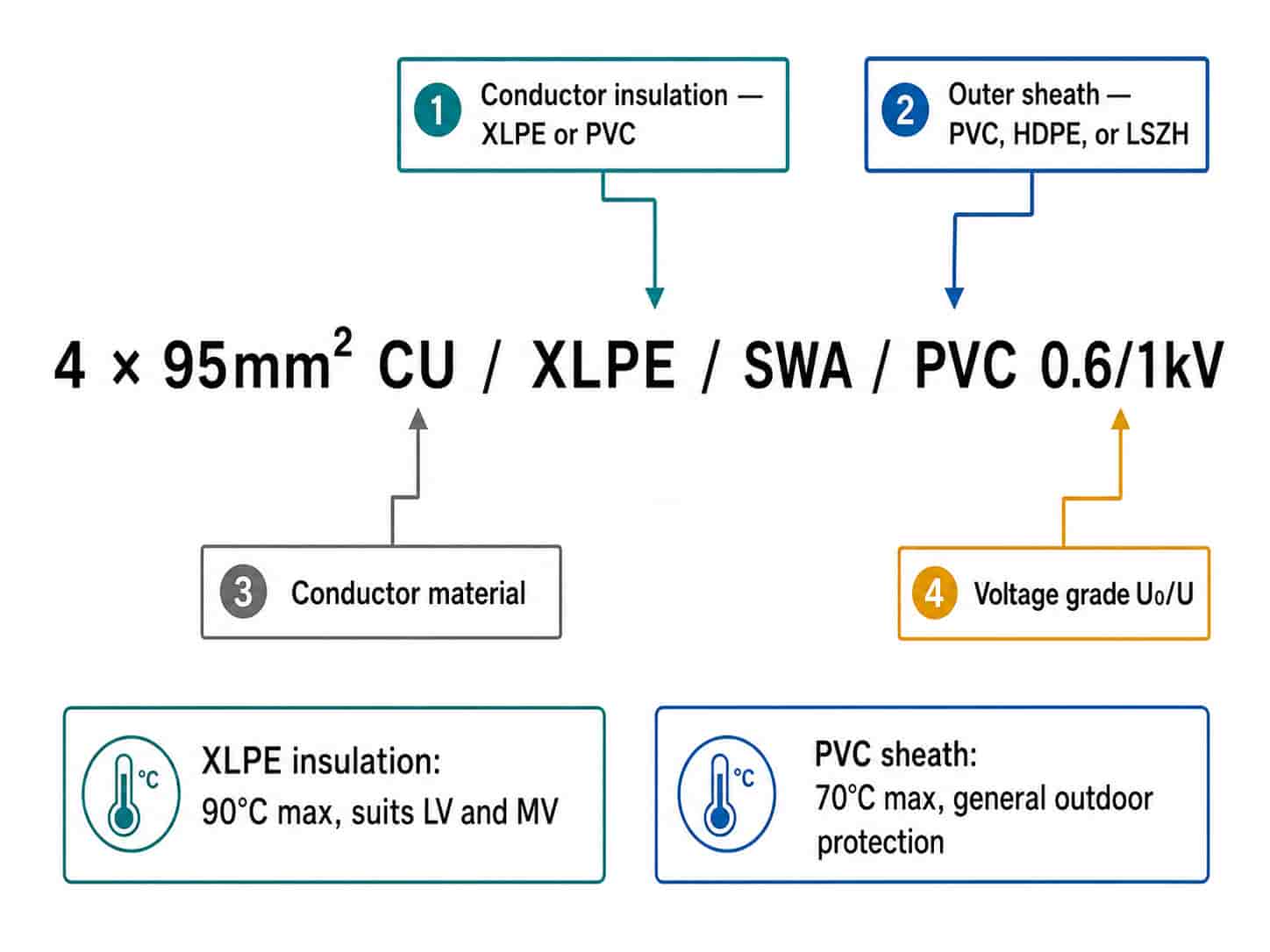
In the cable type code format: 4 × 95mm² CU / XLPE / SWA / PVC 0.6/1kV
- XLPE (third position after conductor) = conductor insulation — the material surrounding each individual conductor core
- PVC (fourth position after armoring) = outer sheath — the material forming the cable’s outer protective jacket
These are two separate specification decisions with different functional requirements:
- Conductor insulation (XLPE or PVC): determines the cable’s electrical, thermal, and dielectric performance — the critical safety and performance material
- Outer sheath (PVC, HDPE, or LSZH): determines the cable’s mechanical and environmental protection — weather resistance, UV resistance, chemical resistance, and fire performance in the outer layer
It is entirely normal and correct to specify XLPE insulation with a PVC outer sheath — this is the most common LV power cable construction globally. It is also correct to specify XLPE insulation with an LSZH outer sheath for data center or tunnel applications.