
Mining operations place more severe demands on electrical cables than almost any other industrial application. Trailing cables for mobile equipment must withstand continuous flexing, mechanical impact, water immersion, chemical exposure, and the risk of ignition from methane or coal dust in underground environments. Feeder cables in mine roadways face similar chemical and mechanical hazards in a fixed installation context.
For B2B buyers sourcing electrical cables for mining projects — whether surface open-cut, underground coal, underground hard rock, or quarrying — this guide covers the cable types required, their construction and safety requirements, applicable standards by region, and what to specify in a procurement inquiry.
Mining Electrical Environment: Why Standard Cables Are Not Sufficient
Standard industrial power cables — even armored IEC 60502-1 cables — are not designed or certified for mining applications. The mining environment imposes hazards that require specifically engineered cable construction:
- Continuous mechanical flexing: trailing and reeling cables flex with every movement of mobile equipment — draglines, continuous miners, shuttle cars, and longwall shearers. Standard cables fail rapidly under repetitive bending.
- Impact and crushing: cables in mine roadways and on pit floors are subject to equipment running over them, rock falls, and torsional stress during trailing cable deployment
- Water and chemical immersion: underground mines use water for dust suppression and cooling — cables must withstand continuous immersion without insulation degradation
- Flammable atmospheres: underground coal mines contain methane gas and coal dust — cables must not propagate flame and must have anti-static sheaths to prevent static discharge ignition
- High-voltage mobile supply: mining equipment operates at higher voltages than most industrial plants — 3.3kV, 6.6kV, and 11kV trailing cables are common for large draglines and shovels
Key Point: Using standard industrial cable in place of certified mining cable is not a cost-saving measure — it is a safety and regulatory compliance failure. Mining cable certifications (IEC 60502, AS/NZS 1802, SANS 1507, or regional equivalents) are mandatory requirements under mining safety legislation in most jurisdictions. Confirm the required certification with the mine safety authority before specifying any cable for underground use.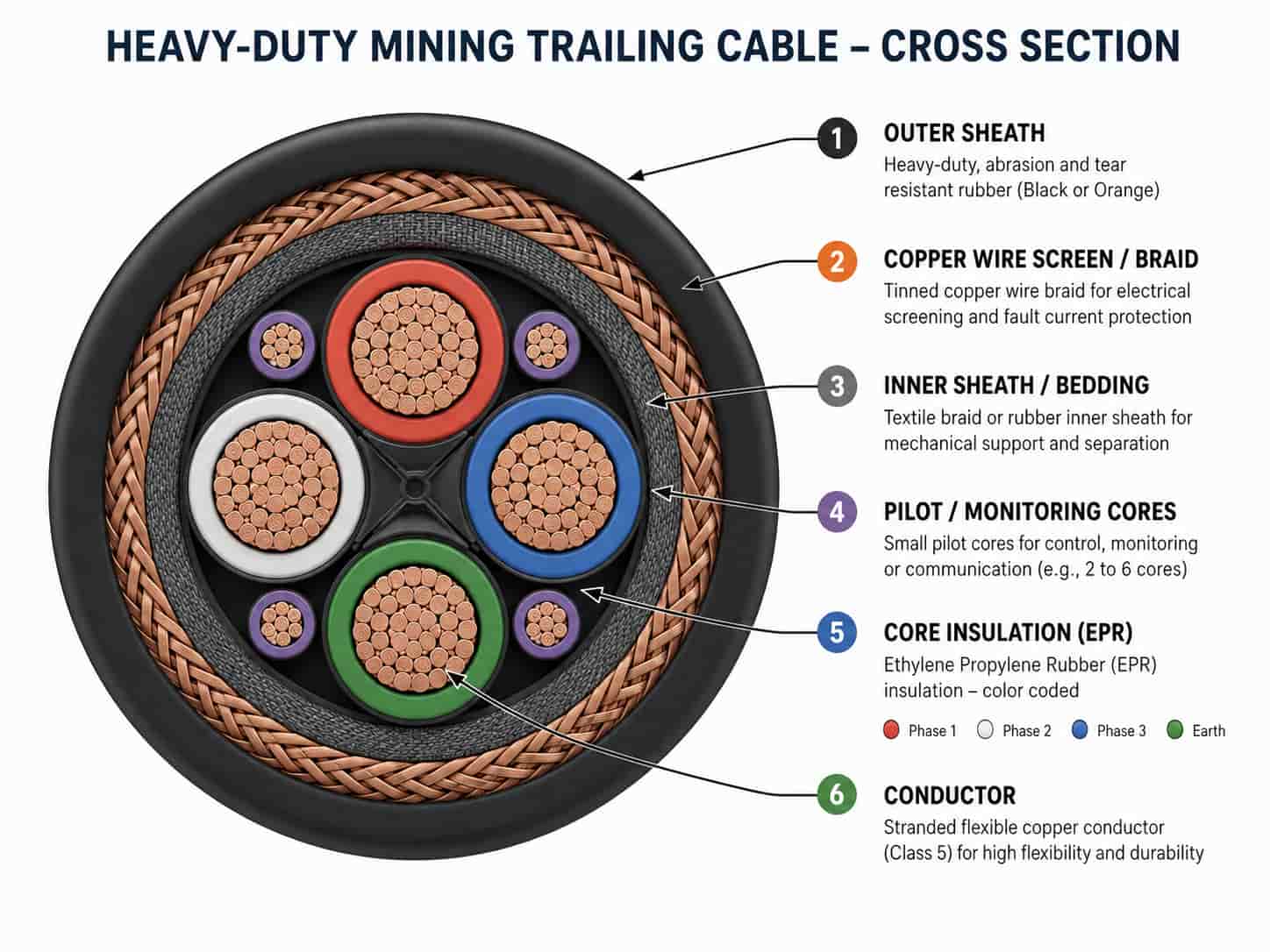
Underground Mining Cables
Underground mining applications require cables designed for both the mechanical demands of mobile equipment and the safety requirements of potentially flammable atmospheres.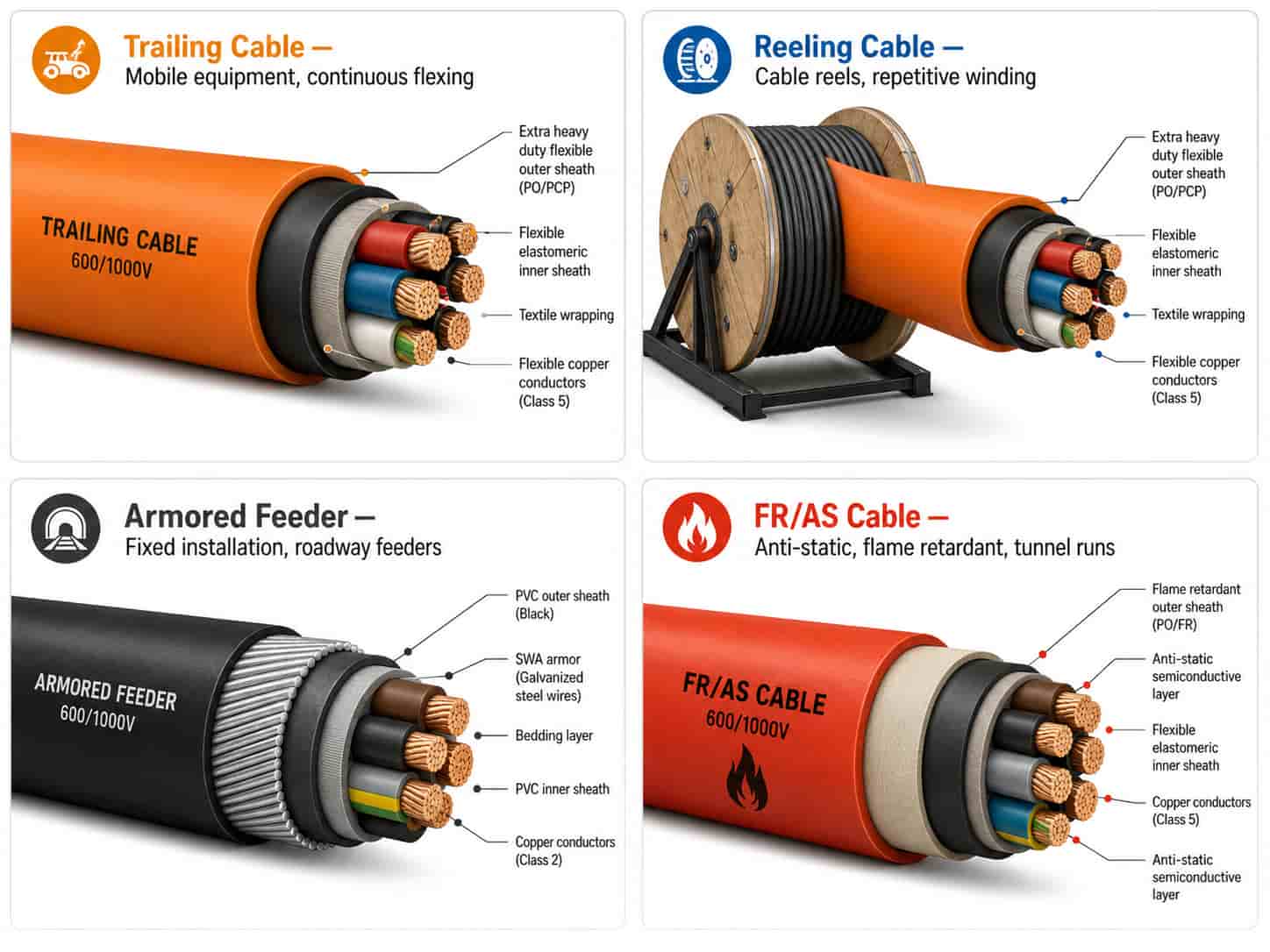
Trailing Cables
Trailing cables supply power to mobile mining equipment — continuous miners, longwall shearers, shuttle cars, and underground loaders — while the equipment moves. The cable drags on the mine floor, subject to repeated bending, abrasion, and mechanical contact with equipment.
Construction requirements for trailing cables:
- Conductor: extra-flexible stranded copper (Class 5 or 6 per IEC 60228) — high strand count to withstand repeated flexing without fatigue failure
- Insulation: EPR (ethylene propylene rubber) — superior flexibility at low temperatures and better electrical performance than XLPE for dynamic applications
- Inner sheath: rubber or thermoplastic elastomer inner separator between conductor assembly and screen
- Pilot and monitoring cores: additional small-conductor cores for ground continuity monitoring, earth leakage protection, and communication circuits — typically 3 or 4 pilot cores
- Screen: copper braid or copper wire helical screen for earth fault detection — the screen is monitored by earth leakage protection relays and trips supply immediately on screen damage
- Outer sheath: heavy-duty polychloroprene (PCP/neoprene) or thermoplastic elastomer — resistant to oil, water, ozone, and mechanical abrasion; flame-retardant and anti-static compound
- Anti-static outer sheath: mandatory for underground coal mines — surface resistivity to IEC 60332 or national equivalent limits static charge accumulation
Key Point: The pilot and monitoring cores in a trailing cable are not optional accessories — they are integral to the earth leakage protection system that cuts power to the cable within milliseconds of a fault. Trailing cables supplied without pilot cores cannot be connected to the mine’s earth leakage protection system and are unsafe for underground use.
Reeling Cables
Reeling cables supply power to equipment mounted on cable reels — the cable winds and unwinds continuously as the equipment moves. Reeling cables face more severe bending stress than trailing cables because they must bend around the drum radius repeatedly without kinking or conductor fatigue.
Key differences from trailing cable:
- Higher flexibility class: typically Class 6 (ultra-flexible) conductors for minimum bending radius requirements
- Torsional stability: cable construction optimized to resist twisting during winding — unbalanced torque causes cable to birdcage and fail
- Lighter outer sheath: reeling cables are protected by the drum enclosure; heavy-duty abrasion resistance is less critical than flexibility
- Drum compatibility: confirm minimum bend radius against the cable reel drum diameter — the cable supplier should confirm compatibility
Armored Feeder Cables (Underground Fixed Installation)
Fixed feeder cables in mine roadways supply power from substations to mobile equipment transformer/switchhouse units and to fixed loads such as ventilation fans, dewatering pumps, and conveyors:
- Voltage grade: 1.9/3.3kV, 3.6/6.6kV, or 6.35/11kV depending on mine distribution voltage
- Conductor: copper, cross-section sized for load with additional derating for installation in hot underground environments
- Insulation: XLPE or EPR — EPR preferred in wet underground environments
- Armoring: heavy-duty steel wire armoring (SWA) for mechanical protection in roadways
- Outer sheath: flame-retardant (FR) and anti-static (AS) compound — both properties required for underground coal
- Standard: IEC 60502-2 base with additional mining-specific requirements per national standard
Flame Retardance and Anti-Static Requirements
Underground mining cables must meet strict flame propagation and anti-static requirements. These are not the same as standard flame-retardant cables used in buildings:
- IEC 60332-3 (flame propagation): cables must not propagate flame in a vertical bundle — standard for underground feeder cables
- IEC 60332-1 (individual flame propagation): for single cables in isolation — less stringent than -3
- Anti-static outer sheath: surface resistivity typically less than 3 × 10⁹ Ω as measured per IEC 60093 or equivalent — prevents static charge buildup that could ignite methane
- Glow wire test: outer sheath must not ignite when subjected to a 650°C or 850°C glow wire per IEC 60695-2-10
Note: Anti-static (AS) and flame-retardant (FR) are two separate properties that must both be specified for underground coal mine cables. A cable marked ‘flame retardant’ only is not necessarily anti-static. When requesting a quotation, explicitly request both FR and AS certification and ask for the test report confirming surface resistivity measurement.
Surface Mining: Open-Cut and Dragline Applications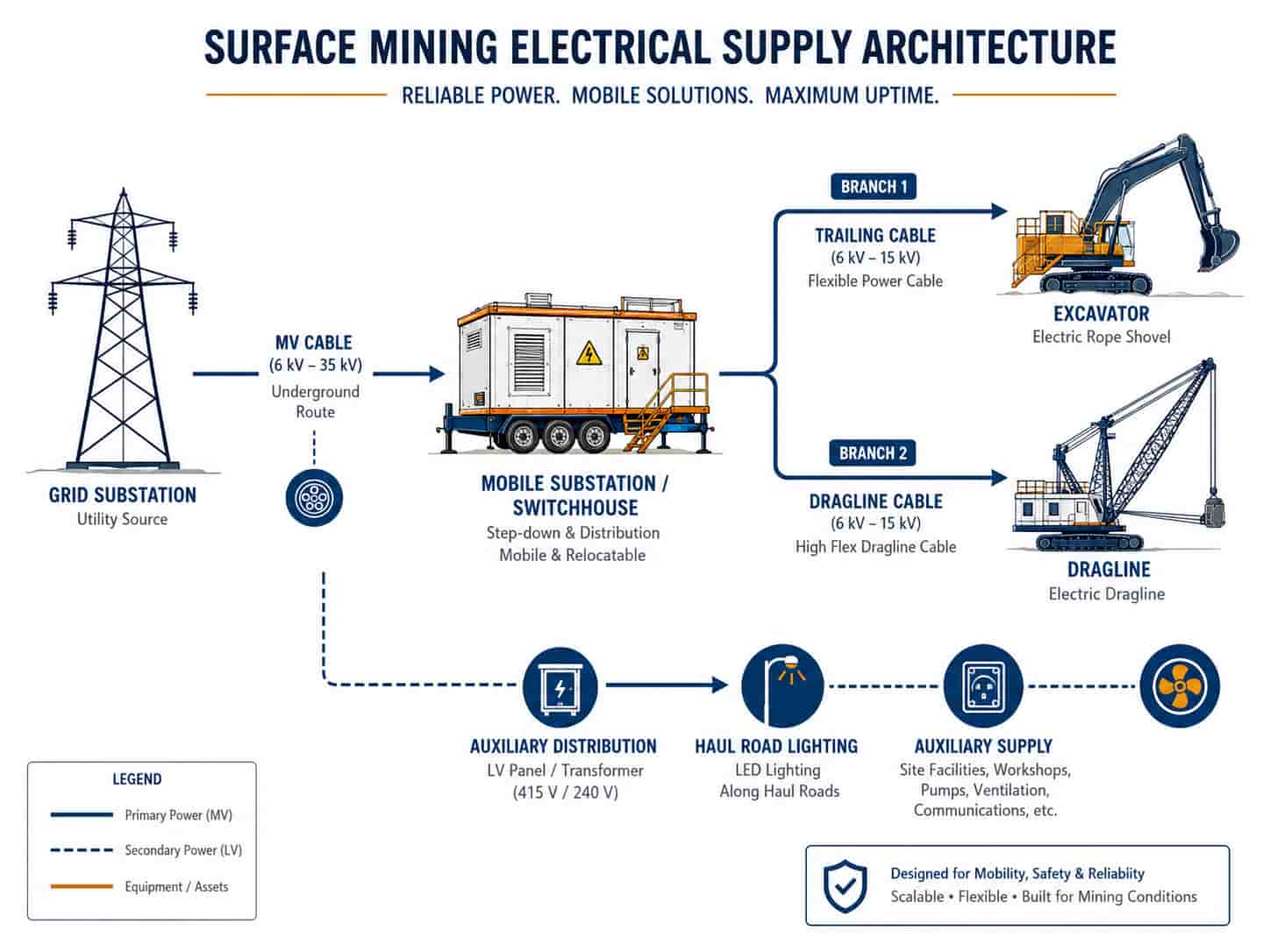
Surface mining — open-cut coal, hard rock quarrying, and dragline operations — involves different cable requirements from underground. The primary hazards are mechanical damage, UV exposure, weather, and the very high voltages used to supply large mining equipment.
Dragline and Shovel Trailing Cables
Large electric draglines and mining shovels use trailing cables at voltages of 6.6kV, 11kV, or even 22kV to minimize current and cable cross-section for the enormous power levels involved (some draglines exceed 25MW):
- Voltage grade: 3.6/6.6kV, 6.35/11kV, or 12/22kV
- Conductor: extra-flexible stranded copper, very large cross-section (240mm² to 630mm² per phase for large draglines)
- Insulation: EPR — essential for flexibility at large cross-sections and for long service life under continuous dynamic stress
- Screen: copper wire or braid screen for earth fault detection
- Outer sheath: heavy-duty PCP (polychloroprene) — UV-resistant, oil-resistant, weather-resistant, flame-retardant
- Ground check and pilot cores: for earth continuity monitoring and protection circuit operation
Key Point: For dragline trailing cables, the manufacturer must confirm the minimum bending radius under the cable’s own weight and the maximum drum/reel diameter. A large-cross-section 11kV cable may have a minimum bending radius of 1.5–2m — this constrains the cable management system design and affects how the cable is stored on the machine.
Open-Cut Fixed Installation Cables
Fixed feeder cables in open-cut mines supply power from the surface substation to mobile substations positioned around the pit floor:
- Typically MV underground cables: 6/10kV or 19/33kV XLPE armored cable
- UV-resistant outer sheath: HDPE or UV-stabilized PVC for exposed runs on surface
- Heavy-duty armoring: SWA with oversized wire gauge for additional mechanical protection in active mining areas
- Direct burial or in conduit depending on traffic exposure level
Standards by Region
Mining cable standards vary significantly by country and mining type. Specifying the correct regional standard is essential — and must match the requirements of the mine safety authority in the project location.
For all trailing and reeling cable applications, EPR insulation and Class 5 or 6 flexible conductors are the correct specification. XLPE insulation is acceptable for fixed feeder cables in underground roadways and surface installations but should not be specified for dynamic applications where repeated flexing is required.
Cable Management and Drum Specification
Mining cables are supplied on drums and require careful handling and storage to avoid damage before installation:
- Drum type: steel or heavy-duty wooden drums for large trailing cables — confirm drum flange diameter and barrel diameter against minimum bending radius
- Drum length: trailing cables for large equipment are typically supplied in single-length drums to avoid underground joints — confirm maximum drum length and weight for site handling equipment
- Drum marking: each drum must be marked with cable type, voltage rating, standard, length, conductor cross-section, and manufacturing date — required for traceability under mining safety regulations
- ISPM 15: wooden drums for export must carry IPPC heat-treatment stamp — mandatory for import into Australia, EU, US, and most mining markets
- Retest interval: trailing cables in service must be periodically retested (insulation resistance and high-voltage withstand) per the applicable mining safety regulation — confirm test interval with mine safety authority and ensure test documentation is maintained
Note: Underground trailing cables have a defined service life and must be removed from service and scrapped when they reach the end of life defined by the mine safety regulation or the operator’s maintenance standard — regardless of visual condition. Cable reuse beyond defined intervals is a regulatory violation in most jurisdictions.
Complete Procurement Checklist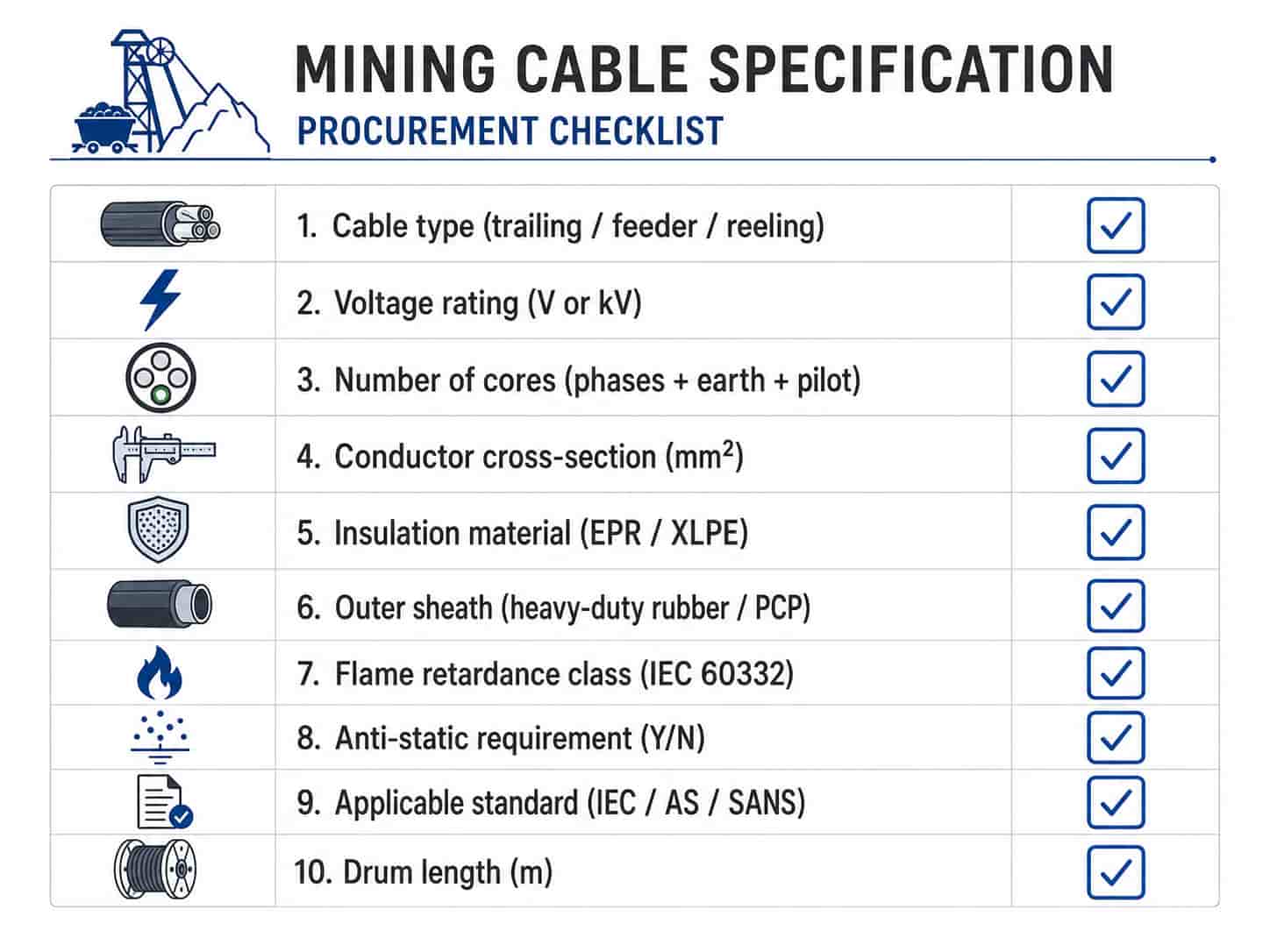
When preparing a mining cable procurement inquiry, provide the following information for accurate quotation:
- Cable type: trailing, reeling, armored feeder, or fixed underground feeder
- Application: underground coal, underground hard rock, surface dragline, open-cut, or quarrying
- Voltage rating (U0/U format): e.g. 1.9/3.3kV, 3.6/6.6kV, 6.35/11kV
- Number of power cores and conductor cross-section (mm²)
- Number and cross-section of pilot/monitoring cores
- Insulation material: EPR (dynamic applications) or XLPE (fixed installations)
- Outer sheath: heavy-duty PCP or equivalent; confirm FR and AS requirements
- Applicable standard: IEC 60502, AS/NZS 1802, SANS 1507, or other regional standard
- Mine authority approval requirements: confirm if cable must appear on an approved products list
- Quantity (meters) and drum length
- Delivery destination and target delivery date
Quotation Requirements
RichingPower supplies mining power cables for underground and surface mining projects, including trailing cables, reeling cables, armored feeder cables, and flame-retardant anti-static power cables. To receive an accurate quotation, please provide:
- Cable type and mining application (underground coal, hard rock, surface, dragline)
- Voltage rating (U0/U format) and number of power and pilot cores
- Conductor cross-section (mm²) and flexibility class requirement
- FR and AS requirement confirmation
- Applicable standard and any mine authority approval requirements
- Total quantity (meters), drum length, and delivery destination
Submit your mining cable specification via the RichingPower contact page. For complex trailing cable specifications — particularly for large draglines or longwall equipment — please include the equipment type, voltage system, and protection relay manufacturer to allow our technical team to confirm pilot core configuration compatibility.
Conclusion
Mining power cable procurement is one of the most safety-critical electrical purchasing decisions in a project. The combination of flame-retardant, anti-static, and flexible construction requirements — together with pilot and monitoring core configuration — means that mining cables cannot be specified using standard industrial cable parameters alone.
Buyers who understand the distinction between trailing, reeling, and feeder cables, who specify the correct regional standard, and who confirm pilot core configuration against the earth leakage protection system will avoid the most common and costly procurement errors in mining electrical supply.
For related guidance on how to interpret cable specification fields, see How to Read a Cable Specification Sheet. For sourcing cables from China with quality and certification verification, see
How to Source Industrial Cables from China. Contact RichingPower with your mining project specification for a technical review and quotation.