
How to Source Industrial Cables from China: Specification, Quality and Supplier Selection

A practical step-by-step guide for B2B importers and project buyers on specifying, evaluating, and procuring industrial power cables from Chinese manufacturers.

Table of Contents

China is the world’s largest producer of power and industrial cables, supplying a significant share of global B2B demand across construction, energy, mining, and infrastructure sectors. For importers, EPC contractors, and project procurement teams, sourcing cables from Chinese manufacturers offers competitive pricing and broad product range — but also requires a structured approach to specification, supplier selection, and quality verification.

This guide walks through the sourcing process from initial specification to shipment, covering the practical steps that separate a successful procurement from one that results in quality disputes, delayed projects, or customs complications.


Step 1: Define Your Cable Specification Before Contacting Suppliers

The most common cause of misquotation and supply errors in cable procurement is an incomplete or ambiguous specification. Chinese manufacturers produce cables to multiple international standards and in a wide range of configurations — without a clear specification, suppliers will quote the product that is easiest or most profitable for them to supply, which may not be what the project requires.

A complete cable specification for B2B procurement includes:

  • Cable type and application (power cable, control cable, instrumentation cable, data cable)
  • Voltage grade in U0/U format (e.g. 0.6/1kV, 6/10kV)
  • Number of cores
  • Conductor material: copper (Cu) or aluminum (Al)
  • Conductor cross-sectional area in mm²
  • Insulation type: XLPE or PVC
  • Armoring requirement: SWA, AWA, or unarmored
  • Outer sheath color (where locally mandated)
  • Applicable standard: IEC 60502-1/2, BS 6622, AS/NZS 1429, or other
  • Quantity: total meters and/or number of drums with drum length
  • Delivery destination and Incoterms (FOB, CIF, DAP)


Key Point: Providing the applicable standard is not optional — it defines the insulation wall thickness, conductor construction, and test requirements. A cable described only as ’10kV 3-core 95mm² XLPE’ without a standard reference could be manufactured to at least three different specifications with meaningfully different construction and performance.Example cable specification sheet showing voltage grade, conductor size, insulation type, standard, and quantity fields
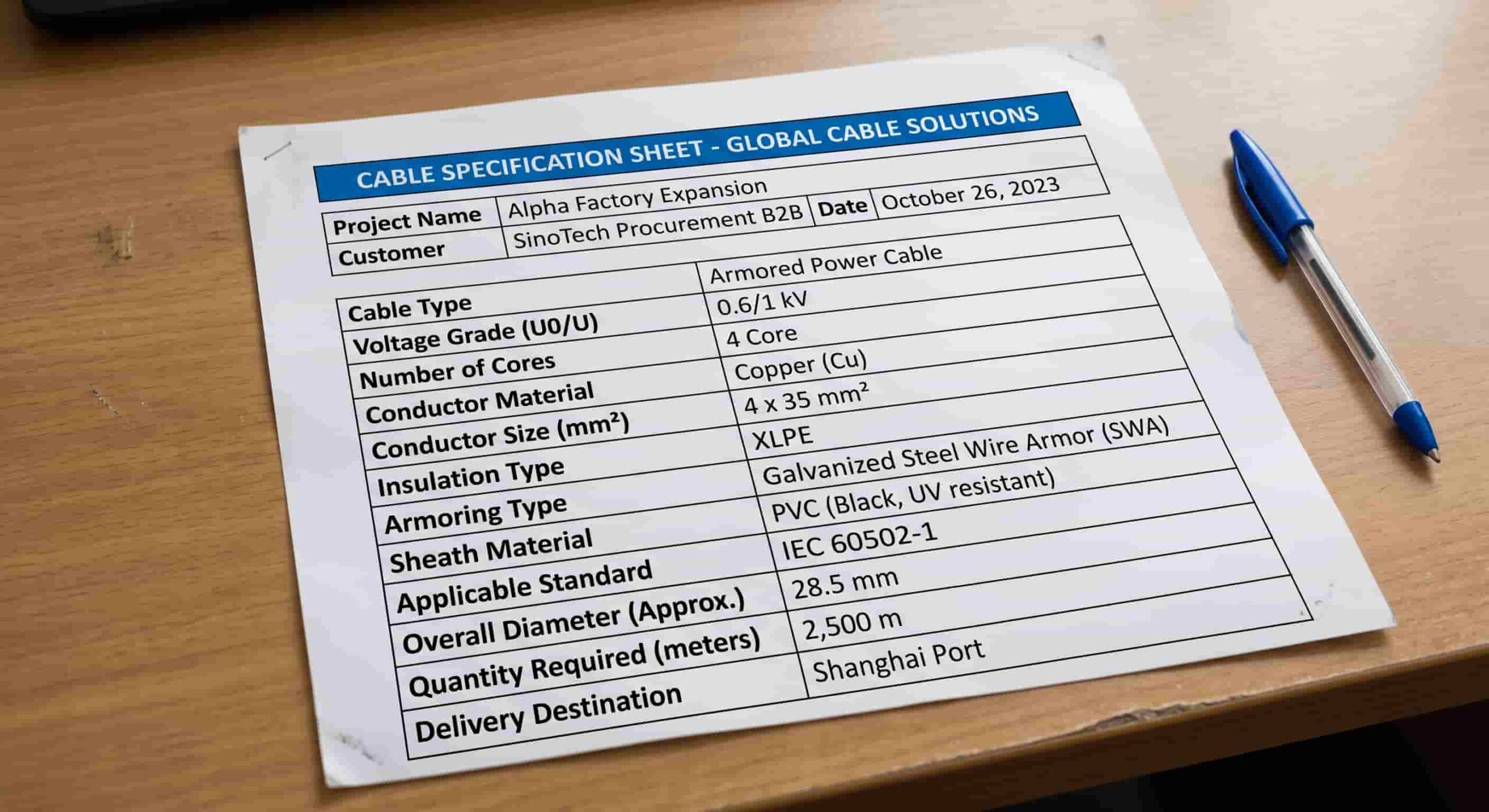
For a detailed breakdown of voltage grade designations and what they mean for cable construction, see Low Voltage vs Medium Voltage Cable: A Procurement Guide.


Step 2: Understand the Chinese Cable Manufacturing Landscape

China’s cable industry includes manufacturers across a wide range of scale and capability — from large state-owned enterprises producing IEC-certified cables for utility and infrastructure projects, to smaller factories producing commodity cables for domestic construction. For B2B export procurement, understanding where a supplier sits in this landscape is important.

Large integrated manufacturers

Produce the full range of low and medium voltage cables, hold multiple international certifications, operate internal test laboratories, and regularly supply to utility, industrial, and EPC clients globally. Lead times are longer, MOQs may be higher, but quality control is systematic and traceable.

Mid-size export-focused manufacturers

Focus on B2B export markets, typically hold ISO 9001 and key product certifications, have established relationships with international freight forwarders, and are experienced with export documentation requirements. This tier is where most B2B importers find their long-term suppliers.

Small or trading companies

May not manufacture cable directly but source from factories and resell. Can be flexible on small quantities and mixed orders but traceability of the actual production source is harder to verify. Not recommended for project-critical supply without factory audit.


Note: When a supplier presents itself as a manufacturer, ask for the factory business license and production license  for cable products. Trading companies sometimes present factory images and claim direct manufacturing capability. For IEC-certified product, ask for the certification body audit report — it will list the actual manufacturing facility address.


Step 3: How to Evaluate a Chinese Cable Supplier

Supplier evaluation for cable procurement should cover five areas:Supplier evaluation checklist for sourcing industrial cables from China including factory audit, certifications and quality control
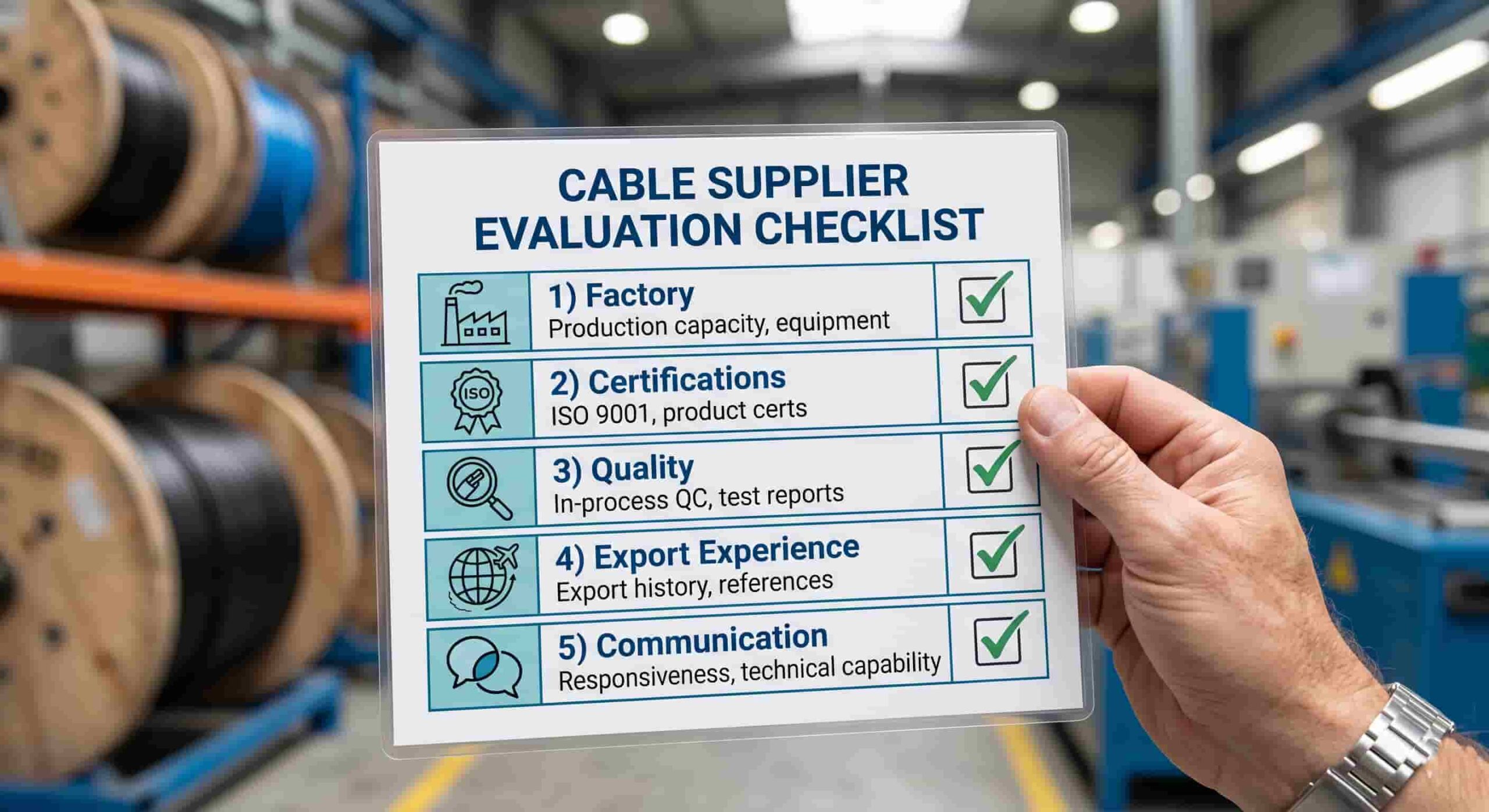
1. Production capability

Confirm that the factory produces the specific cable type you require — not all cable manufacturers produce the full product range. A factory specializing in low-voltage building wire may not have the equipment or process capability for medium voltage armored cable. Ask specifically: do you manufacture this product in your own facility, and what is your annual production capacity for this cable type?

2. Certifications and quality system

ISO 9001 certification is a baseline indicator of a documented quality management system but does not guarantee product quality. For product-specific quality assurance, ask for:

  • IEC or equivalent product test reports for the specific cable type (not a generic certificate)
  • Third-party type test reports from an accredited laboratory (CNAS, ILAC-accredited)
  • Internal quality control procedures for the production stage you are procuring


3. Export experience and references

Ask how many years the supplier has been exporting to your target market, and request references from buyers in similar industries or geographies. A supplier with a track record of exporting to the Middle East, Southeast Asia, or Australia — depending on your market — will be more familiar with the documentation, packaging, and certification requirements relevant to your procurement.

4. Sample order and pre-production sample

For new supplier relationships involving significant volume, request a pre-production sample (PPS) of the cable before confirming the full order. The PPS should be tested against the specification — at minimum: conductor resistance, insulation thickness (cross-section measurement), and voltage withstand test. Third-party inspection of the PPS at the factory is possible through services such as SGS, Bureau Veritas, or Intertek.

5. Communication and technical responsiveness

A supplier’s ability to respond accurately to technical questions — voltage grade, standard, conductor construction, test requirements — before the order is placed is a reliable indicator of their capability during production. A supplier who cannot explain the difference between IEC 60502-1 and IEC 60502-2, or who confirms everything without asking clarifying questions, is a risk regardless of price.


Step 4: Understanding Test Reports and Certificates

Cable quality documentation falls into three tiers, each serving a different purpose in procurement verification:Overview diagram of cable test report types: routine test, sample test, and type test as required by IEC 60502
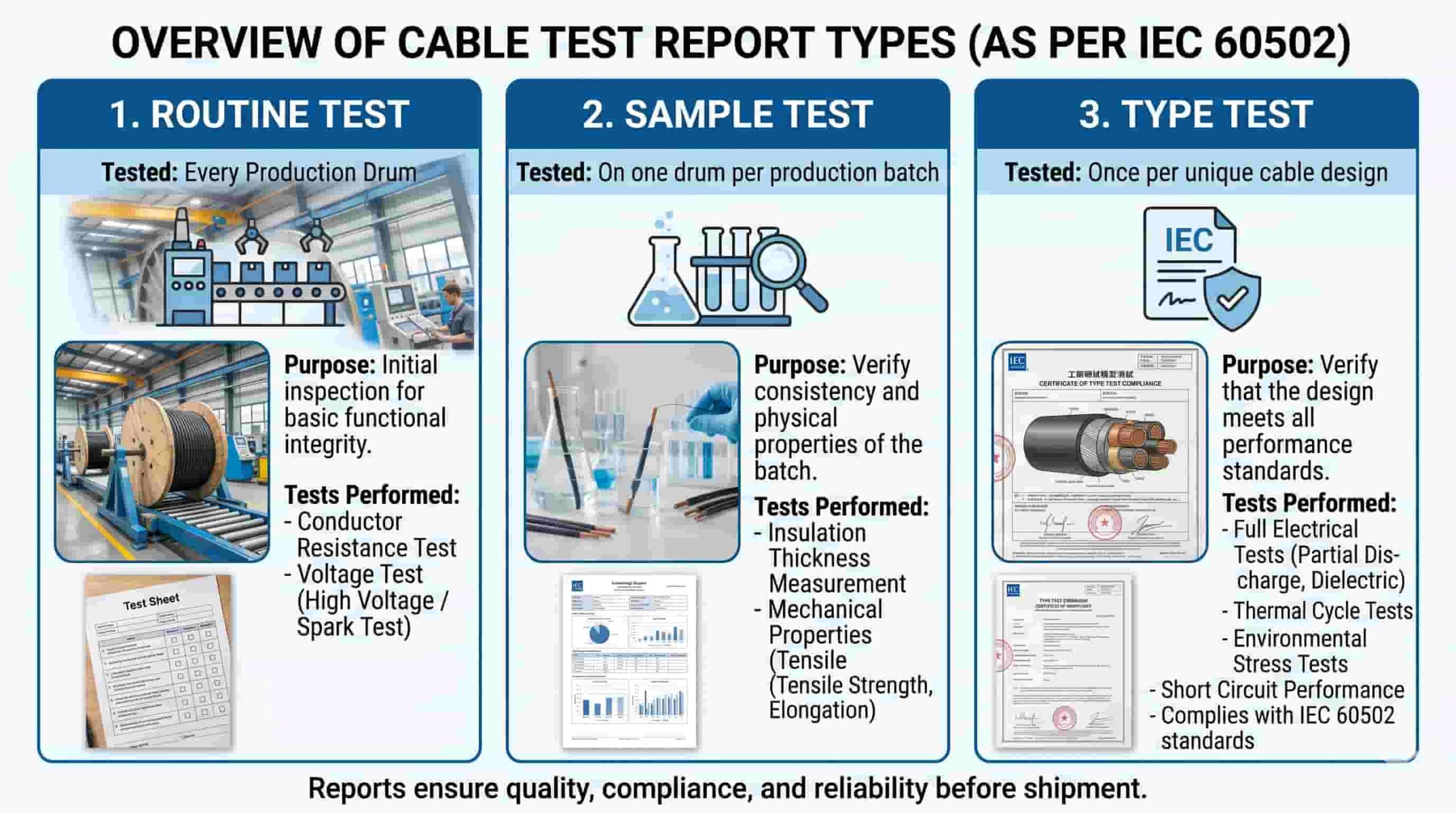
Test Type Frequency What It Covers Who Issues It
Routine TestEvery drum / coilConductor resistance, high-voltage test, insulation resistance — confirms no manufacturing defects on individual lengthsFactory (internal)
Sample TestPer production batchInsulation thickness, conductor dimensions, mechanical properties — verifies that the batch meets dimensional and material requirementsFactory or third-party lab
Type TestPer cable design (not per order)Full IEC/BS standard compliance — bending, thermal aging, flame retardance, water penetration, electrical performance over lifeAccredited third-party laboratory (CNAS / ILAC)
Third-Party Inspection ReportPer shipment (buyer-requested)Independent verification of dimensions, weight, drum marking, and electrical tests on samples from the actual shipmentSGS / Bureau Veritas / Intertek

For B2B procurement, the minimum documentation to request with each shipment is:

  • Routine test report for each drum (conductor resistance, voltage test, insulation resistance)
  • Certificate of conformance stating the cable was manufactured to the specified standard
  • Packing list showing drum numbers, cable lengths, and net/gross weights
  • Material test certificate for copper conductor (where specified)


For higher-value or project-critical orders, additionally request:

  • Third-party inspection report from SGS, BV, or Intertek covering dimensional checks and electrical tests on samples from the shipment
  • Type test report from an accredited laboratory confirming the cable design meets the full requirements of the specified standard


Key Point: A factory-issued test report and a third-party test report are not equivalent. Factory routine test reports confirm that basic electrical tests were performed — they do not independently verify the results. For specification-critical or large-volume orders, third-party inspection at the factory before shipment is the most effective quality control investment a buyer can make.


Step 5: Price Comparison — What Affects Cable Pricing from China

Cable pricing from Chinese manufacturers is primarily driven by copper or aluminum commodity prices, which fluctuate with the London Metal Exchange (LME). When comparing quotations, it is important to understand the pricing components:

Price Component What to Verify Impact on Quality / Cost
Copper / aluminum conductorConductor purity (99.9% Cu minimum), cross-section toleranceLargest cost driver; lower purity reduces conductivity
Insulation materialXLPE grade, insulation wall thickness to standard (not minimum)Reduced thickness lowers cost but compromises voltage performance
Armoring (SWA)Steel wire diameter and coverage to IEC specificationLighter armoring reduces mechanical protection and overall weight
Outer sheathPVC compound grade, sheath thickness to standardLower-grade PVC affects UV and chemical resistance
Drum and packagingISPM 15 compliance, drum dimensions, standard drum lengthsNon-compliant drums cause customs delays at destination
Certification / test reportsIncluded in quotation or separately pricedThird-party inspection cost is typically 0.3–1% of order value

When comparing quotations from multiple suppliers for the same specification, the most common sources of price difference are:

  • Conductor purity: standard commercial-grade copper (99.9% Cu) vs. oxygen-free copper (OFC) — confirm which is quoted
  • Insulation wall thickness: some suppliers quote to the minimum permissible wall thickness under the standard; confirm the nominal thickness is to standard, not reduced
  • Drum length: shorter drums per the same total quantity increase per-meter cost and may create more site waste — confirm standard drum lengths
  • Armoring wire diameter: SWA wire gauge affects both mechanical performance and weight — confirm to standard


Tip: Request that all suppliers quote against the same specification document. If you allow suppliers to quote ‘equivalent’ products, you will receive prices for different cables that are not directly comparable. A locked specification — listing standard, voltage grade, conductor, insulation, armoring, and drum length — is the only basis for a valid price comparison.


Step 6: Packaging, Shipping, and Lead Time

Cable exported from China is supplied on wooden or steel drums, or in coils for smaller cross-sections and shorter lengths. The packaging specification affects both shipping cost and site usability.Illustration of cable export packaging options: wooden drum, steel drum, and coil packaging for different cable sizes and quantities
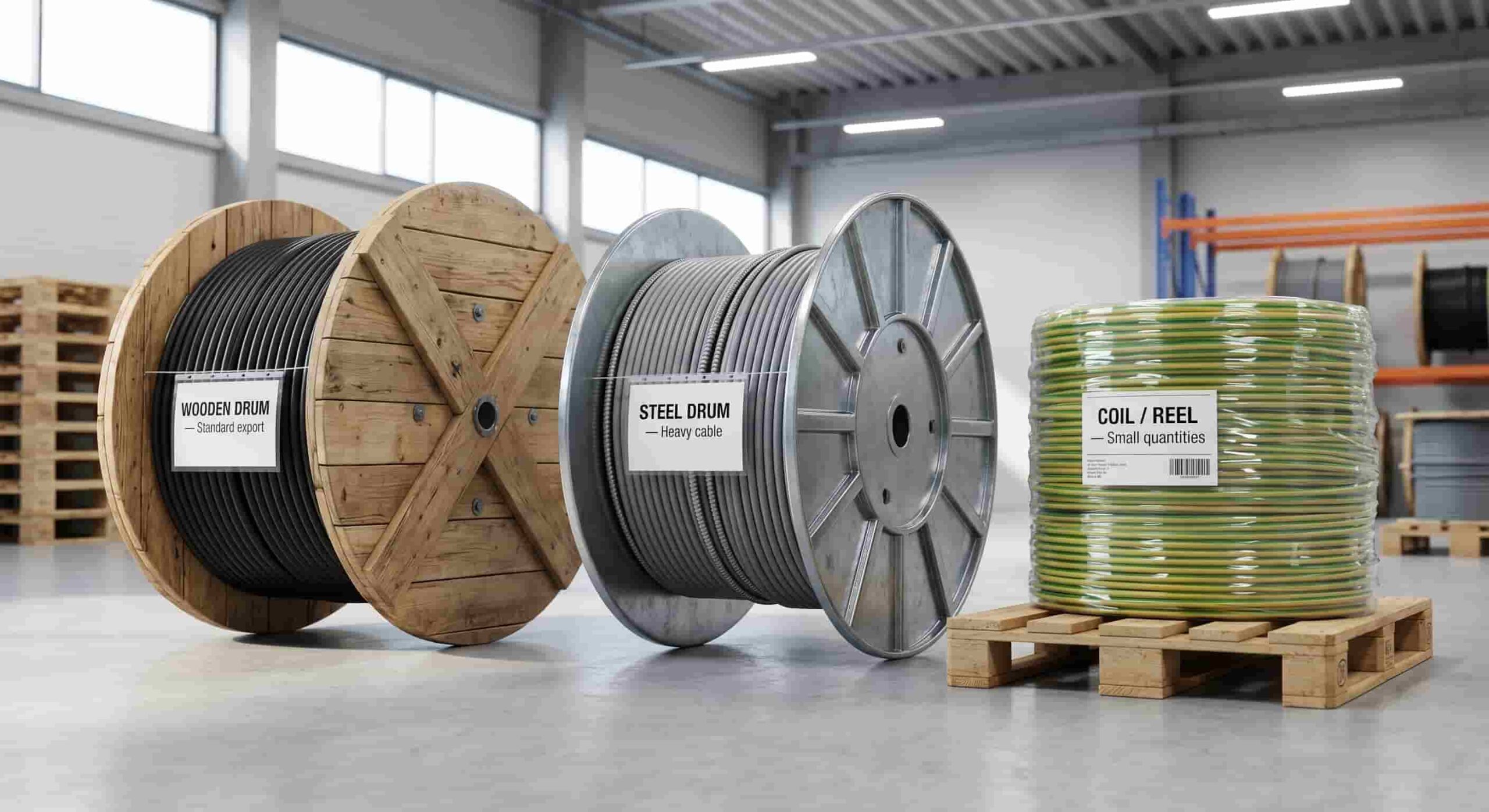
Drum types

  • Wooden drums: standard for most export cable, available in a range of flange diameters. Confirm drum dimensions if container space is constrained.
  • Steel drums: used for heavier cables where drum rigidity is required. Higher packaging cost but reusable.
  • Coils / plastic reels: used for smaller cross-section cables in shorter lengths. Lower cost but not suitable for site pulling of long runs.


Shipping considerations

  • 20ft container: typically accommodates 4–8 large cable drums depending on drum diameter and height
  • 40ft container: standard for larger cable orders with multiple drum sizes
  • LCL (less than container load): available for small orders but higher per-unit freight cost and greater handling risk for drums
  • Lead time from Chinese cable manufacturers: typically 15–35 working days for standard products; 45–60 days for non-standard or large-diameter MV cables


Note: Wooden cable drums are classified as wood packaging material (WPM) and must be ISPM 15 heat-treated and marked for import into most countries including Australia, the EU, and the US. Confirm with your supplier that drums carry the IPPC stamp before shipment.


Step 7: Export Documentation Checklist

A complete cable shipment from China should be accompanied by the following documents:

Document Purpose Issued By
Commercial InvoiceCustoms valuation and clearanceSupplier
Packing ListDrum-by-drum breakdown of cable lengths, weights, and marksSupplier
Bill of Lading (B/L)Proof of shipment and title transfer documentShipping line
Certificate of OriginConfirms product is made in China for customs duty purposesChina Council for Promotion of International Trade (CCPIT)
Routine Test ReportPer-drum electrical test resultsFactory
Certificate of ConformanceConfirms cable was manufactured to the specified standardFactory
ISPM 15 Phytosanitary CertificateConfirms wooden drum heat treatment for WPM import complianceChinese inspection authority (IPPC stamp on drum)
Third-Party Inspection Report (optional)Independent pre-shipment quality verificationSGS / Bureau Veritas / Intertek

For certain destination markets, additional documentation may be required — country of origin certificate (Form E for ASEAN FTA, EUR.1 for EU preferential tariff), SABER or SASO certification for Saudi Arabia, or Standards Mark certification for some Australian utility projects. Confirm destination-specific requirements with your freight forwarder or customs broker before placing the order.


Common Sourcing Mistakes and How to Avoid Them

Based on recurring issues in B2B cable procurement from China, the following errors are worth specific attention:

  • Specifying only a product name without a standard: results in price comparison of non-equivalent products
  • Accepting a factory test report as equivalent to third-party verification: routine test results are not independently verified
  • Not confirming ISPM 15 compliance for wooden drums: can result in quarantine hold or fumigation costs at destination port
  • Ordering without a pre-production sample for new suppliers: first-article inspection at the factory prevents full-batch quality issues
  • Comparing prices without locking conductor purity and insulation thickness: the cheapest quote is often the one with the thinnest insulation or lower-grade conductor
  • Not confirming export license or product certification validity: some certifications are issued at factory level and may not cover the specific cable type being ordered


Quotation Requirements

RichingPower manufactures and exports industrial power cables for B2B project and volume supply. To receive an accurate quotation, please provide:

  • Cable type, voltage grade (U0/U format), and applicable standard
  • Number of cores, conductor material, and cross-sectional area (mm²)
  • Insulation type, armoring requirement, and outer sheath specification
  • Total quantity (meters) and preferred drum lengths
  • Delivery destination, Incoterms, and target delivery date
  • Any certification or third-party inspection requirements


Submit your cable specification via the RichingPower contact page. For project orders involving multiple cable types, attaching a cable schedule in spreadsheet format allows us to provide a comprehensive, itemized quotation.


Conclusion

Sourcing industrial cables from China is straightforward for buyers who approach the process with a complete specification, a structured supplier evaluation, and a clear understanding of the quality documentation required. The most effective procurement outcomes come from treating the specification as the fixed reference point — not a negotiable variable — and verifying quality through a combination of factory documentation and independent inspection for orders where specification compliance is critical.

Chinese cable manufacturers supply a significant share of global industrial cable demand reliably and at competitive cost. The buyers who experience the fewest supply issues are those who invest time in the specification and supplier evaluation stages rather than optimizing exclusively on price.

View RichingPower’s industrial power cable range, or contact us with your cable schedule for a project quotation.

Frequently Asked Questions

QWhat information do I need to get a cable quotation from China?
+
AA complete cable specification should include: voltage grade (U0/U format), number of cores, conductor material (Cu or Al), cross-sectional area (mm²), insulation type (XLPE or PVC), armoring requirement, applicable standard (IEC, BS, AS/NZS), total quantity in meters, drum length preference, delivery destination, and Incoterms. Without a complete specification, suppliers cannot provide comparable or accurate quotations.
QHow do I verify cable quality from a Chinese manufacturer?
+
AQuality verification for cables from China involves three layers: factory routine test reports for every drum (conductor resistance, voltage test), sample tests per batch confirming dimensional compliance, and for significant orders, third-party pre-shipment inspection by SGS, Bureau Veritas, or Intertek. Type test reports from an accredited laboratory confirm that the cable design meets the full requirements of the specified standard.
QWhat is ISPM 15 and why does it matter for cable drum shipments?
+
AISPM 15 is an international standard for wood packaging material (WPM) that requires wooden cable drums to be heat-treated and marked with the IPPC stamp before export. Most importing countries — including Australia, the EU, the US, and others — require ISPM 15 compliance. Non-compliant wooden drums can be held at the destination port for fumigation or destroyed, causing significant project delays and additional costs.
QWhy are cable prices different between Chinese suppliers for the same specification?
+
APrice differences for the same nominal specification usually reflect differences in conductor purity, insulation wall thickness, armoring wire gauge, and sheath compound quality. Some suppliers quote to the minimum permissible dimensions under the standard, which reduces material cost but affects long-term performance. Locking a complete specification — including standard, conductor purity, and nominal dimensions — is the only way to compare prices on an equivalent basis.
QWhat is a typical lead time for industrial cable from China?
+
AStandard low-voltage power cables from Chinese manufacturers typically have a lead time of 15–25 working days from order confirmation. Medium voltage or non-standard cables may require 35–60 working days. Add 20–35 days for sea freight depending on the destination port. Always confirm the production lead time with the supplier before committing to a project delivery schedule.
QShould I use a trading company or a manufacturer when sourcing cables from China?
+
AFor project-critical or large-volume cable supply, sourcing directly from a manufacturer is preferred — it provides clearer traceability, easier access to test documentation, and more direct communication on specification and quality issues. Trading companies can be appropriate for small mixed orders where minimum order quantities are a constraint, but buyers should verify the actual production source and confirm that certifications cover the specific cable type being ordered.

Ready to source cables or electrical equipment for your project?

Send your specification below — or message us directly on WhatsApp.


    Leave a Comment

    Your email address will not be published. Required fields are marked *

    Scroll to Top