
Oil and gas projects — upstream wellheads, onshore processing facilities, offshore platforms, FPSOs, and subsea installations — represent one of the most demanding and specification-intensive electrical procurement environments in B2B project supply. The combination of hazardous atmospheres, harsh environmental conditions, and extreme safety consequences of electrical failure means that standard industrial cables are frequently not suitable without significant additional specification requirements.
This guide covers the cable types, classification requirements, key standards, and procurement considerations for B2B buyers sourcing power and instrumentation cables for oil and gas projects from Chinese manufacturers.
Oil and Gas Electrical Environment: What Makes It Different
The oil and gas industry imposes requirements on electrical cables that go beyond those of standard industrial applications. The primary drivers are: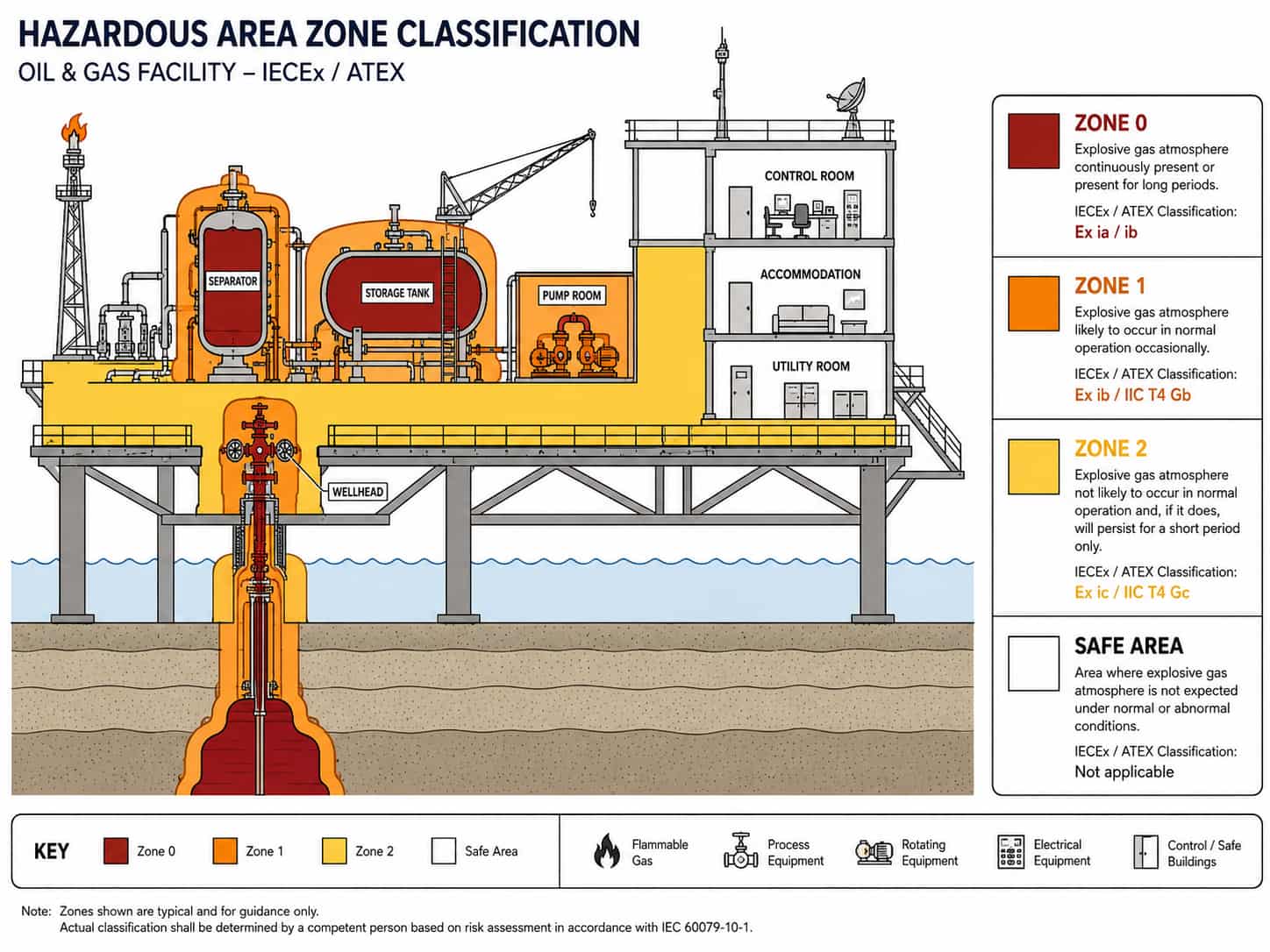
Hazardous Atmospheres
Hydrocarbon gases, vapors, and mists can be present in process areas of oil and gas facilities. An ignition source — including an electrical spark or hot surface — in the presence of a flammable atmosphere can cause fire or explosion. This hazard is managed through hazardous area classification, which divides the facility into zones based on the likelihood of flammable atmosphere presence:
- Zone 0: flammable atmosphere present continuously or for long periods — typically inside process vessels, storage tanks, and wellbore assemblies
- Zone 1: flammable atmosphere likely to occur in normal operation — wellhead areas, pump rooms, areas surrounding flanged pipe connections with potential for leakage
- Zone 2: flammable atmosphere unlikely to occur in normal operation but may occur in abnormal conditions — general production deck, areas downwind of Zone 1
- Safe area (non-hazardous): control rooms, administration buildings, accommodation — no flammable atmosphere under any normal condition
Electrical equipment and cables installed in Zone 0, Zone 1, and Zone 2 areas must be selected, installed, and certified to prevent them from becoming ignition sources. This certification is covered by ATEX (Europe) and IECEx (international) standards.
Key Point: Cable in hazardous areas must be selected in conjunction with the hazardous area classification drawing (also called the area classification drawing or Ex zone drawing). This drawing is produced by the process safety engineer and defines the zone boundaries for every area of the facility. Never specify cables for a hazardous area without reference to this drawing.
Harsh Environmental Conditions
Oil and gas installations — particularly offshore platforms, FPSOs, and onshore desert or arctic locations — impose environmental stresses on cables that exceed standard industrial specifications:
- Hydrocarbon exposure: crude oil, condensate, drilling mud, hydraulic fluid, and process chemicals can attack standard PVC cable sheaths
- Seawater exposure: offshore cables on deck and in splash zones are subject to salt spray and periodic immersion
- UV radiation: tropical or desert locations with high UV index degrade standard PVC sheaths over time
- Temperature extremes: arctic upstream locations may require cables rated to -40°C or lower; process areas near fired equipment may reach elevated ambient temperatures
- Mechanical damage: cables on production decks are subject to impact from equipment, dropped objects, and heavy maintenance traffic
Fire Safety Requirements
Fire is the most severe safety risk on an offshore platform or onshore process facility. Cables that propagate flame or emit toxic smoke during a fire can accelerate the spread of fire and impede evacuation. For this reason, LSZH (Low Smoke Zero Halogen) cables are mandatory throughout enclosed and occupied areas of oil and gas facilities, and fire-resistant cables are required for circuits that must maintain operation during a fire — emergency lighting, fire detection, emergency shutdown systems, and bilge pump circuits on offshore vessels.
ATEX and IECEx: The Certification Framework for Hazardous Areas
Equipment used in hazardous areas must be certified to demonstrate it will not ignite a flammable atmosphere under normal or defined fault conditions. Two parallel certification frameworks apply:
- ATEX (ATmosphères EXplosibles): the European hazardous area certification framework, mandatory for equipment used in EU countries and widely specified in projects following European engineering standards
- IECEx: the international hazardous area certification scheme, managed by the IEC and accepted in most international oil and gas markets outside Europe
For cables in hazardous areas, the primary certification concern is the cable gland — the mechanical seal at the point where the cable enters the electrical equipment enclosure. The cable itself does not typically require ATEX or IECEx certification, but the cable gland must be certified for the zone and protection concept of the enclosure it is used with.
Note: While the cable itself does not carry ATEX/IECEx certification in most cases, the cable construction must be compatible with the certified gland — specifically the cable outer diameter, armor type, and sheath hardness. Confirm cable outer diameter tolerance with the supplier and verify compatibility with the gland manufacturer before ordering. A cable with an oversized or undersized outer diameter will not form a correct seal in the gland.
Intrinsically Safe (IS) Circuits
In Zone 0 and Zone 1 areas, instrumentation circuits are often protected using intrinsic safety (Ex i) — a protection concept that limits the energy available in the circuit to below the ignition energy of the target gas group. IS circuits require:
- Individually screened pairs of instrumentation cable — the screen prevents capacitive coupling between IS and non-IS circuits
- Blue outer sheath for IS cable — this is a mandatory color coding convention under IEC 60079-14 to identify IS circuits during installation and maintenance
- Maximum cable capacitance and inductance specified by the IS barrier or isolator manufacturer — the cable must be short enough or of a small enough cross-section to stay within these limits
- Segregation from non-IS cable runs — IS cable cannot be run in the same tray as non-IS power cables without a physical barrier
Cable Types for Oil and Gas Applications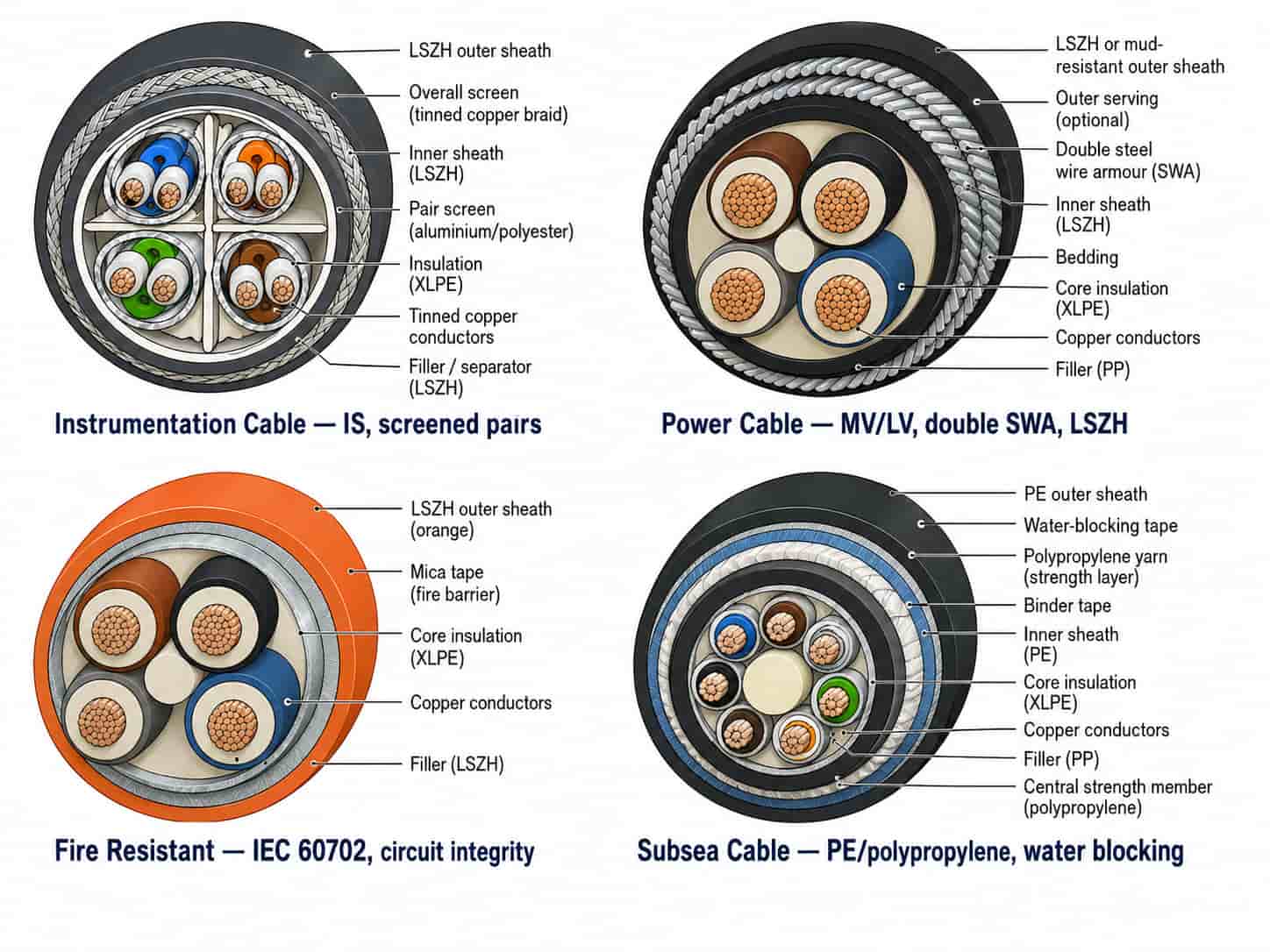
LV and MV Power Cables
The base power cable specification for onshore upstream facilities typically references IEC 60502-1 (LV) or IEC 60502-2 (MV) with the following additional requirements:
- LSZH inner sheath and outer sheath — mandatory in all enclosed or occupied areas
- Double steel wire armoring (DSWA) — two layers of SWA applied in opposite directions, providing higher mechanical protection than single SWA for exposed outdoor runs and for cables that may be subject to hydrocarbon contamination
- Mud and hydrocarbon-resistant outer sheath compound — standard PVC ST2 compound is not resistant to crude oil, drilling mud, or hydraulic fluid. Specify a thermoplastic elastomer (TPE) or modified PVC compound rated for hydrocarbon exposure
- Temperature range: -40°C to +90°C continuous for arctic and tropical applications — confirm with the manufacturer that the sheath compound maintains flexibility at the minimum installation temperature
Instrumentation and Control Cables
Instrumentation cables for oil and gas carry 4–20mA analogue signals, thermocouple signals, HART communications, and foundation fieldbus or PROFIBUS signals between field instruments and the control room or DCS:
- Individually screened pairs (IS): each signal pair has its own foil or braid screen with drain wire — prevents crosstalk between channels
- Overall screen: a second screen over all pairs — provides additional EMI protection for the cable bundle
- Blue outer sheath for IS circuits — mandatory color code for intrinsically safe instrumentation cable
- LSZH sheath compound throughout — mandatory for enclosed process areas
- Operating temperature range confirmed for installation location
- For multi-pair cables: confirm the number of pairs, pair cross-section (0.5mm² or 1.5mm² typically), and whether triplexed (3-wire) or paired (2-wire) construction is required
Fire-Resistant Cables
Fire-resistant (FR) cables maintain circuit integrity during a fire — they continue to function after exposure to fire that would destroy a standard cable. FR cables are mandatory for:
- Emergency shutdown (ESD) system cables — the ESD system must operate during a fire to initiate safe shutdown
- Fire and gas detection system cables — the detection system must function to alert personnel and activate suppression
- Emergency lighting cables — evacuation lighting must remain powered during a fire
- Deluge and fire suppression system cables — the suppression system must be energized when needed
Oil and gas fire-resistant cables typically reference:
- IEC 60702-1 (mineral insulated cable) — highest fire resistance, maintains circuit integrity at 950°C for 3 hours with mechanical impact
- IEC 60331-series (enhanced fire performance cable with XLPE insulation and mica tape) — circuit integrity at 750°C for 90 minutes, used where full mineral-insulated cable is not required
- BS 7629 (fire resistant cable to British Standard) — used on UK-specification projects
Key Point: Fire-resistant cable and flame-retardant cable are fundamentally different products. A flame-retardant cable (to IEC 60332-3) resists the propagation of fire along its length but will lose circuit function once directly exposed to flame. A fire-resistant cable maintains circuit function during and after direct flame exposure. For emergency systems in oil and gas facilities, fire-resistant cable is always required — flame-retardant alone is not sufficient.
Subsea and Umbilical Cables
Subsea cables and umbilicals supply power, control signals, hydraulics, and chemicals from a topside installation to subsea wellheads and manifolds. These are highly specialist products:
- Outer sheath: polyethylene (PE) or polypropylene — resistant to seawater at depth, UV-stabilized for surface sections
- Armor: typically two layers of galvanized steel wire (double SWA) or stainless steel wire for corrosive seawater environments
- Water blocking: water-blocking tape or filling compound in all interstices to prevent seawater ingress if the outer sheath is breached
- Pressure rating: subsea cables must withstand hydrostatic pressure at installation depth — confirm rated depth with the manufacturer
- Bend stiffener and bend restrictor compatibility: subsea dynamic cables require specific outer sheath stiffness characteristics to interface correctly with the bend management system
Offshore vs Onshore Upstream: Key Differences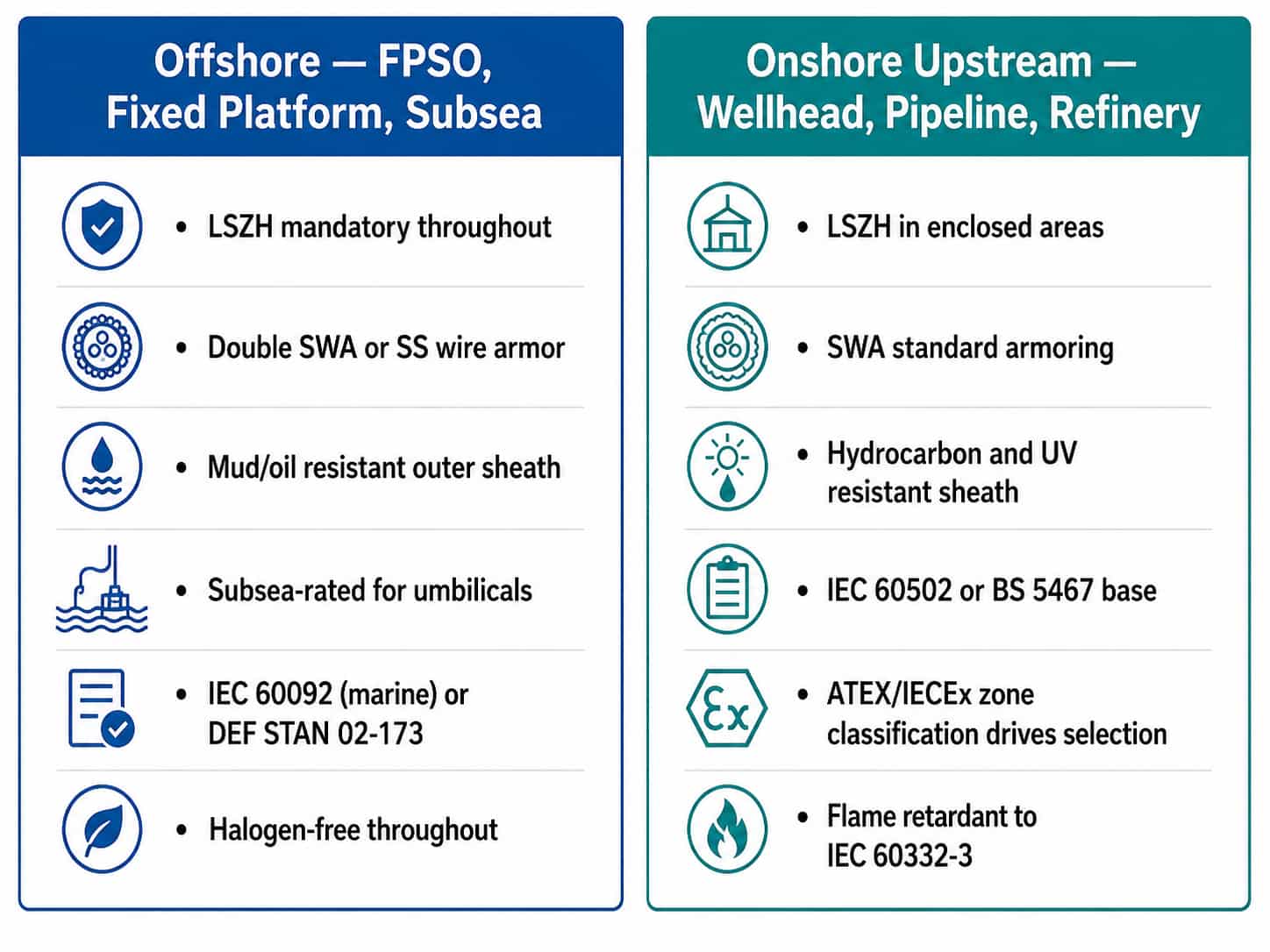
LSZH in Oil and Gas: What Is Required
LSZH (Low Smoke Zero Halogen) cable is not simply a preference in oil and gas projects — it is a mandatory requirement in most enclosed and occupied areas. The rationale is straightforward: in a fire on a confined offshore platform or onshore control building, smoke from burning PVC cable can incapacitate personnel before they can evacuate, and hydrochloric acid released from burning PVC corrodes equipment and impairs survival systems.
Key LSZH requirements to specify:
- IEC 60754-1/2: test for acid gas generation — measures the quantity and corrosivity of gas emitted when the cable sheath burns
- IEC 61034-1/2: measurement of smoke density — measures the opacity of smoke produced during combustion
- IEC 60332-3: flame propagation in a bundle — confirms the cable does not propagate flame along a tray installation
- EN 50267 (for European projects): similar to IEC 60754 for acid gas, used on projects following CENELEC standards
Oil and gas project specifications typically require all three properties simultaneously: low acid gas (IEC 60754), low smoke (IEC 61034), and flame retardant (IEC 60332-3). A cable marketed as ‘LSZH’ should have test reports confirming all three. Request the test reports — not just the marketing claim.
Tip: Ask suppliers to confirm which specific LSZH compound is used in the sheath — different LSZH compounds have different performance characteristics at low temperatures and in hydrocarbon contact. For offshore applications in cold climates, confirm that the LSZH sheath compound remains flexible at the minimum installation temperature specified in the project datasheet.
Oil and Gas Cable Procurement Checklist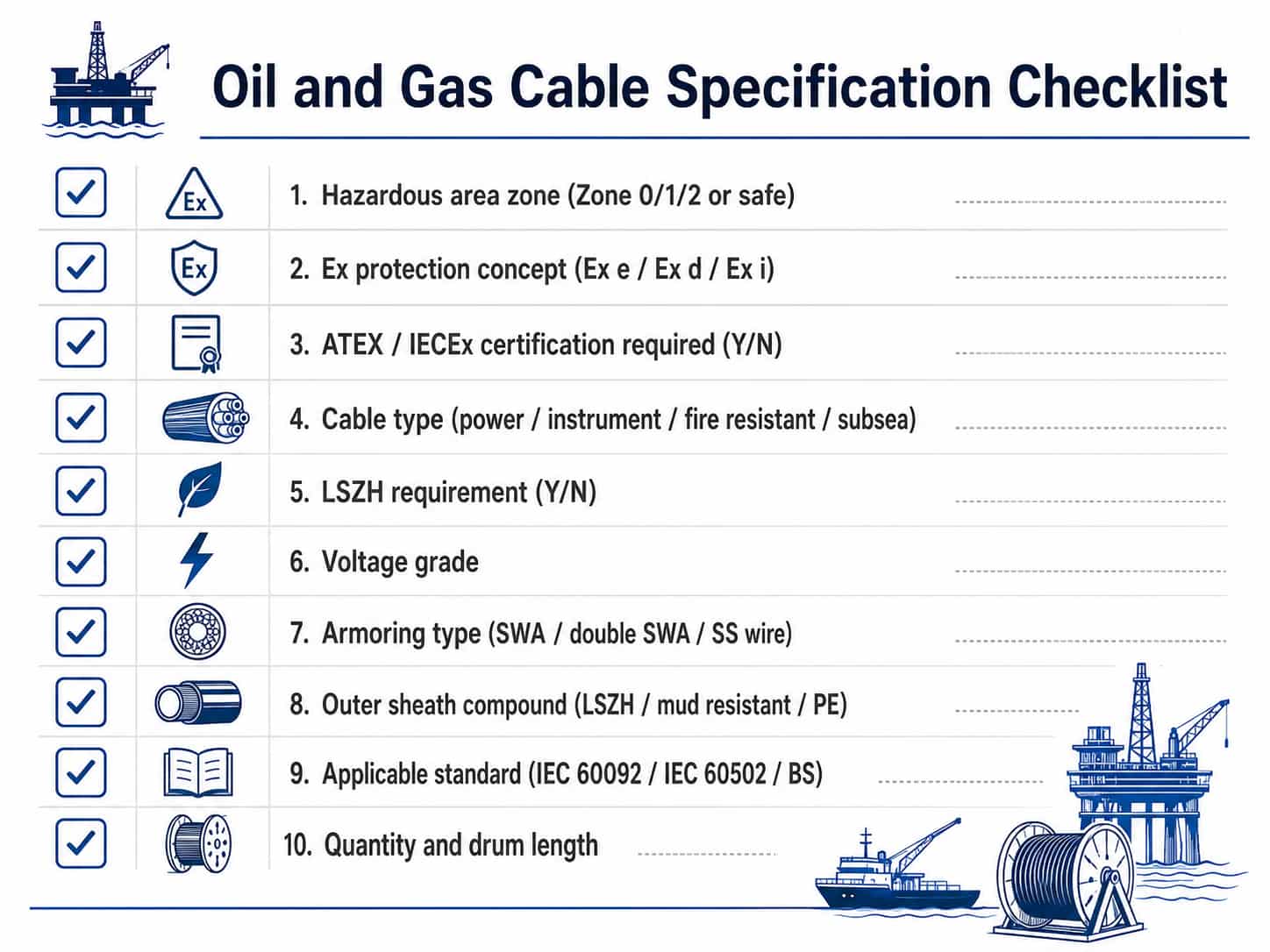
When preparing a cable inquiry for an oil and gas project, include the following information to receive an accurate and specification-matched quotation:
- Project type: onshore upstream, offshore fixed platform, FPSO, subsea, or refinery/LNG
- Hazardous area zone for each cable run (Zone 0, 1, 2, or safe area) — from area classification drawing
- ATEX or IECEx certification required for equipment (confirm whether cable gland cert is needed)
- Cable type: power (LV or MV), instrumentation (IS or non-IS), fire-resistant, or subsea
- Voltage grade and number of cores (for power cables), or number of pairs/triads (for instrument cables)
- Conductor cross-section (mm²) or signal type (for instrument cables)
- Armoring requirement: single SWA, double SWA (DSWA), stainless steel wire, or AWA
- Outer sheath compound: LSZH, mud/hydrocarbon-resistant, PE (subsea), or standard PVC
- LSZH test requirements: IEC 60754, IEC 61034, IEC 60332-3 — confirm all three
- Fire resistance requirement: IEC 60702-1 (MI), IEC 60331, or BS 7629
- Applicable standard: IEC 60092 (marine/offshore), IEC 60502 (onshore), BS 5467, or other
- Classification society type approval required: Lloyd’s, DNV, BV, ABS — and class notation
- Operating temperature range (minimum and maximum) at installation location
- Total quantity (meters), drum length, and delivery destination
Quotation Requirements
RichingPower supplies power cables, instrumentation cables, fire-resistant cables, and LSZH cables for oil and gas upstream and offshore projects. To receive a technically accurate quotation, please provide:
- Project type and installation environment (onshore upstream, offshore platform, FPSO, subsea)
- Hazardous area zone classification for the cable runs being specified
- Cable type, voltage grade, core count, and cross-section
- LSZH requirement with applicable test standards
- Fire resistance requirement if applicable
- Armoring type and outer sheath compound specification
- Applicable standard and any classification society requirements
- Quantity, drum length, and delivery destination
Submit your oil and gas cable specification via the RichingPower contact page. For projects with a full cable schedule or material requisition, attaching the document allows our team to review all cable types and provide a comprehensive itemized quotation.
Conclusion
Oil and gas cable procurement is more technically demanding than standard industrial cable supply because it combines multiple overlay requirements: hazardous area zone classification, ATEX/IECEx compatibility, LSZH fire performance, hydrocarbon-resistant sheathing, and in offshore applications, marine classification society approval. Each requirement must be addressed in the cable specification — and each must be verified through appropriate test documentation.
The most effective approach for B2B buyers is to build the cable specification directly from the project’s area classification drawings, fire and safety philosophy document, and equipment datasheets — not from a general standard reference. The project documents define exactly which requirements apply to each cable run, which removes ambiguity and enables accurate quotation from suppliers.
For guidance on ATEX and hazardous area requirements in industrial plants, see Industrial Plant Power Supply: Complete Electrical Procurement Guide. For fire-resistant and LSZH cable requirements in data centers and enclosed buildings, see
Data Center Power Infrastructure: Cable and Electrical Supply Checklist. Contact RichingPower with your oil and gas project specification for a technical review and quotation.