LSZH — Low Smoke Zero Halogen — appears on an increasing proportion of B2B cable specifications, particularly for data centers, offshore platforms, tunnels, marine vessels, and enclosed industrial buildings. For buyers who encounter this requirement in a project specification, understanding what it means technically, how it is tested, and how to verify it from a Chinese manufacturer is essential for compliant procurement.
This guide explains what LSZH is, what the three key test standards measure, where LSZH is mandatory versus recommended, how LSZH differs from standard flame-retardant PVC cable, and what to specify and request from your supplier to ensure genuine compliance.
What Does LSZH Mean?
LSZH stands for Low Smoke Zero Halogen. It describes a cable sheath and insulation compound that, when exposed to fire, produces:
- Low smoke: the material generates significantly less smoke than standard PVC, maintaining better visibility in enclosed spaces during a fire — allowing personnel to evacuate and firefighters to navigate
- Zero halogen: the material contains no halogenic elements (chlorine, bromine, fluorine, iodine) in its polymer chemistry — when burned, it does not release halogenic acid gases such as hydrogen chloride (HCl)
Standard PVC cable sheath contains approximately 25–30% chlorine by weight. When PVC burns, it releases HCl gas, which is toxic when inhaled and highly corrosive to electronic equipment, switchgear, and structural metals. In a confined space fire such as a cable room, data center, offshore platform, or tunnel, the combination of dense black smoke and HCl gas from burning PVC cables creates conditions that can incapacitate personnel before they can evacuate and can cause equipment damage that extends far beyond the fire zone itself.
Key Point: LSZH is not a single material — it is a performance specification that defines how the cable material behaves during and after a fire. Multiple polymer chemistries can meet LSZH requirements, including cross-linked polyolefin (XLPO), thermoplastic polyolefin (TPO), ethylene-vinyl acetate (EVA) compounds, and others. The LSZH designation means the material passes the three key test standards for smoke density, halogen content, and flame propagation.
Why PVC Cable Is Not Acceptable in Enclosed Spaces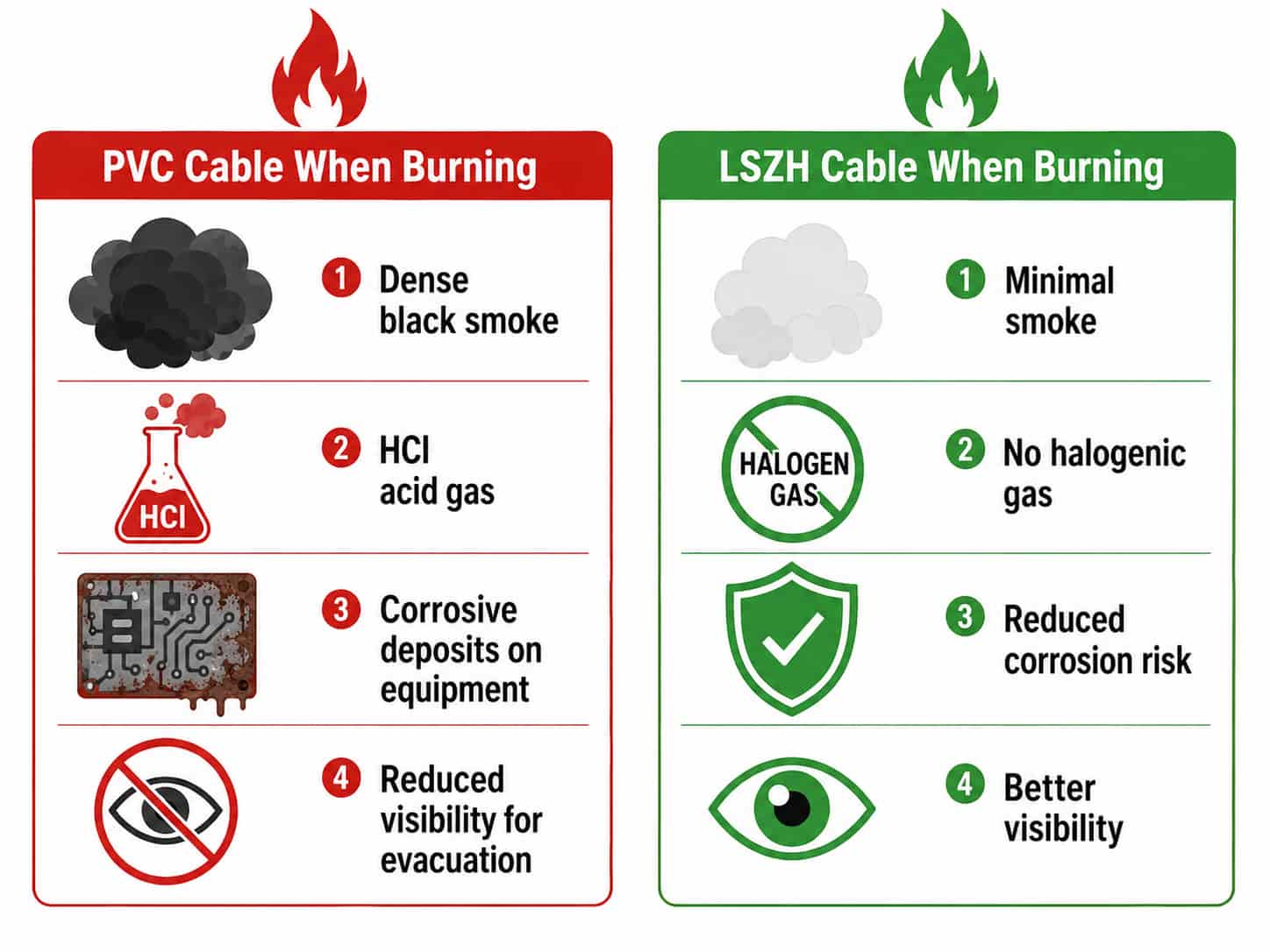
The case for LSZH over PVC in enclosed installations is not just regulatory — it is based on the documented consequences of PVC cable fires in confined spaces:
Smoke Density
Standard PVC cable produces very dense black smoke when burning. In a cable room or data center fire, smoke from a single cable tray can reduce visibility to near zero within minutes. Dense smoke is the primary cause of occupant incapacitation and death in building fires — not direct flame exposure. LSZH materials produce significantly less smoke, and the smoke that is produced is lighter in color, maintaining better visibility for evacuation.
Halogenic Acid Gas
HCl gas released by burning PVC is toxic at concentrations above approximately 5 parts per million (ppm) — concentrations in a cable room fire can reach hundreds of ppm within the first minutes. HCl is also hygroscopic — it combines with moisture in the air to form hydrochloric acid mist, which deposits on electronic equipment, printed circuit boards, switchgear contacts, and structural metals. The corrosion damage from a PVC cable fire often extends to equipment far from the fire zone and can write off an entire data center, control room, or switchgear building even when the fire itself was small and quickly extinguished.
The Cost Argument for LSZH
LSZH cables cost 15–30% more than PVC cables of the same electrical specification. In enclosed installations where LSZH is appropriate, this upfront cost is justified by:
- Reduced risk of mass casualty events from smoke and toxic gas inhalation
- Significantly reduced equipment damage from HCl corrosion in the event of a fire
- Lower insurance premiums on facilities with full LSZH cable installation
- Regulatory compliance — LSZH is mandatory, not optional, in many installation types
The Three LSZH Test Standards
LSZH compliance is defined by three separate IEC test standards, each measuring a different fire performance property. A cable that passes all three is correctly described as LSZH. A cable that passes only one or two is not fully LSZH.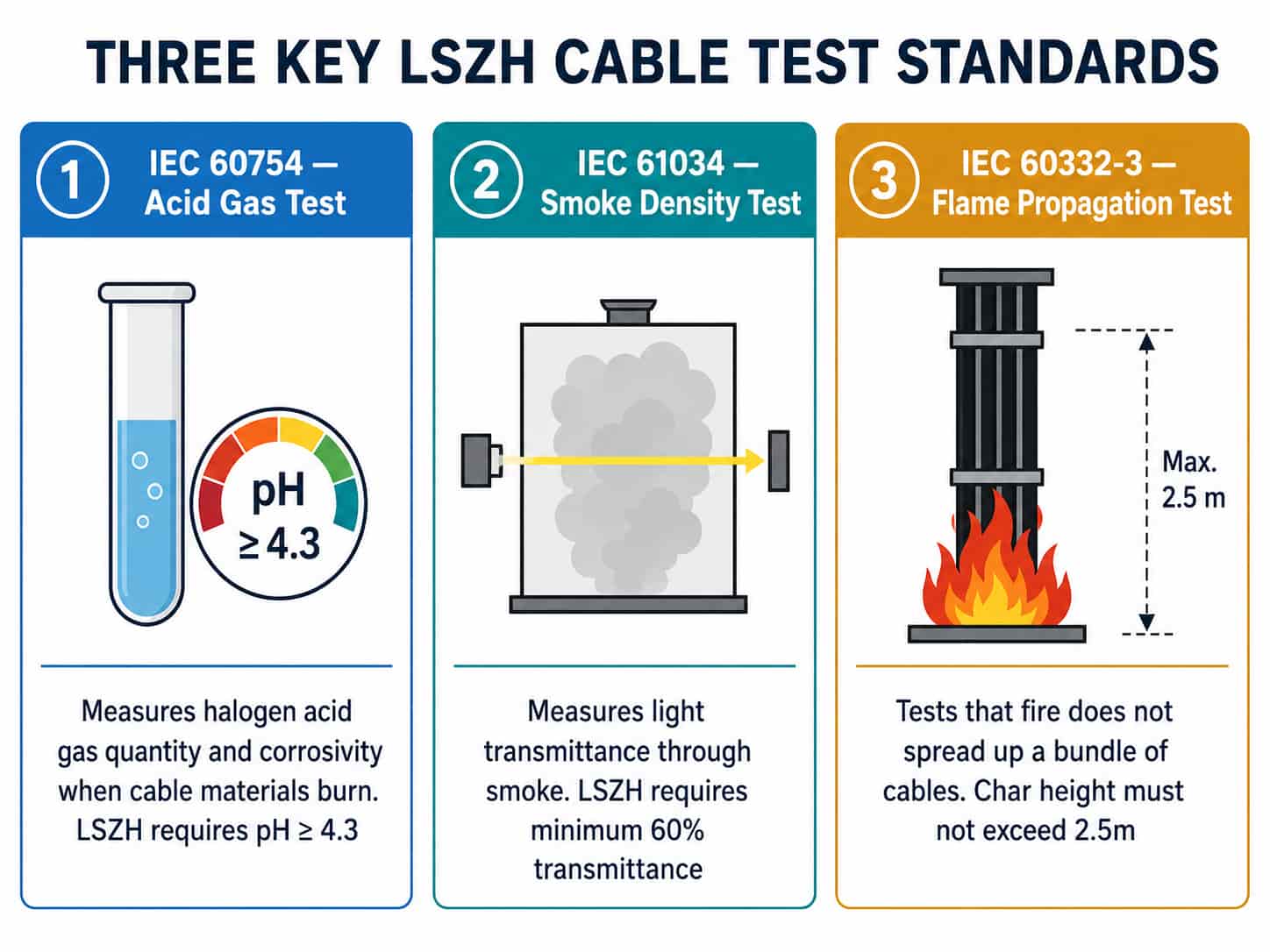
IEC 60754: Acid Gas Emission Test
IEC 60754 measures the quantity and corrosivity of gases emitted when the cable insulation and sheath materials are burned under controlled conditions:
- IEC 60754-1: measures the amount of halogenic acid gas expressed as equivalent hydrogen chloride (HCl) — LSZH materials must produce less than 0.5% HCl by weight
- IEC 60754-2: measures the pH and conductivity of the water solution produced when the combustion gases are absorbed — LSZH requires pH ≥ 4.3 (weakly acidic, as opposed to the pH 1–2 produced by burning PVC)
- Both parts must be passed for genuine LSZH compliance — Part 1 confirms low halogen content, Part 2 confirms the gas is not strongly acidic
Note: Some cable manufacturers market cables as ‘halogen-free’ based on IEC 60754-1 alone (low measured HCl), without testing to IEC 60754-2. A material that produces low HCl but highly acidic gases from other combustion products may still pass Part 1 while failing the corrosivity requirement of Part 2. For full LSZH specification, request test reports for both IEC 60754-1 and IEC 60754-2.
IEC 61034: Smoke Density Test
IEC 61034 measures the opacity of smoke produced when cables are burned in a 3m × 3m × 3m test chamber under controlled conditions:
- IEC 61034-1: specifies the test apparatus and procedure
- IEC 61034-2: defines acceptance criteria — the minimum light transmittance through the smoke must be 60% or above (meaning the smoke must not reduce visibility by more than 40%)
- Standard PVC cables typically produce smoke that reduces light transmittance to below 10% in this test — far below the LSZH requirement
- LSZH materials are formulated to produce smoke that meets or exceeds the 60% transmittance requirement
IEC 60332: Flame Propagation Test
IEC 60332 tests the ability of cable or cable bundle to resist the propagation of flame:
- IEC 60332-1: tests a single cable — the cable is exposed to a flame for 60 seconds and must self-extinguish within 60 seconds, with char height not exceeding 50mm above the flame application point. This is the minimum standard and is met by most FR cables.
- IEC 60332-3: tests a vertical bundle of cables installed on a cable tray, exposed to a flame for 20 minutes — the char height must not exceed 2.5m above the flame application point. This is the test that matters for tray installations in buildings and industrial facilities, where cable bundle density creates conditions very different from a single cable test.
- IEC 60332-3 has sub-categories (Category A, B, C, D) based on the volume of non-metallic material per unit length of cable tray — Category A is most demanding and covers dense cable tray fill with large cables.
Key Point: For most B2B cable specifications in data centers, offshore, and industrial buildings, IEC 60332-3 is the relevant test — not IEC 60332-1. A cable that passes IEC 60332-1 (single cable) may still propagate fire rapidly in a bundle installation. Confirm which IEC 60332 category is specified in the project documents and request the test report for the correct category.
LSZH vs Flame-Retardant PVC: The Critical Distinction
A common source of confusion in B2B cable procurement is the relationship between LSZH and flame-retardant (FR) PVC cable. These are different products with different performance characteristics:
The key distinction: flame-retardant PVC cables resist the propagation of fire but still release HCl gas and dense smoke when burning. In a fire in an enclosed space, FR PVC provides no protection against the smoke and toxic gas hazard to personnel and equipment. LSZH addresses all three hazards — flame propagation, smoke density, and halogenic gas emission.
Key Point: Never substitute FR PVC cable for LSZH cable in an installation where LSZH is specified. The specification requirement is specific to fire performance — a cable that resists flame but still releases toxic smoke and HCl gas does not meet the intent of the LSZH requirement, even if it passes IEC 60332 flame tests.
Where LSZH Is Required: Installation Environments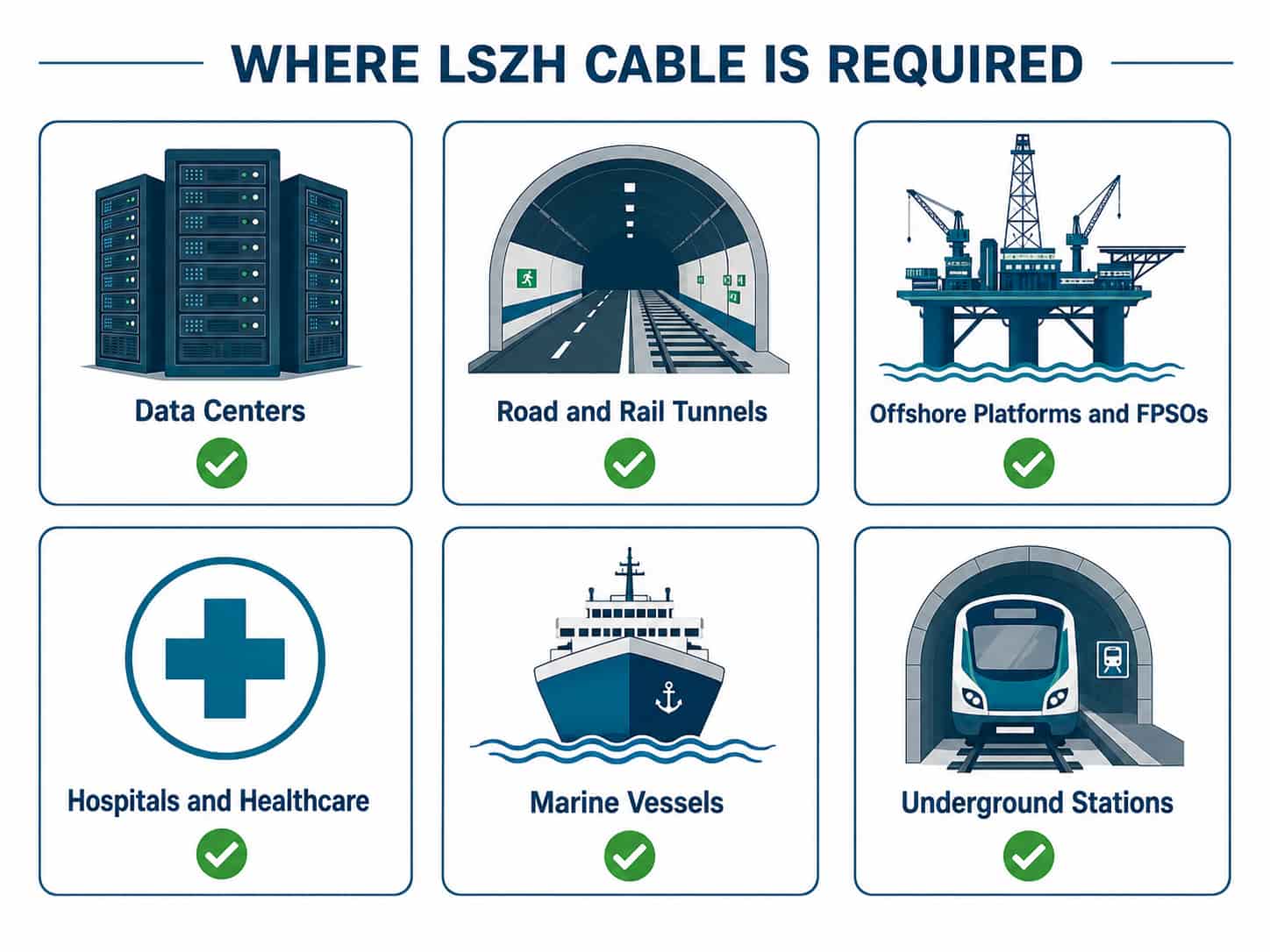
LSZH cable is mandatory or strongly recommended in the following installation types:
Data Centers
Data centers house dense concentrations of cable in enclosed spaces with continuous human occupation during operations. A fire producing HCl gas and dense smoke would incapacitate personnel and cause catastrophic equipment corrosion damage extending far beyond the fire zone. LSZH is the default specification for all cables in data center cable trays, raised floors, and overhead containment — power cables, structured cabling, control cables, and instrument cables.
For the complete data center electrical procurement scope, see Data Center Power Infrastructure: Cable and Electrical Supply Checklist.
Offshore Platforms and FPSOs
Offshore production platforms and FPSOs are floating facilities with limited escape routes where a fire can rapidly become life-threatening. IEC 60092 (the marine electrical standard) mandates LSZH cable throughout all enclosed areas. Classification societies (Lloyd’s, DNV, Bureau Veritas, ABS) require LSZH in their vessel rules for accommodation, control rooms, and machinery spaces.
Road and Rail Tunnels
Tunnels present extreme fire hazards because smoke cannot disperse naturally and evacuation routes are limited to the tunnel itself. LSZH is mandatory for all cables in tunnel installations in most jurisdictions. For high-speed rail tunnels, the standards are even more stringent — some specify EN 50264 or EN 50306 (railway cable standards) which incorporate LSZH requirements.
Underground Stations and Metro Systems
Public transport infrastructure with high passenger density requires LSZH throughout to protect evacuating passengers and emergency responders. Most urban metro and subway systems specify LSZH for all fixed cable installations.
Hospitals and Healthcare Facilities
Hospitals contain patients who cannot self-evacuate, making smoke and toxic gas particularly dangerous. LSZH is typically mandated by national building codes or healthcare facility standards for all internal wiring and cable tray installations.
Marine Vessels
Ships and vessels follow IEC 60092 or flag state regulations which require LSZH (or equivalent) throughout accommodation, control, and machinery spaces. Marine vessels have very limited fire suppression options and confined spaces where smoke and HCl from a cable fire can be lethal.
Enclosed Industrial Buildings
Industrial buildings with enclosed control rooms, cable cellars, marshalling rooms, or UPS rooms — particularly where the building is occupied during normal operations — increasingly specify LSZH for all cables in those enclosed areas, even where the rest of the plant uses standard PVC. Confirm project requirements with the electrical design engineer.
Where PVC Cable Remains Acceptable
Standard PVC-insulated and sheathed cable remains appropriate in:
- Outdoor installations without enclosed spaces — open cable tray on outdoor structures, buried cables in conduit or direct burial
- Industrial plant areas that are not enclosed — open-air process areas, outdoor switchyards, outdoor equipment connections
- Temporary installations with defined short service life
- Installations where the project specification explicitly permits PVC and no fire safety override applies
The practical boundary is enclosure: cables in enclosed, occupied spaces where fire products cannot disperse freely should be LSZH. Cables in open outdoor environments where smoke and gas can disperse are generally acceptable in PVC. When in doubt about whether a specific installation area requires LSZH, consult the project’s fire and safety philosophy document or seek confirmation from the design engineer.
LSZH in Practice: What to Specify and Verify
When specifying LSZH cable, the specification must be precise — ‘LSZH cable’ alone is not a complete specification. The following elements must be defined:
Which Layers Must Be LSZH
In a power cable with XLPE insulation and PVC sheath, the insulation and sheath are separate layers with separate material specifications. LSZH can apply to:
- Outer sheath only: the most common specification — XLPE insulation (standard) with LSZH outer sheath. This limits HCl emission from the sheath material but XLPE insulation does not emit HCl in any case.
- Both insulation and sheath LSZH: required in some high-specification projects — all polymer materials in the cable must be halogen-free and low-smoke. This typically means using cross-linked polyolefin (XLPO) insulation rather than XLPE.
- For power cables, ‘XLPE insulation + LSZH sheath’ is the most common combination and is what most project specifications mean when they require ‘XLPE/LSZH power cable’.
Test Standard References
The specification should reference the specific test standards required:
- IEC 60754-1 and IEC 60754-2: acid gas emission — confirm both parts
- IEC 61034-1 and IEC 61034-2: smoke density — confirm both parts
- IEC 60332-3 Category A, B, or C: flame propagation — confirm the category applicable to the cable tray fill density in the installation
What to Request from the Supplier
- Type test reports for all three LSZH standards — from an accredited third-party laboratory (CNAS or ILAC member)
- Confirmation of which cable layers are LSZH (sheath only, or both insulation and sheath)
- The specific LSZH compound used in the sheath — some compounds have better low-temperature flexibility or chemical resistance than others
- Routine test confirmation: LSZH sheath compounds can vary in quality between production batches — some manufacturers conduct batch-level material testing to confirm consistency
Key Point: A manufacturer’s declaration that a cable is ‘LSZH’ without supporting test reports is not adequate for project compliance. Test reports must reference the specific cable construction (not a similar cable from the same product range) and must be issued by an accredited laboratory. For high-value or safety-critical projects, consider commissioning an independent pre-shipment inspection that includes a material sample for LSZH compliance testing.
LSZH and Low-Temperature Performance
One practical limitation of some LSZH compounds compared to standard PVC is reduced flexibility at low temperatures. Standard PVC cable sheaths maintain acceptable flexibility at temperatures down to approximately -10°C to -15°C. Some LSZH compounds become brittle below 0°C — this is a concern for:
- Arctic and sub-arctic installations where cables must be handled and installed at temperatures below 0°C
- Cold-climate offshore platforms where deck cables are exposed to freezing temperatures
- Refrigeration plant cable runs where cables pass through cold zones
For cold-climate installations, specify a low-temperature LSZH compound — typically cross-linked polyolefin (XLPO) grades formulated for cold flexibility. The cable datasheet should state the minimum installation and operating temperature. Confirm that this temperature is appropriate for the coldest expected condition at the installation site.
LSZH Procurement Checklist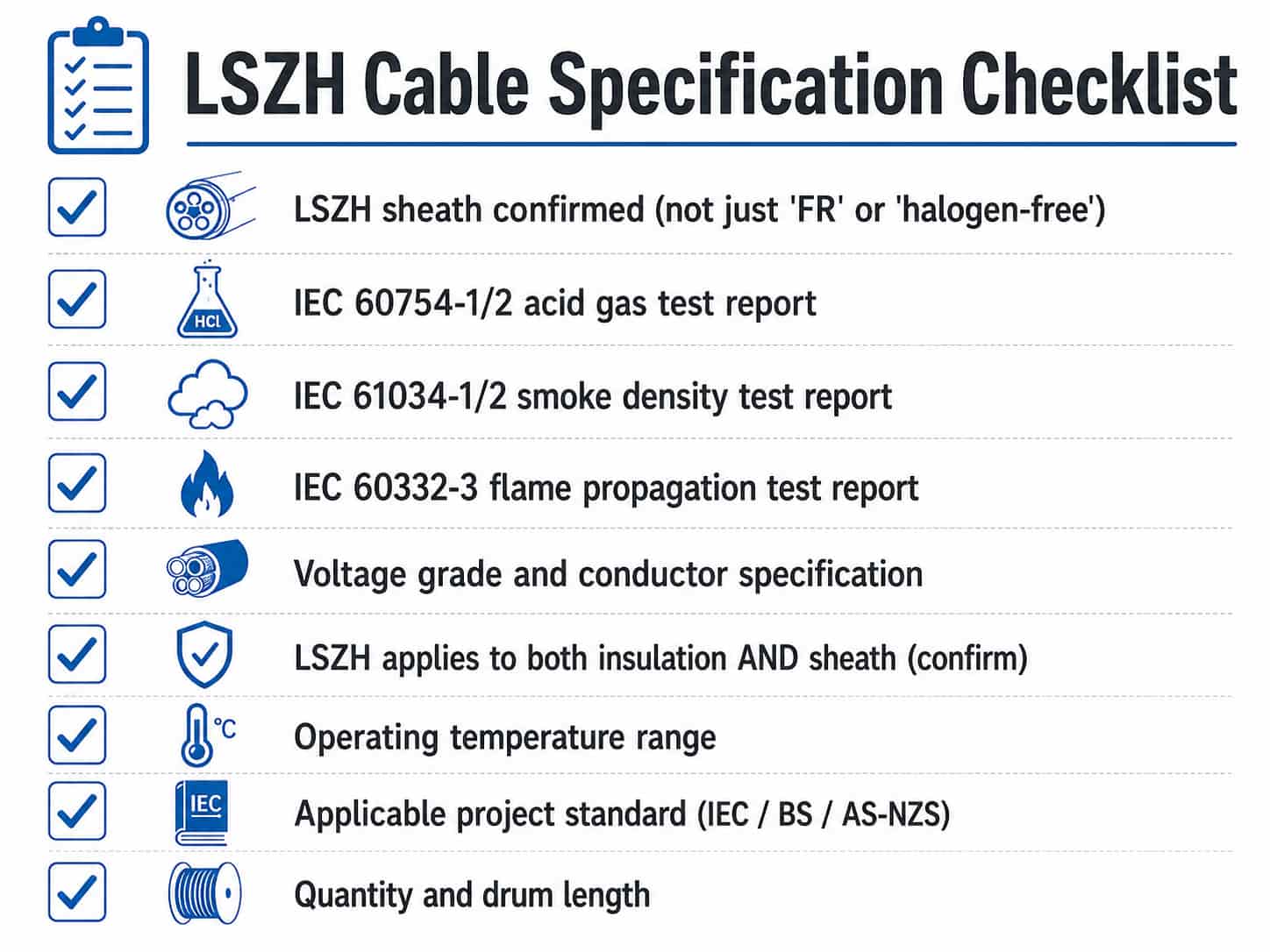
When specifying LSZH cable for a B2B procurement inquiry, include the following:
- Confirm LSZH applies to outer sheath only, or both insulation and sheath
- Specify IEC 60754-1/2 (acid gas), IEC 61034-1/2 (smoke density), and IEC 60332-3 category (flame propagation) — all three
- Voltage grade, core count, conductor cross-section, and base cable type (power, control, instrumentation)
- Armoring requirement (SWA, AWA, or unarmored)
- Minimum operating temperature at installation location
- Applicable project standard (IEC 60502-1 base with LSZH sheath, IEC 60092 for offshore, or project specification)
- Request type test reports from an accredited laboratory for all three LSZH standards
- Total quantity (meters), drum length, and delivery destination
Quotation Requirements
RichingPower supplies LSZH power cables, LSZH control cables, and LSZH instrumentation cables for data centers, offshore platforms, tunnels, marine, and enclosed industrial installations. To receive an accurate quotation, please provide:
- LSZH scope: outer sheath only, or both insulation and sheath
- Required LSZH test standards: IEC 60754, IEC 61034, IEC 60332-3 — and IEC 60332-3 category if specified
- Cable type, voltage grade, core count, conductor cross-section, and armoring requirement
- Minimum operating and installation temperature
- Applicable base standard (IEC 60502-1, IEC 60092, or other)
- Total quantity (meters), drum length, and delivery destination
Submit your LSZH cable specification via the RichingPower contact page. Specify whether type test reports from an accredited laboratory are required — we will confirm availability and provide documentation with the quotation.
Conclusion
LSZH is defined by three simultaneous fire performance properties — low acid gas emission (IEC 60754), low smoke density (IEC 61034), and controlled flame propagation (IEC 60332-3). A cable that passes only one or two of these tests is not LSZH. Standard flame-retardant PVC cable is not a substitute for LSZH — it addresses flame propagation only, not the smoke density or toxic gas hazards that LSZH is specifically designed to mitigate in enclosed spaces.
For B2B procurement, specifying LSZH correctly means stating all three test standards, confirming which cable layers must comply, and requesting type test reports from an accredited laboratory. For Chinese manufacturers, LSZH cables produced by reputable factories with the correct compound formulation and proper type testing are available — the buyer’s responsibility is to specify clearly and verify documentation before accepting shipment.
For related guidance on cable insulation and sheath materials, see XLPE vs PVC Cable Insulation: A Practical Selection Guide. For LSZH requirements specific to oil and gas projects, see
Oil and Gas Power Cable: Procurement Guide for Upstream and Offshore Projects. Contact RichingPower with your LSZH cable specification for a quotation with full compliance documentation.