
Battery energy storage systems — commonly referred to as BESS — have moved from grid-scale pilot projects to mainstream industrial and commercial procurement over the past several years. For B2B buyers sourcing electrical equipment from China, BESS is increasingly part of project supply packages alongside cables, inverters, and switchgear.
This guide covers what a BESS is, how it is structured, what the key procurement variables are, and how to prepare a specification for an industrial or commercial energy storage project.
What Is a BESS and Why Does It Matter for B2B Projects
A battery energy storage system (BESS) is an integrated assembly of battery cells, a battery management system (BMS), a power conversion system (PCS), and energy management software (EMS) that stores electrical energy and releases it on demand. The system can charge from the grid, from renewable sources such as solar or wind, or from a generator, and discharge to supply loads during peak demand periods, power outages, or grid instability events.
For B2B project buyers, BESS is relevant in several contexts:
- Industrial and commercial facilities reducing peak demand charges by discharging during high-tariff periods
- Backup power applications replacing or supplementing diesel generators
- Renewable energy projects — solar farms, wind farms — requiring storage to firm up intermittent generation
- Grid-scale frequency regulation and ancillary services
- Remote or off-grid installations where grid connection is unavailable or unreliable
Key Point: BESS is not a single product — it is a system. Procurement requires specifying each major component and confirming how they integrate. Buying battery modules without a compatible BMS and PCS results in a non-functional system.
BESS Core Components
Understanding the major subsystems is essential for evaluating supplier proposals and writing a technically complete specification.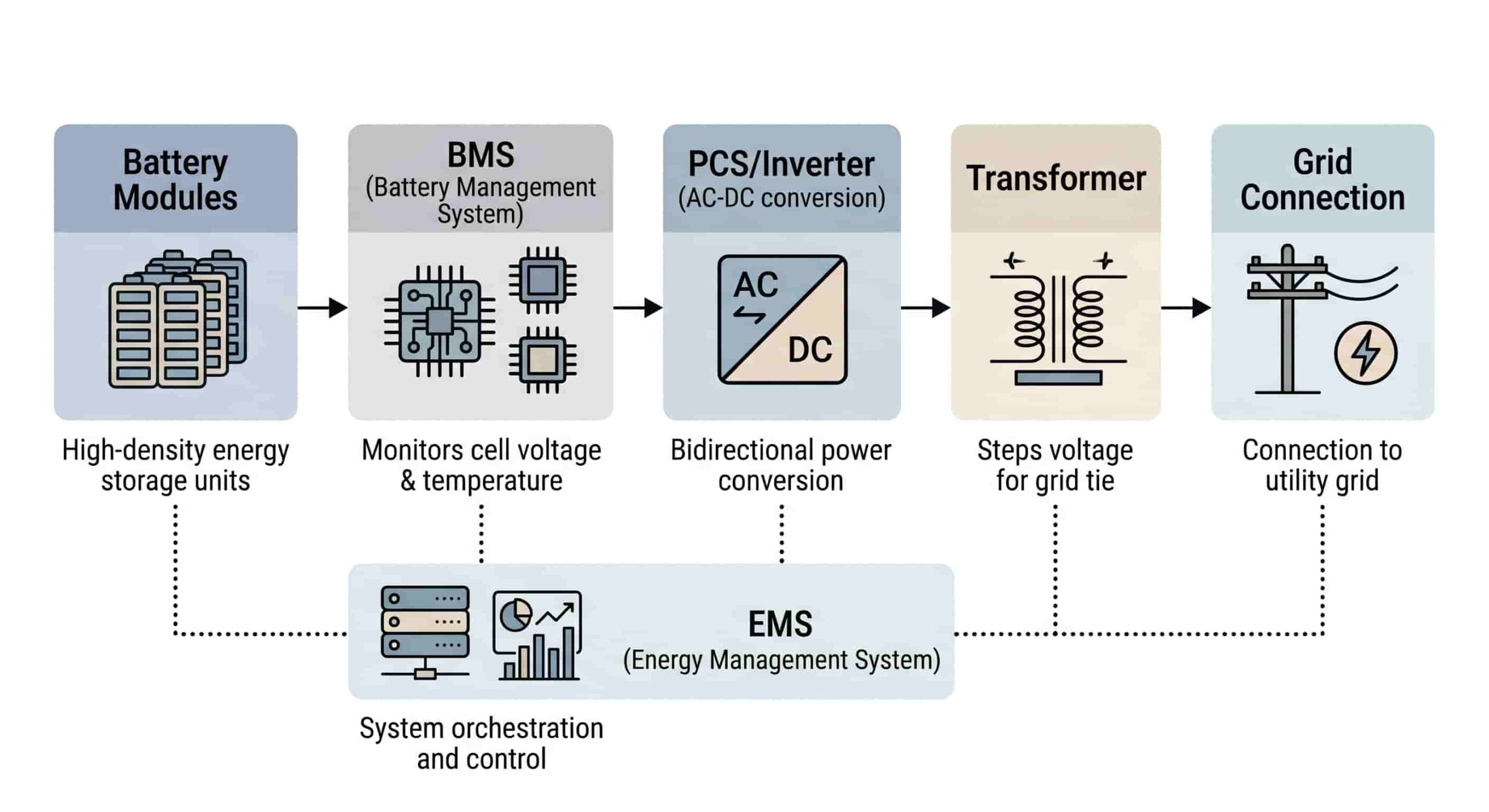
Battery Modules
The battery modules are the energy storage medium. They consist of individual cells (cylindrical, prismatic, or pouch format) assembled into modules and then into racks or cabinets. The total energy capacity of the system — expressed in kilowatt-hours (kWh) or megawatt-hours (MWh) — is determined by the number and configuration of modules.
Battery Management System (BMS)
The BMS monitors cell voltage, temperature, and state of charge across all modules. It protects the battery pack from overcharge, over-discharge, overcurrent, and thermal events. A well-designed BMS also performs cell balancing to equalize charge distribution across the pack and communicates state-of-health data to the EMS.
Note: Always confirm that the BMS is included in the supplier’s scope. Some low-cost BESS quotations price battery cabinets without an integrated BMS — this is a significant technical and safety gap.
Power Conversion System (PCS)
The PCS — also called a battery inverter or storage inverter — converts DC power from the batteries to AC power for grid connection or load supply, and reverses the conversion during charging. For grid-connected systems, the PCS must synchronize with grid frequency and voltage. For off-grid systems, it must generate a stable AC output independently.
PCS capacity is rated in kilowatts (kW) and determines the maximum charge and discharge power of the system. It is separate from the energy capacity (kWh) of the batteries — both must be specified.
Energy Management System (EMS)
The EMS is the supervisory layer that controls when the BESS charges and discharges based on predefined logic — time-of-use tariffs, demand setpoints, renewable output signals, or grid frequency signals. For commercial projects, the EMS typically interfaces with the facility’s building management system (BMS) or SCADA platform. Confirm whether the EMS is included in the supplier’s package or requires separate procurement.
Battery Chemistry: LFP vs NMC
The two dominant battery chemistries in the current B2B energy storage market are lithium iron phosphate (LFP, also written LiFePO4) and lithium nickel manganese cobalt oxide (NMC). Each has distinct characteristics relevant to procurement decisions.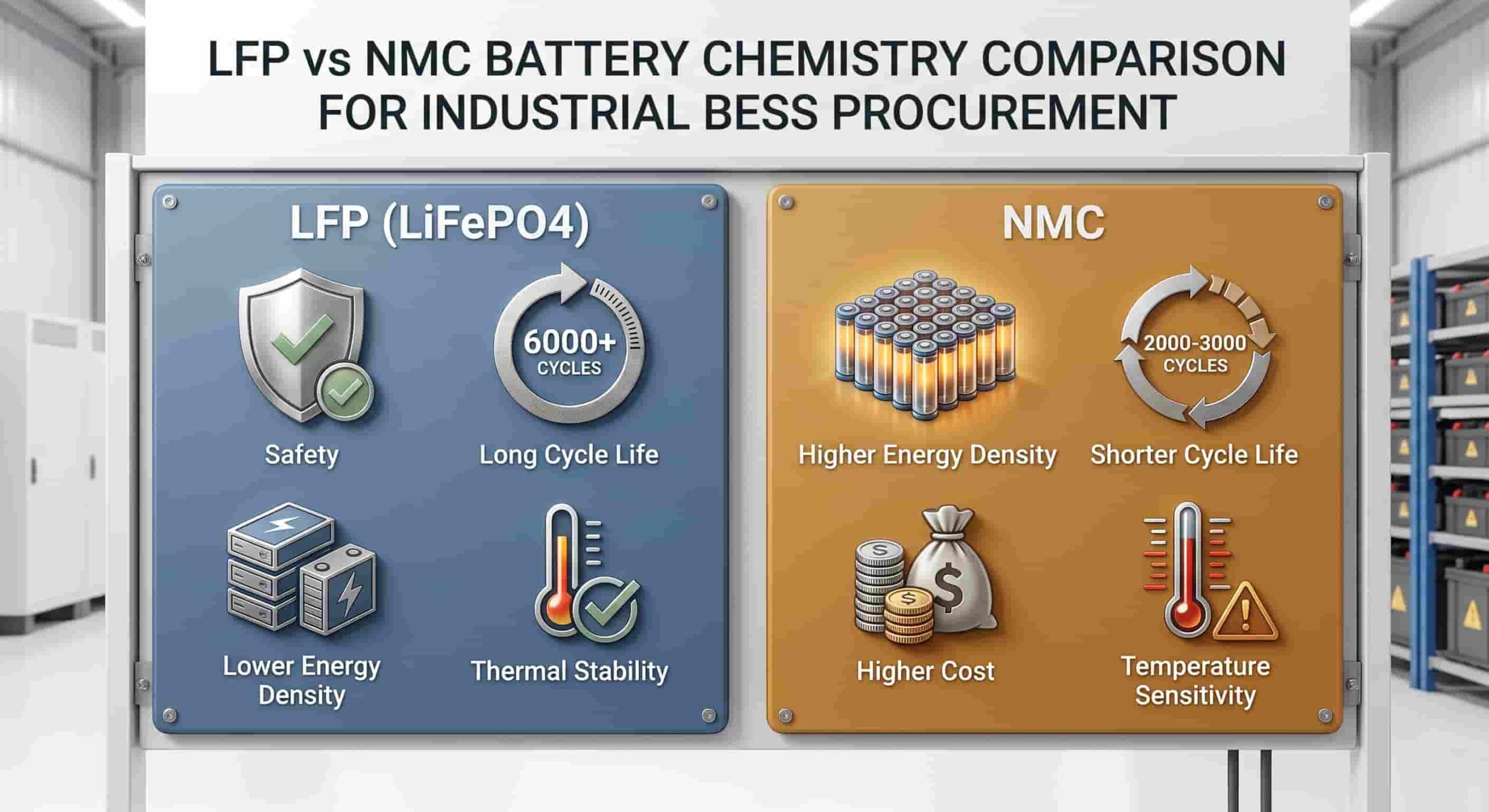
Tip: For peak demand shaving applications, match the PCS power rating to the peak demand reduction target, and size the energy capacity to cover the duration of the peak demand period (typically 1–4 hours). For backup power, size based on critical load (kW) multiplied by required backup duration (hours), with a margin for inverter efficiency losses.
BESS Application Scenarios
The intended application determines the system configuration, PCS specification, and EMS logic required.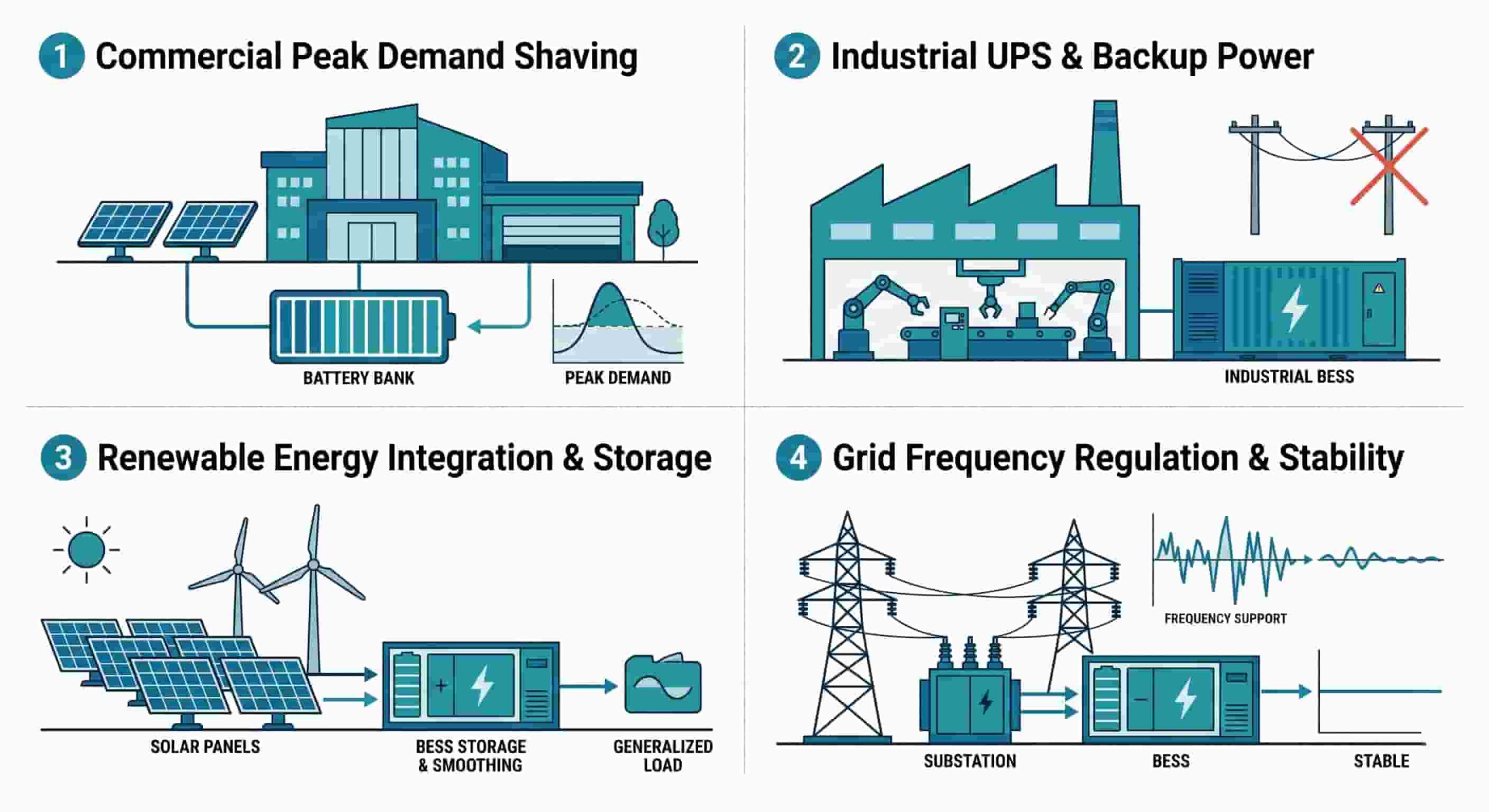
Peak Demand Shaving
The BESS discharges during peak demand periods to reduce the facility’s maximum demand charge on the utility bill. Requires an EMS with demand monitoring capability and integration with the facility metering system. Typical duration: 1–4 hours.
Industrial UPS and Backup Power
The BESS provides seamless power continuity during grid outages. For critical industrial processes, the transition time from grid to battery must be under 20ms — confirm the PCS switching speed in the specification. Typical duration: 30 minutes to 4 hours depending on critical load size.
Renewable Energy Storage (Solar + Storage)
The BESS charges from a solar PV array during daylight hours and discharges in the evening or on demand. The PCS must support DC coupling (connected directly to the PV string before the solar inverter) or AC coupling (connected at the AC bus after the solar inverter). Confirm which topology is required for the project.
Grid Frequency Regulation
Used primarily by utilities and large industrial grid participants. The BESS responds to frequency deviations by injecting or absorbing power within seconds. Requires a high C-rate PCS and low-latency EMS with grid frequency measurement. This application demands specialist configuration — confirm supplier experience with frequency regulation deployments.
Key Certifications and Standards
For project-based procurement, the following certifications are commonly required:
For export projects, confirm which certifications are mandatory in the destination country. IEC standards are widely accepted internationally, but some markets — particularly Europe (CE marking), Australia (AS/NZS), and North America (UL listing) — require additional or alternative certification.
Note: UN38.3 certification covers the transport safety of lithium batteries and is required for international shipping by air, sea, and road. Always confirm this is in place before arranging freight for battery shipments.
Physical Format: Containerized vs Rack-Mount
BESS systems are available in two primary physical configurations:
- Containerized BESS: battery cabinets, PCS, BMS, EMS, HVAC, and fire suppression are pre-integrated inside a standard shipping container (20ft or 40ft). Suitable for outdoor installation, rapid deployment, and projects where indoor space is unavailable. Capacities typically range from 500kWh to 5MWh per container.
- Rack-mount / indoor cabinet BESS: battery racks and PCS are installed in an existing building or dedicated electrical room. Requires the buyer to provide the installation environment including HVAC, fire suppression, and structural support. More flexible for capacity scaling and integration with existing electrical infrastructure.
For most industrial and commercial buyers new to BESS procurement, containerized systems reduce integration complexity and installation timeline. Rack-mount systems offer greater flexibility but require more detailed civil and electrical coordination.
Procurement Specification Checklist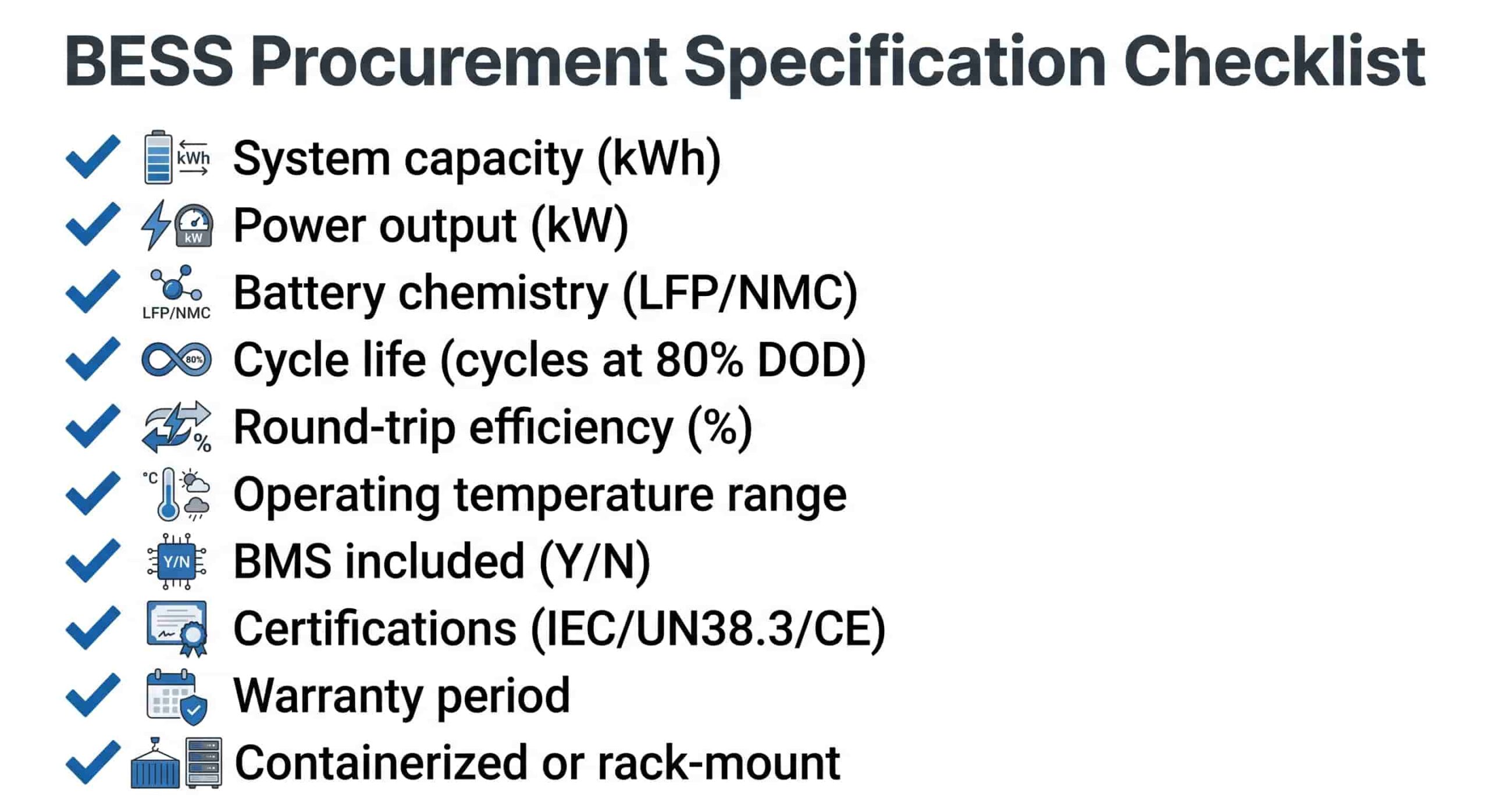
To obtain an accurate BESS quotation, provide the following information:
- Application type (peak shaving, backup, solar storage, grid frequency regulation, or hybrid)
- Required energy capacity (kWh or MWh)
- Required power rating (kW or MW)
- Discharge duration requirement (hours)
- Battery chemistry preference (LFP recommended for most applications)
- Grid connection voltage (e.g. 400V AC three-phase, 11kV)
- Physical format preference (containerized or indoor rack-mount)
- Operating environment (indoor / outdoor, ambient temperature range)
- Required certifications (IEC, CE, UL, AS/NZS, or other)
- Warranty requirement (cycle life warranty, years, and DOD basis)
- EMS integration requirement (standalone or integration with existing BMS/SCADA)
- Delivery destination and port
- Project timeline and target commissioning date
Tip: For large projects (above 1MWh), attaching a single-line diagram of the electrical system and a load profile (kW demand over 24 hours) significantly improves the accuracy of supplier proposals and reduces back-and-forth during the quotation stage.
Quotation Requirements
RichingPower supplies BESS systems for industrial, commercial, and project-based applications. To prepare an accurate quotation, please provide:
- Application type and discharge duration requirement
- Required energy capacity (kWh) and power rating (kW)
- Battery chemistry (LFP preferred for most stationary applications)
- Physical format (containerized or rack-mount)
- Grid connection voltage and certification requirements
- Delivery destination and target delivery date
Submit your specification via the RichingPower contact page. For complex projects, attaching a load profile or single-line diagram helps our technical team provide a more accurate system recommendation.
Conclusion
A BESS is a multi-component system that must be specified and sourced as an integrated package — battery chemistry, BMS, PCS, and EMS must all be aligned to the application requirements. For B2B buyers, the most common procurement errors are under-specifying the PCS power rating, selecting battery chemistry based on unit price rather than total cost of ownership, and overlooking certification requirements for the destination market.
Defining the application, capacity, duration, and certification requirements before approaching suppliers produces faster, more comparable quotations and reduces the risk of technical mismatches in a delivered system.
Explore RichingPower’s energy storage and inverter product range, or contact us with your project specification to receive a tailored BESS quotation.