
For buyers sourcing inverters for solar-plus-storage or remote power projects, the choice between a hybrid inverter and an off-grid inverter is one of the first technical decisions to resolve. The two inverter types share some similarities — both manage battery charging and discharging — but they serve fundamentally different system configurations and project requirements.
This guide explains how each inverter type works, where each is appropriate, what the key specification differences are, and how to structure a procurement inquiry for either product.
How a Hybrid Inverter Works
A hybrid inverter — sometimes called a multi-mode inverter or solar storage inverter — manages three energy sources simultaneously: a solar PV array, a battery bank, and the utility grid. It can import power from the grid, export surplus solar generation to the grid, charge batteries from solar or the grid, and supply AC loads from any combination of these sources.
The core capability that distinguishes a hybrid inverter is its ability to remain connected to and synchronized with the grid while also managing battery storage. This enables several operating modes:
- Self-consumption mode: use solar generation to supply loads first, store surplus in batteries, draw from grid only when solar and battery are insufficient
- Time-of-use mode: charge batteries from grid during low-tariff periods, discharge during peak tariff periods to reduce electricity costs
- Backup mode: maintain battery charge as a reserve; switch to battery supply automatically during grid outages
- Grid export mode: export surplus solar generation to the grid under net metering or feed-in tariff arrangements
Key Point: A hybrid inverter requires a grid connection to operate at full capability. Without a grid connection, most hybrid inverters can still function in off-grid or island mode, but this is a secondary operating mode — not the primary design intent.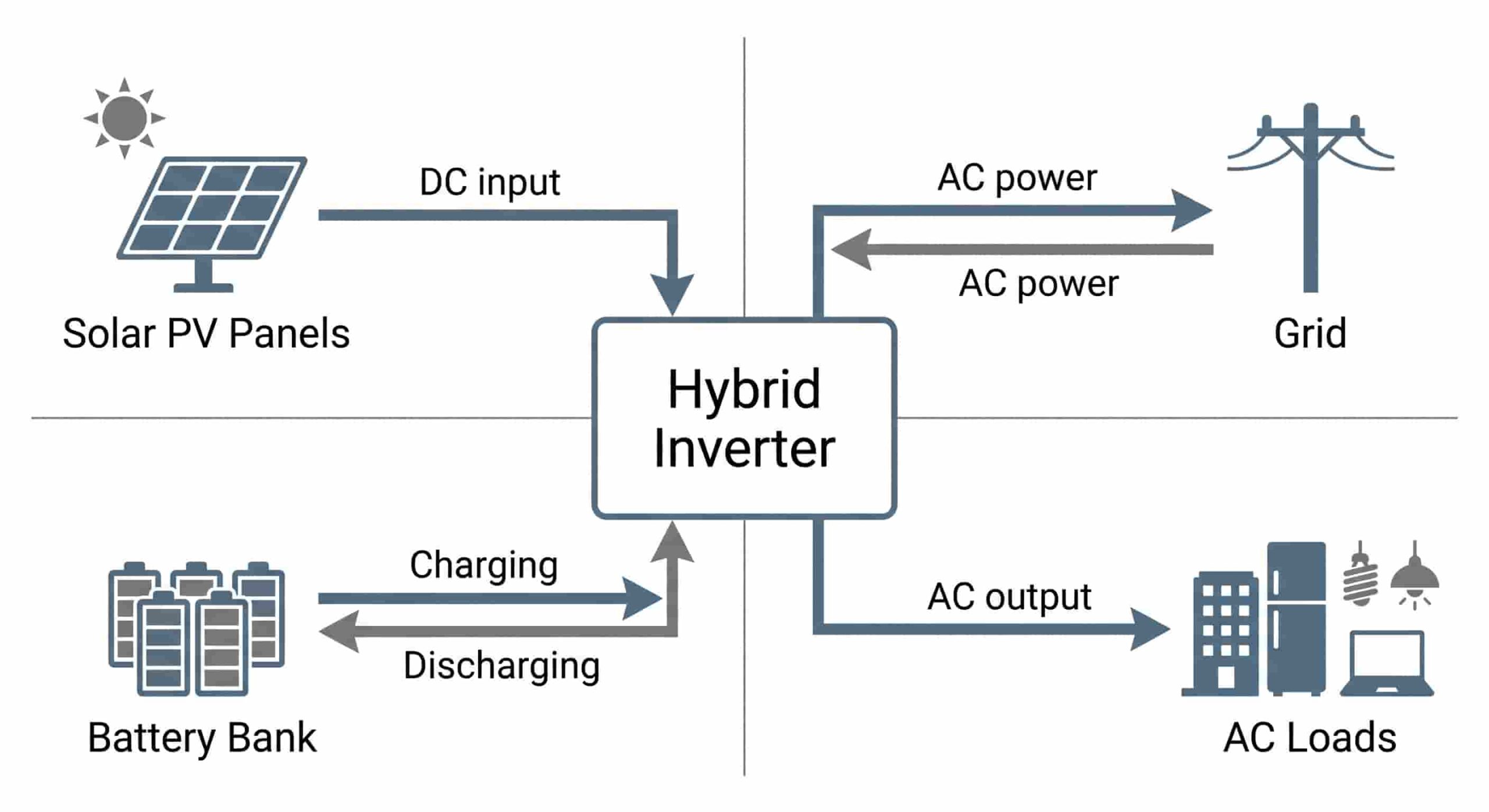
How an Off-Grid Inverter Works
An off-grid inverter — also called a standalone inverter or island inverter — is designed to operate entirely without a grid connection. It generates its own AC output voltage and frequency, drawing energy from a battery bank that is charged by solar PV, a generator, wind turbine, or a combination of sources.
Because there is no grid to synchronize with, the off-grid inverter must independently regulate output voltage and frequency within acceptable limits for the connected loads. This places greater demands on the inverter’s control system and requires careful battery bank sizing to ensure continuous supply.
Off-grid systems typically involve:
- Solar PV array connected via an MPPT charge controller or directly through the inverter’s built-in MPPT
- Battery bank sized to cover load demand through periods of low or zero solar generation (nights, overcast days)
- Optional backup generator for extended low-generation periods or for high-load surge events
- AC load panel supplied entirely by the inverter output
Note: Off-grid inverters must produce a pure sine wave output to support sensitive loads such as motors, medical equipment, or variable-frequency drives. Confirm pure sine wave output in the specification — modified sine wave inverters are unsuitable for most commercial and industrial applications.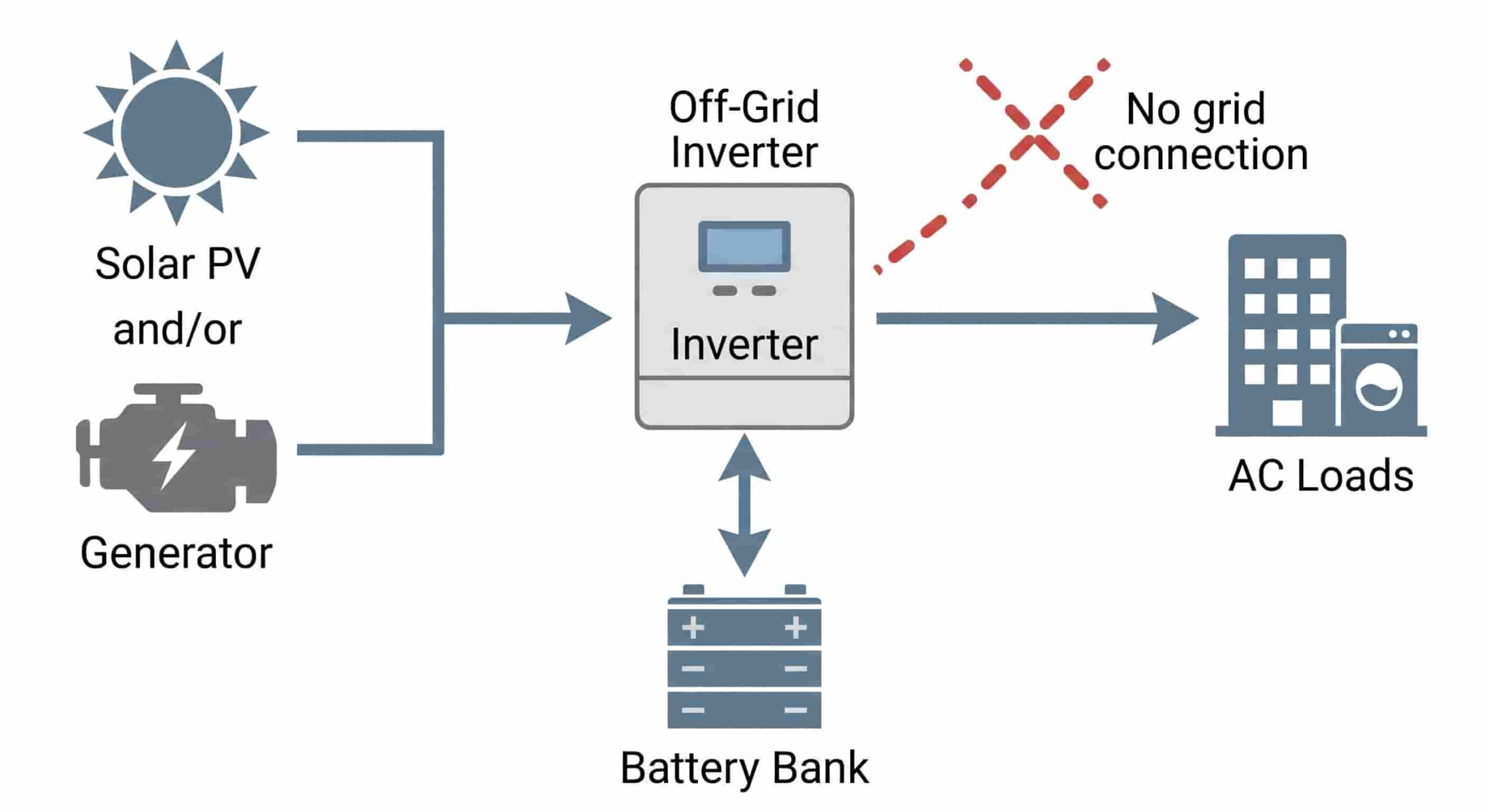
Key Differences: Hybrid vs Off-Grid Inverter
The table below summarizes the principal technical and application differences between the two inverter types.
When to Choose a Hybrid Inverter
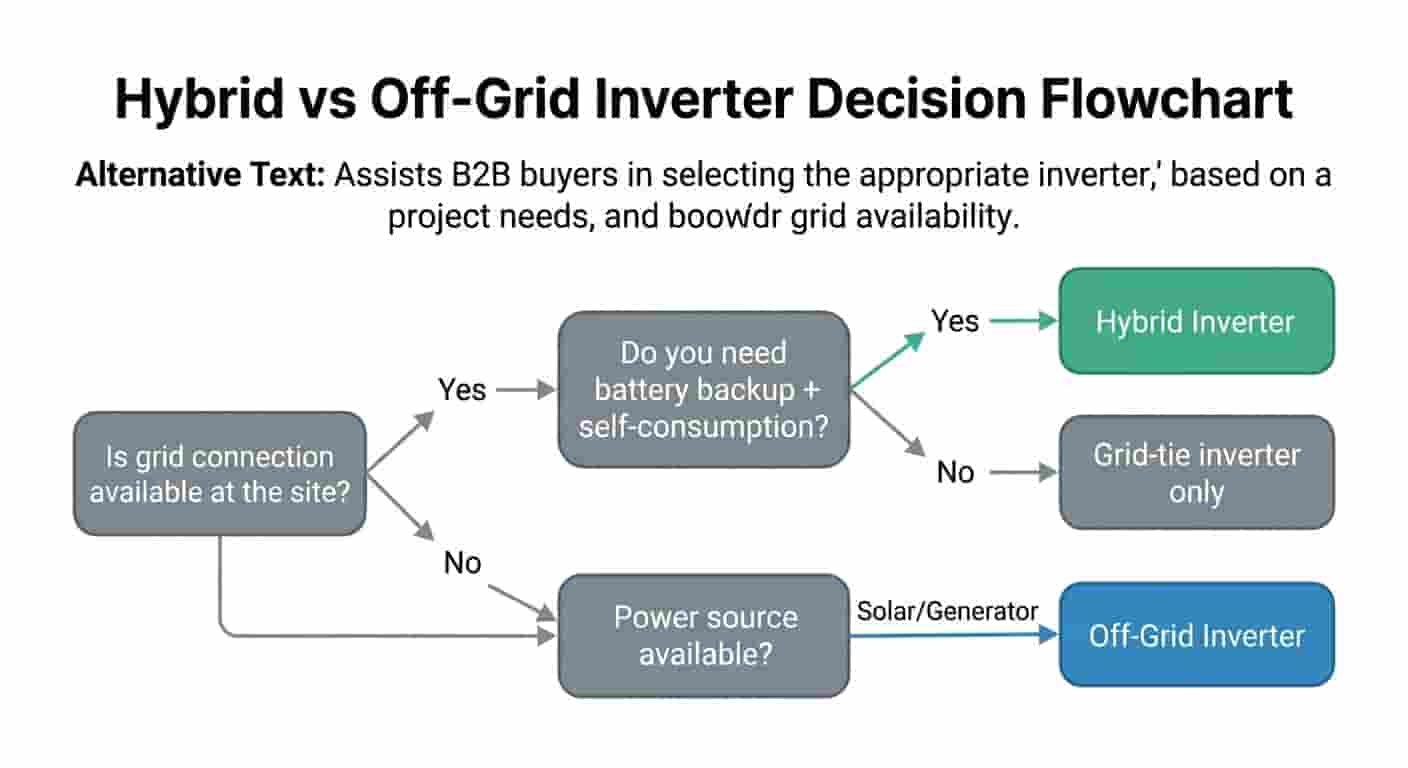
A hybrid inverter is the appropriate choice when all of the following conditions apply:
- Grid connection is available at the site
- The project goal includes reducing grid electricity costs, maximizing solar self-consumption, or providing backup power during outages
- The buyer wants flexibility to export surplus generation or participate in feed-in tariff schemes
- The installation is a commercial building, industrial facility, or residential project in a grid-connected area
Hybrid inverters are well-suited to projects in commercial and industrial facilities where electricity tariffs have a significant peak demand or time-of-use component. They are also the standard choice for grid-connected solar-plus-storage projects, including retail, warehousing, light manufacturing, and office buildings.
Key Point: If the site has a reliable grid connection and the buyer wants to reduce electricity costs or add resilience without going fully off-grid, a hybrid inverter is almost always the right choice. Specifying an off-grid inverter for a grid-connected site results in a more complex installation with fewer operating benefits.
When to Choose an Off-Grid Inverter
An off-grid inverter is required when:
- The site has no grid connection and grid extension is not feasible or economical
- The project is in a remote location — telecommunications towers, mining camps, agricultural pumping stations, island communities, or rural health facilities
- The application requires a fully autonomous power system that cannot depend on grid availability
- The buyer is replacing or supplementing a diesel generator with a solar-battery-inverter system
Off-grid inverters are also used in temporary power applications — construction sites, event infrastructure, and disaster relief — where grid connection is not available and portability or rapid deployment is required.
For remote industrial applications such as oil and gas wellheads, telecommunications repeater stations, or off-grid water pumping, off-grid inverters are specified alongside large battery banks and solar arrays designed to provide continuous power with minimal manual intervention.
Battery Compatibility and Voltage Range
Both hybrid and off-grid inverters must be matched to the battery bank voltage and chemistry. This is a critical specification point that affects system performance and safety.
Off-grid inverters do not require grid connection certification, but must still meet general electrical safety standards (IEC 62109 for solar inverter safety, CE marking for Europe). For projects in regulated industries or government facilities, confirm what certification documentation is required before placing an order.
Specification Checklist for B2B Buyers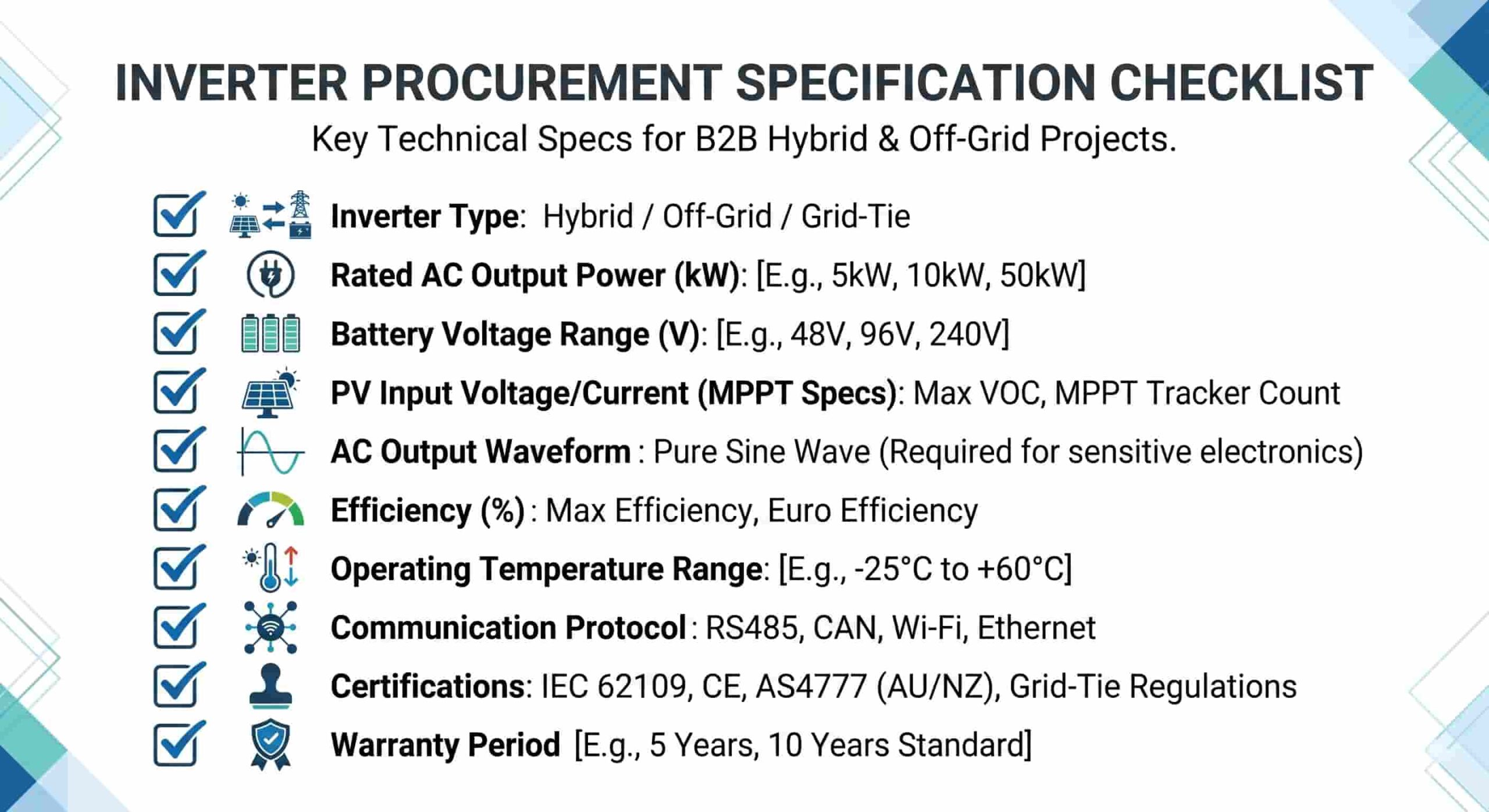
When preparing an inverter inquiry, provide the following information for accurate quotation:
- Inverter type required: hybrid (grid-connected) or off-grid (standalone)
- Rated AC output power (kW)
- Number of phases: single-phase or three-phase
- Battery voltage range and chemistry (LFP, lead-acid, or other)
- Number of MPPT inputs and maximum PV array capacity (kWp)
- AC output waveform: pure sine wave (required for commercial/industrial)
- Operating temperature range for installation environment
- Communication interface required: RS485, CAN bus, WiFi, Ethernet, or Modbus
- Grid connection standard (for hybrid inverters): IEC 62116, AS4777, VDE-AR-N 4105, or other
- Required certifications: CE, IEC 62109, UL 1741, or other
- Enclosure rating: IP65 for outdoor, IP20/IP21 for indoor
- Quantity and delivery destination
Quotation Requirements
RichingPower supplies hybrid and off-grid inverters for commercial, industrial, and project-based applications. To receive an accurate quotation, please provide:
- Inverter type (hybrid or off-grid) and rated AC output power (kW)
- Single-phase or three-phase output
- Battery voltage range and chemistry
- PV array capacity and number of MPPT inputs required
- Required certifications and grid connection standard (if applicable)
- Quantity and delivery destination
Submit your specification via the RichingPower contact page. For larger projects or system packages combining inverter, battery, and cables, attach a system single-line diagram or load summary to receive a coordinated proposal.
Conclusion
The choice between a hybrid inverter and an off-grid inverter is determined by one primary factor: whether a grid connection is available and whether the system needs to interact with that grid. For grid-connected commercial and industrial sites, a hybrid inverter provides the most flexible and cost-effective path to solar-plus-storage. For remote sites without grid access, an off-grid inverter is the only viable option for autonomous power supply.
Secondary factors — battery voltage compatibility, MPPT configuration, certification requirements, and communication protocol — should be confirmed in the specification before requesting quotations to ensure supplier proposals are directly comparable.
View RichingPower’s range of hybrid and off-grid inverters, or contact us with your project specification for a technical recommendation and quotation.