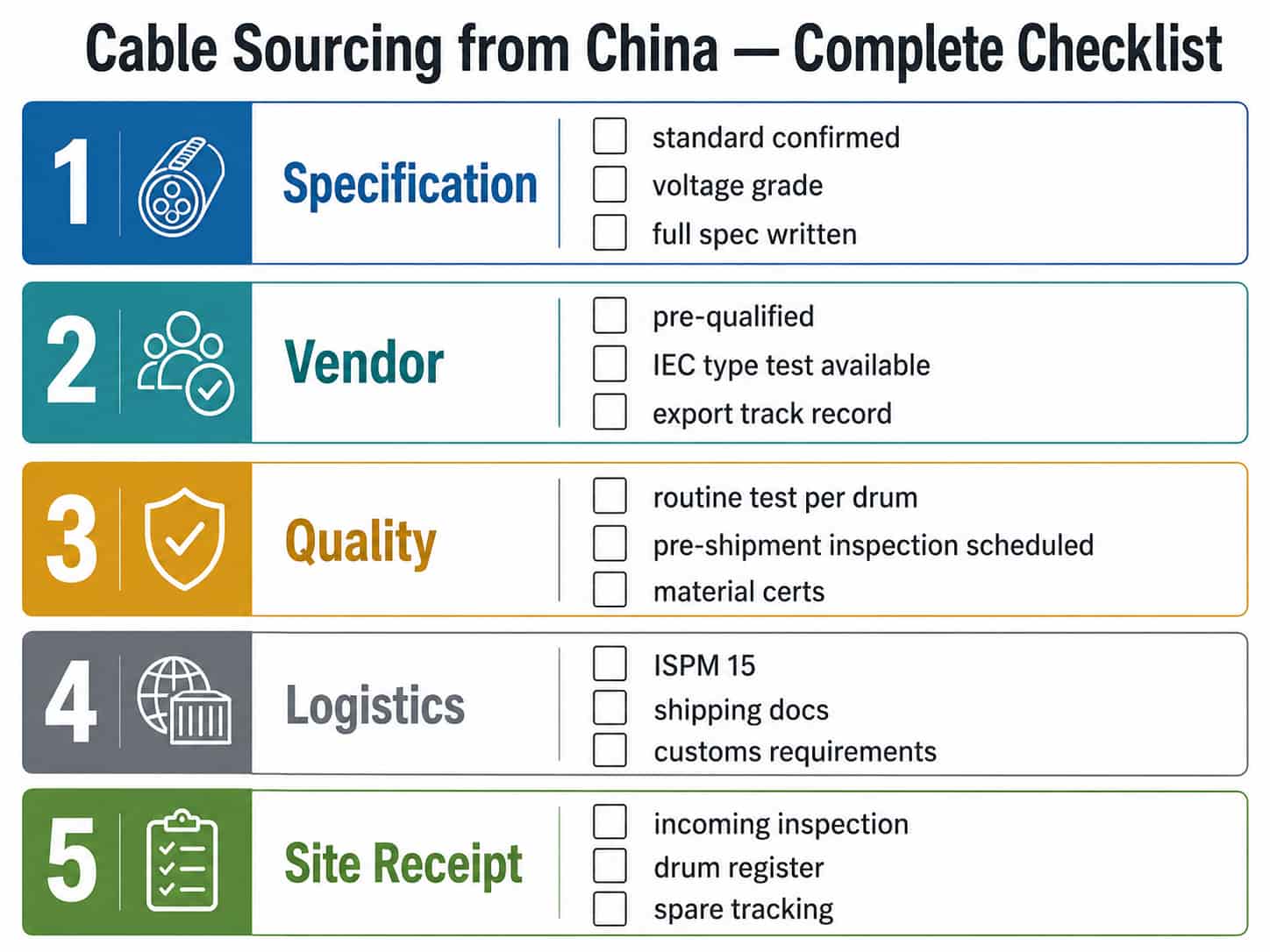
China is the world’s largest producer of power cables, supplying a significant share of global B2B demand for low voltage, medium voltage, control, and instrumentation cables. For international buyers — EPC contractors, importers, distributors, and project procurement teams — sourcing cables from China offers competitive pricing, broad product range, and established export capability. It also requires a structured approach to quality verification, certification compliance, and logistics management that goes beyond routine domestic procurement.
This guide consolidates the key considerations for B2B cable sourcing from China into a single reference: how to evaluate and select a manufacturer, how to verify quality through documentation and inspection, how to confirm certification compliance for your destination market, and how to manage the logistics from factory to project site.
Understanding the Chinese Cable Manufacturing Landscape
China’s cable industry spans a wide range of manufacturer types — from large state-affiliated enterprises producing the full range of cables for utility and export markets, to small factories serving domestic construction. Understanding where a potential supplier sits in this landscape is the foundation of vendor evaluation.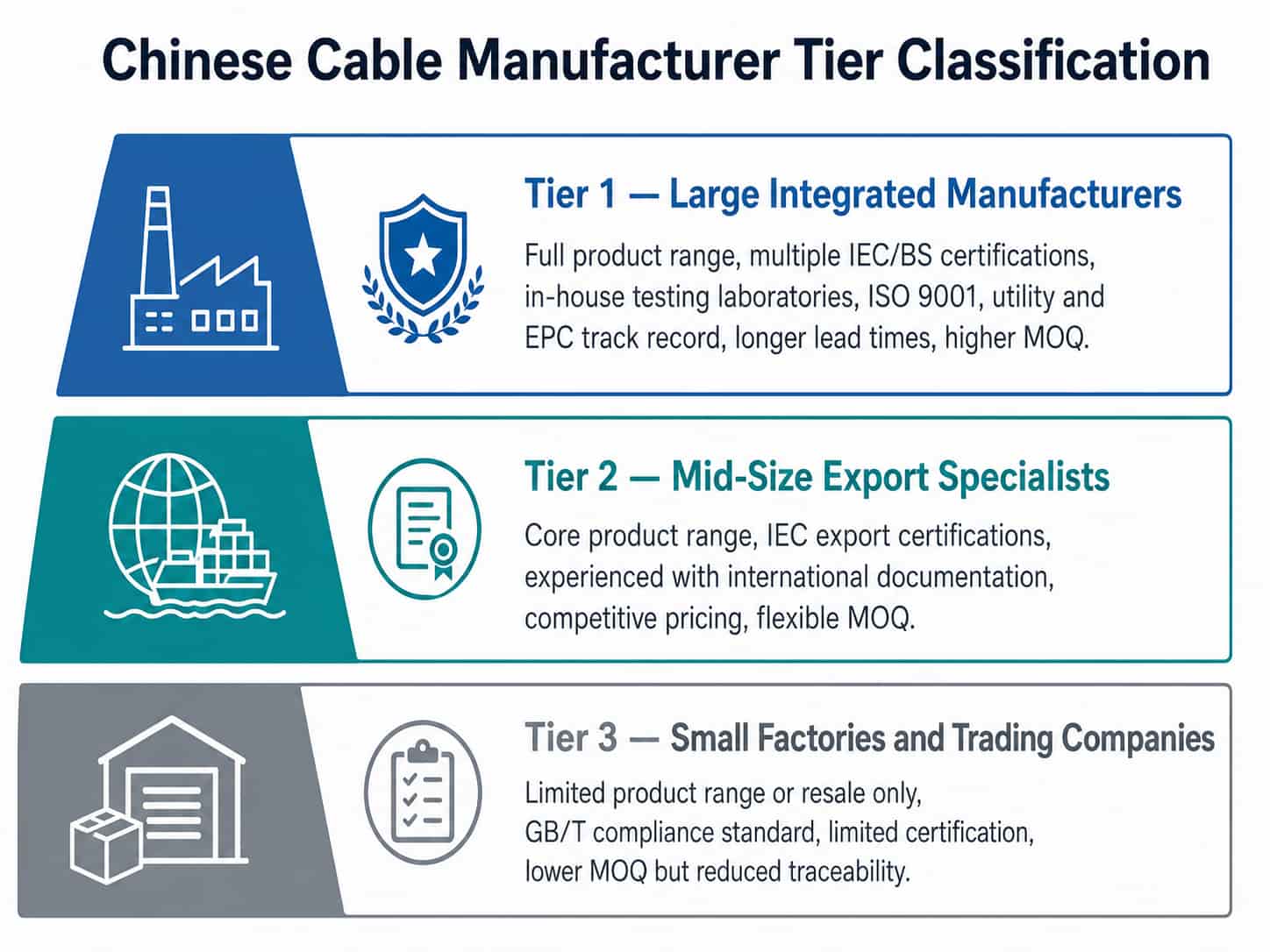
Tier 1: Large Integrated Manufacturers
The largest Chinese cable manufacturers — companies such as Hengtong, Zhongtian, Baosheng, and Fareast — produce cables across the full voltage range from LV building wire to high-voltage transmission cables. They hold multiple international certifications (IEC, BS, AS/NZS), operate accredited in-house test laboratories, have established relationships with international EPC clients and utilities, and supply to large-scale projects globally. For high-specification, large-volume, or project-critical procurement, Tier 1 manufacturers offer the most comprehensive quality assurance capability.
Tier 2: Mid-Size Export-Focused Manufacturers
Mid-size Chinese cable manufacturers specializing in export supply are the most common procurement partner for international B2B buyers. They produce a defined product range — typically LV and MV power cables, control cables, and instrumentation cables — hold IEC and sometimes BS or AS/NZS certifications from accredited laboratories, are experienced with international documentation requirements, and offer competitive pricing with flexible minimum order quantities. This tier represents the best balance of quality, price, and service for most B2B export procurement.
Tier 3: Small Factories and Trading Companies
Smaller factories and trading companies may offer attractive prices, particularly for small quantities. However, they present higher risk for B2B project procurement: limited certification capability, reduced traceability to production records, and lower consistency between production batches. Trading companies — which resell cable sourced from other factories — add further opacity to the supply chain. For project-critical procurement, Tier 3 suppliers should be used only for genuinely commodity LV cables where quality requirements are minimal and the order size does not justify a Tier 1 or 2 relationship.
Key Point: Verifying whether a supplier is a manufacturer or a trading company is straightforward but important. Request the factory’s business license (营业执照) and production license (生产许可证). Trading companies will have a business license but not a production license. For IEC-certified products, the certification body’s audit report lists the actual manufacturing facility address — confirm this matches the supplier’s address.
Building a Complete Cable Specification Before Approaching Suppliers
The specification is the reference document for every subsequent step in the sourcing process — vendor evaluation, quotation comparison, production inspection, and quality acceptance. An incomplete specification produces incomparable quotations and creates disputes at delivery.
A complete cable specification for B2B procurement includes:
- Cable type: power cable, control cable, or instrumentation cable
- Voltage grade in U0/U format: e.g. 0.6/1kV, 6/10kV
- Number of cores (power/control) or pairs/triads (instrumentation)
- Conductor material: copper (CU) or aluminum (AL)
- Conductor cross-section (mm²)
- Insulation type: XLPE, PVC, or LSZH
- Armoring: SWA, AWA, or unarmored
- Outer sheath: PVC, HDPE, or LSZH
- Applicable standard: IEC 60502-1/2, BS 5467, BS 6622, AS/NZS 1429, or other
- Total quantity (meters) and preferred drum length
- Delivery destination and Incoterms
- Any additional requirements: LSZH fire performance tests, special temperature range, special compound
For detailed guidance on reading and writing cable specifications, see How to Read a Cable Specification Sheet. For standard selection by market, see
IEC vs BS vs AS/NZS Cable Standards.
Evaluating and Qualifying Chinese Cable Manufacturers
Vendor evaluation for cable sourcing from China covers five areas:
1. Production Capability Confirmation
Confirm the factory produces the specific cable type you require — not all manufacturers produce the full product range. A factory specializing in LV building wire may not produce MV armored cable. Ask specifically:
- Do you manufacture this cable type in your own facility?
- What is your monthly production capacity for this cable type?
- What is your current order backlog and realistic lead time for this order quantity?
2. Certification and Type Test Reports
Request type test reports for the specific cable construction you are procuring:
- The report must reference the exact standard: IEC 60502-1, BS 5467, or other as applicable
- The report must be issued by an accredited laboratory: CNAS-accredited (China National Accreditation Service) or ILAC-member body
- The report must cover the cable construction you are ordering: voltage grade, conductor cross-section range, insulation type, armoring — a type test for 4-core 95mm² does not automatically cover 3-core 95mm²
- Check the report date: type tests are valid indefinitely unless the cable design changes — ask whether the construction has changed since the report was issued
3. Quality Management System
ISO 9001 certification is the baseline indicator of a documented quality management system but does not guarantee product quality. Confirm:
- The ISO 9001 scope covers the specific cable types being procured — not just ‘cable manufacturing’ generically
- The certificate is current and issued by an accredited certification body
- The factory has documented quality procedures for incoming material inspection, in-process testing, and final product testing
4. Export Track Record
A manufacturer’s export experience to your destination market significantly reduces documentation and compliance risk:
- How many years has the factory been exporting to your target country or region?
- Can the factory provide references from buyers in similar industries or geographies?
- Is the factory familiar with the applicable standard and any local utility authority requirements?
- Has the factory previously handled the export documentation requirements for your destination — ISPM 15, certificate of origin format, end-use certificates?
5. Communication and Technical Responsiveness
A supplier’s ability to respond accurately to technical questions before the order is the most reliable predictor of their performance during production. A salesperson who confirms every technical question without asking clarifying questions, or who cannot explain the difference between GB/T and IEC type test requirements, represents a significant quality risk regardless of the price offered.
Quality Verification: The Three-Layer Approach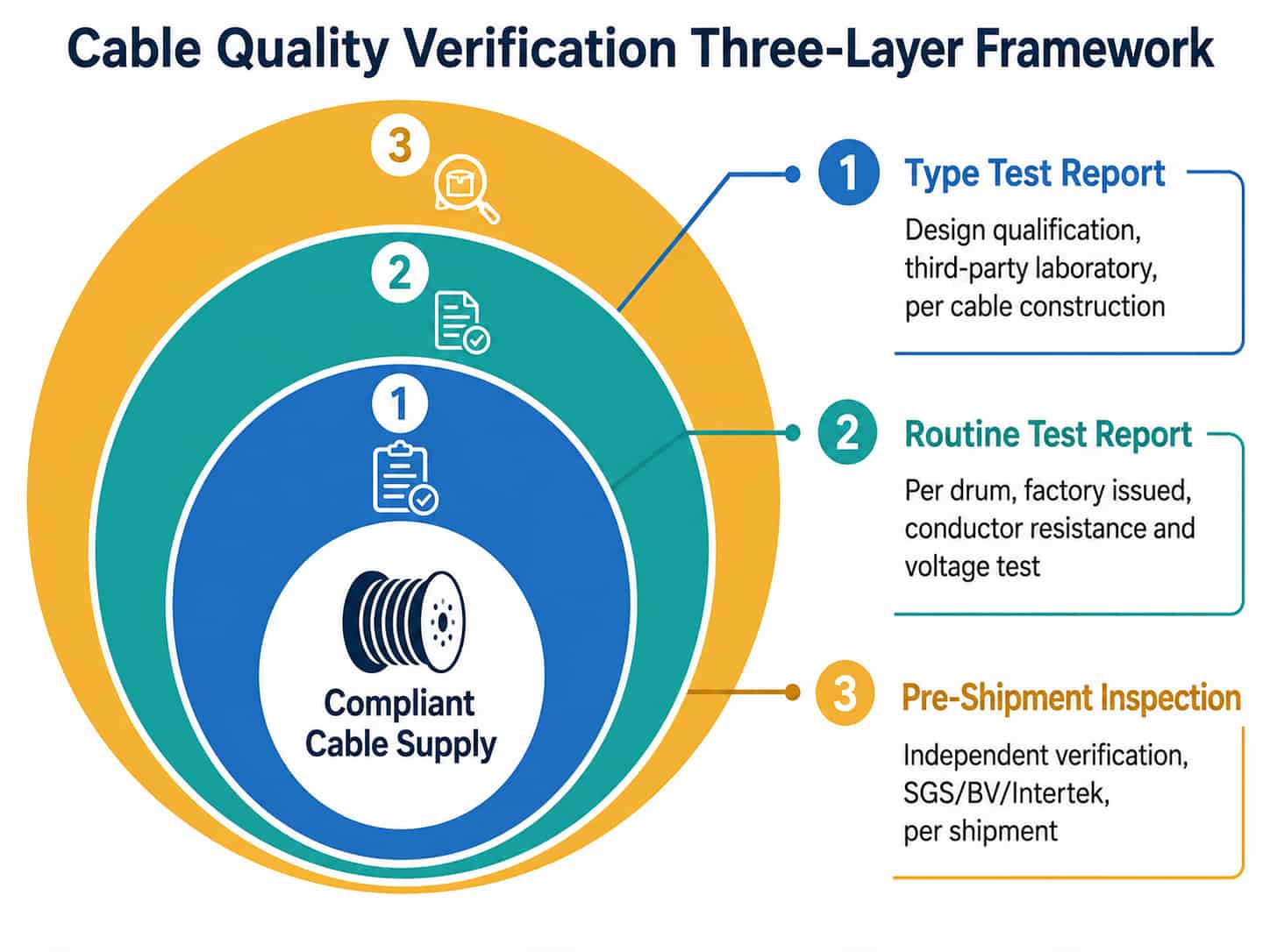
Effective quality verification for cable sourcing from China uses three complementary layers, each serving a different function:
Layer 1: Type Test Reports (Design Qualification)
Type test reports confirm that the cable design — as a category — meets the full requirements of the specified standard. They are conducted once per cable construction at an accredited laboratory and cover the complete test programme: mechanical, thermal, electrical, and environmental performance tests. Type tests are not conducted per order — they are the manufacturer’s standing credential for that cable design.
What to check in a type test report:
- Standard reference: IEC 60502-1/2, BS 5467, BS 6622, or other — must match your specification
- Laboratory accreditation: CNAS or ILAC — not a factory-issued report
- Construction coverage: voltage grade and conductor cross-section range must include your order
- Date and construction validity: confirm no design changes since the test date
Layer 2: Routine Test Reports (Per Drum)
Routine test reports confirm the basic electrical integrity of each individual drum of cable produced. They are factory-issued for every drum and cover:
- Conductor resistance measurement: confirms the conductor cross-section is within tolerance — a resistance higher than the IEC 60228 maximum for the specified cross-section indicates an undersized conductor
- Voltage withstand test: confirms insulation integrity — typically 3,500V AC for 5 minutes on 0.6/1kV cable
- Insulation resistance measurement: confirms insulation quality
Note: Routine test reports are the minimum documentation for any cable order. They are factory-issued and not independently verified. If the factory’s routine test report shows exactly the IEC maximum resistance value for every drum — rather than a range of values close to but below the maximum — this may indicate the resistance values have been entered without actual measurement. For first-time orders with a new supplier, request the raw data from a sample of drums rather than just the summary certificate.
Layer 3: Pre-Shipment Inspection (Independent Verification)
Pre-shipment inspection by an independent inspection body — SGS, Bureau Veritas, Intertek, or an equivalent ILAC-member body — provides independent verification that the cable supplied matches the specification and the documentation. The inspection covers:
- Dimensional inspection: outer diameter, insulation wall thickness, armor wire diameter — spot-checked against standard minimum requirements
- Conductor resistance: independent measurement on a sample of drums, compared against the factory routine test values and IEC 60228 maximum
- Marking inspection: cable surface marking, drum labeling, and packing list accuracy
- ISPM 15 compliance: visual inspection of the IPPC heat treatment stamp on wooden drums
- Quantity verification: actual drum count against packing list
Pre-shipment inspection typically costs 0.3–1% of the cable order value and is one of the most effective quality control investments in cable sourcing from China. For first-time supplier relationships or for orders above a threshold value defined by the buyer’s quality policy, pre-shipment inspection should be the default.
Key Point: Pre-shipment inspection and factory acceptance testing are different products. Factory acceptance testing (FAT) is a more comprehensive assessment conducted at the factory before production is complete — it may include witness of electrical tests and detailed dimensional sampling. Pre-shipment inspection is typically a lighter-touch verification conducted on completed, packaged cable before it is loaded for shipment. For large or project-critical orders, FAT may be specified in addition to pre-shipment inspection.
Certification Compliance: What Your Destination Market Requires
Beyond the cable construction standard (IEC, BS, AS/NZS), some destination markets require additional certification or approval documentation:
For markets with formal approval processes — Australia (network operator approved lists), Middle East (utility authority approval), South Africa (SABS marking) — confirm the approval status of the specific manufacturer and cable construction before placing the order. Approval processes can take 3–6 months and cannot be fast-tracked after the cable has been manufactured.
Logistics: From Factory to Site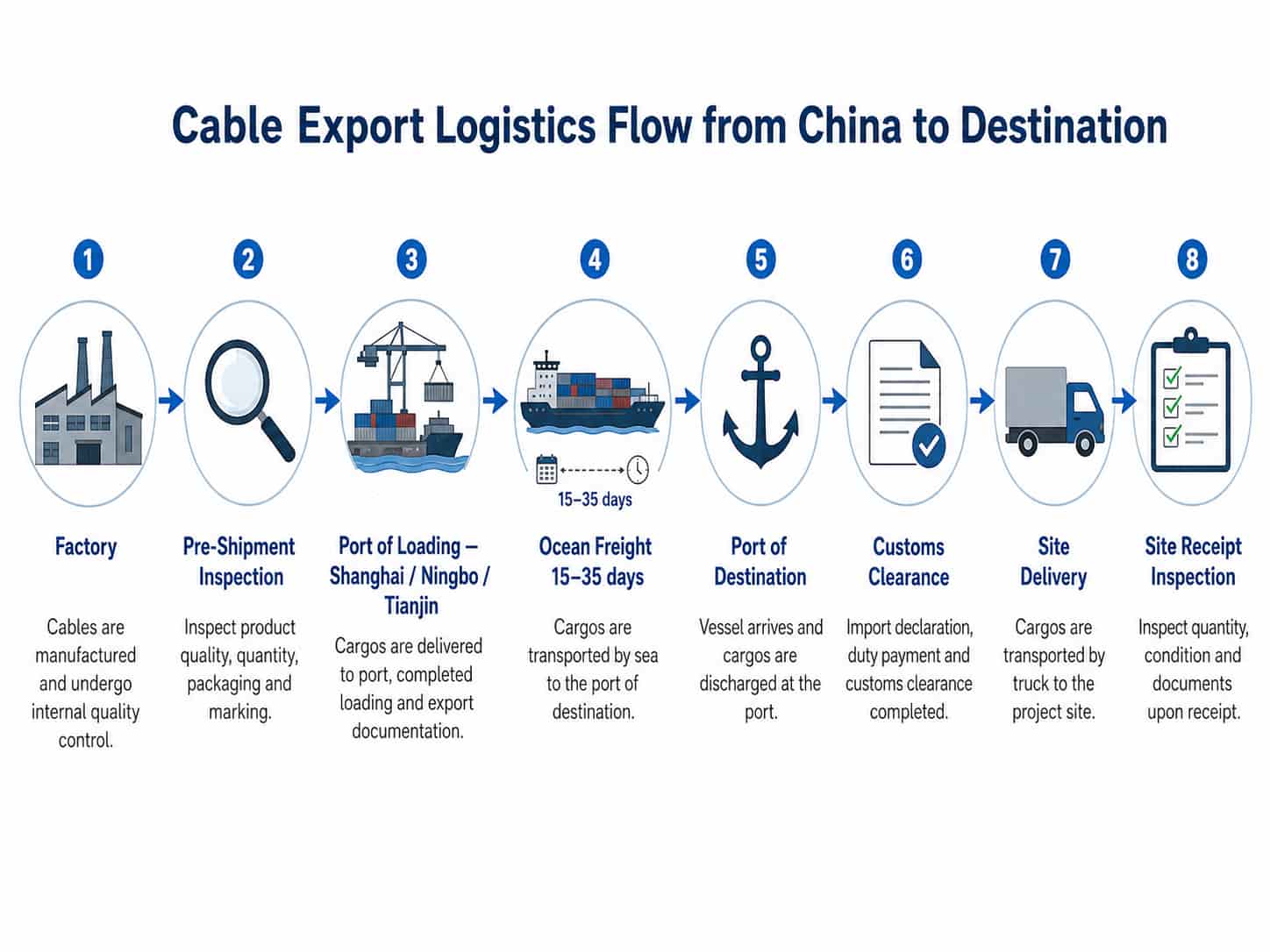
Incoterms Selection
The choice of Incoterms determines where risk and cost responsibility transfer from the seller to the buyer:
- FOB (Free on Board): the seller delivers the cable to the named port of shipment and loads it onto the vessel. The buyer arranges and pays for ocean freight, insurance, and delivery from the destination port. FOB is common for B2B cable import where the buyer has established freight arrangements.
- CIF (Cost, Insurance, Freight): the seller arranges and pays for ocean freight and insurance to the destination port. The buyer takes risk and responsibility from the destination port. CIF simplifies logistics for buyers without established freight arrangements but gives less visibility and control over shipping cost.
- DAP (Delivered at Place): the seller delivers to the named destination, including ocean freight and destination country inland transport, but excluding customs clearance and duties. Useful for project sites where the seller has local logistics capability.
- DDP (Delivered Duty Paid): the seller is responsible for all costs including customs duties and delivery to the named destination. Simplest for the buyer but highest seller risk — only offered by suppliers with strong logistics capability in the destination country.
Shipping Timeline
Typical shipping lead times for cable from China to major international markets:
- Southeast Asia: 5–12 days sea freight
- Middle East (Gulf): 18–25 days sea freight
- East Africa: 20–30 days sea freight
- West Africa: 25–35 days sea freight
- Australia: 18–28 days sea freight
- Europe: 28–38 days sea freight
- South America: 30–45 days sea freight
Add 7–14 days for customs clearance, port handling, and inland delivery at the destination. Total logistics time from factory to site is typically 6–12 weeks for most international destinations.
ISPM 15 and Wood Packaging Compliance
Wooden cable drums are classified as wood packaging material (WPM) and must comply with ISPM 15 — the international standard for heat treatment of wood packaging to prevent the spread of plant pests. Compliance requirements:
- All wooden drums must be heat-treated (56°C core temperature for 30 minutes minimum) or fumigated with methyl bromide
- The IPPC mark must be physically branded or stamped on each drum — a printed label is not acceptable
- The mark includes: the IPPC symbol, country code (CN for China), producer code, and treatment code (HT for heat treatment)
- Drums without the correct IPPC mark will be quarantined at the destination port — in Australia, the US, and the EU, non-compliant wood packaging may be destroyed
Key Point: Confirm ISPM 15 compliance with the cable supplier at the time of order — not at the time of shipment. Some smaller factories source drums from third-party drum manufacturers and may not consistently use ISPM 15-compliant drums. A written confirmation in the purchase order that all wooden packaging must carry the IPPC stamp provides a contractual basis for rejection if non-compliant drums are discovered.
Import Documentation Checklist
Common Sourcing Mistakes and How to Avoid Them
Based on recurring issues in international cable sourcing from China, these are the most costly and preventable errors:
- Specifying only a product name without a standard: ‘XLPE armored cable’ without a standard reference produces incomparable quotations for different products
- Accepting GB/T type test reports as IEC compliance: the two standards are harmonized but not identical — request IEC type test reports from an accredited laboratory explicitly
- Not confirming the manufacturer’s production capacity before placing the order: discovering the factory cannot meet the delivery date after the PO is placed causes project delays that cannot be recovered
- Comparing prices without locking the full specification: the cheapest quote is often for a cable with thinner insulation, lower-grade conductor, or non-galvanized armor — a locked specification is the only basis for a valid price comparison
- Omitting pre-shipment inspection on first-time supplier orders: the cost of a non-compliant shipment arriving at site — demurrage, return freight, re-procurement — is always higher than the cost of pre-shipment inspection
- Not confirming ISPM 15 for wooden drums before shipment: quarantine at the destination port causes project delays and additional costs that fall to the buyer
- Neglecting to plan for the total logistics lead time: treating cable as a ‘short-lead-time’ item and placing orders too late is the single most common cause of construction programme delays related to cable