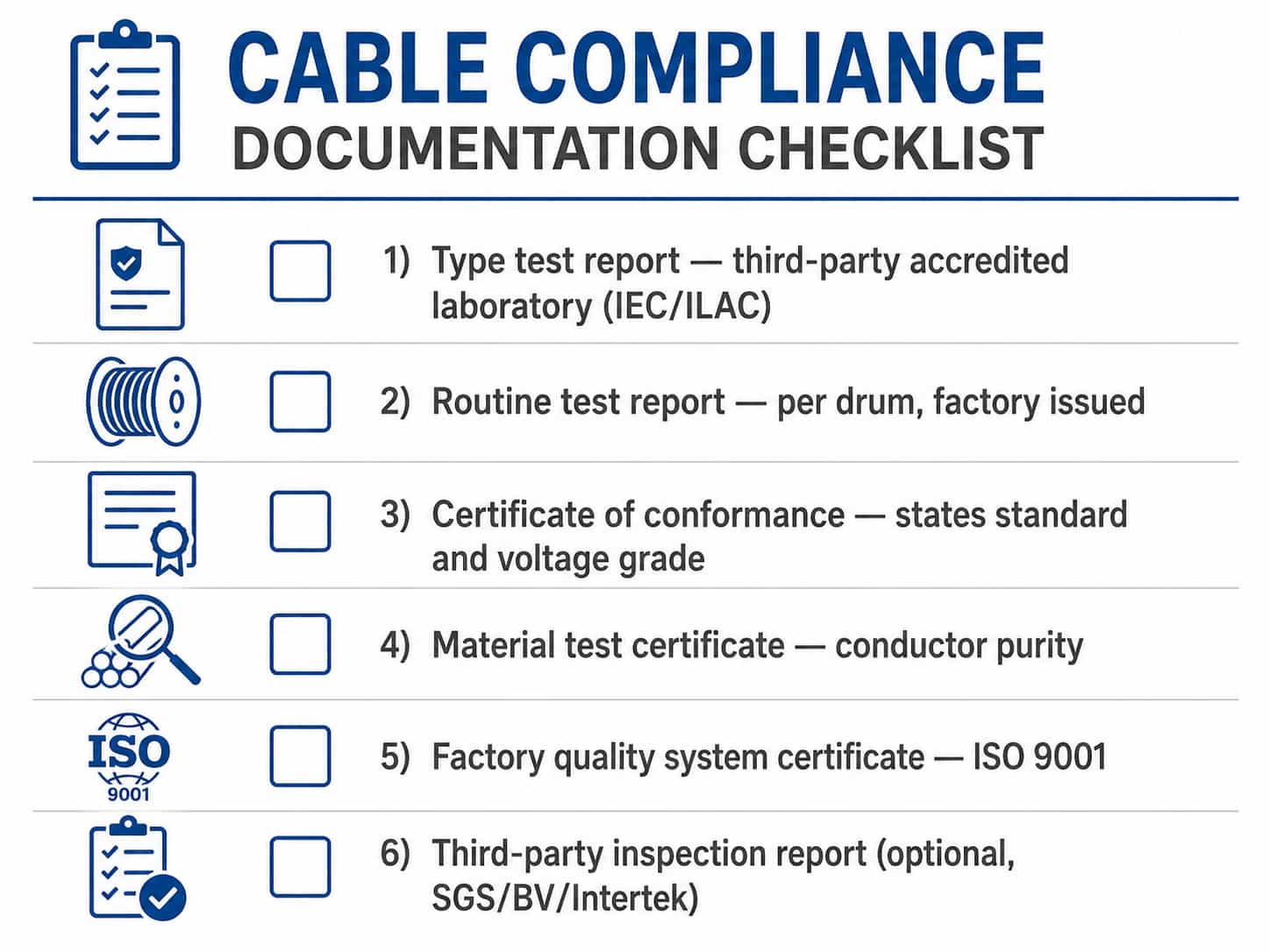
When sourcing industrial power cables from China for export to international markets, specifying the correct standard is not optional — it is the technical foundation of the procurement. The standard defines insulation wall thickness, conductor construction, test requirements, and marking. A cable that meets IEC 60502-1 may or may not also satisfy BS 6622 or AS/NZS 1429, depending on the specific requirements.
This guide explains the major international cable standards, which markets they apply to, the key differences between them, and how to confirm compliance documentation from a Chinese manufacturer exporting cables to your destination market.
Why Cable Standards Matter for B2B Export Procurement
A cable standard is not a label — it is a binding technical specification that defines how the cable must be constructed, tested, and marked. When a project specification references a standard, the supplied cable must comply with every relevant clause of that standard. Non-compliant cable can result in:
- Rejection at customs or by the local utility authority, requiring the entire consignment to be returned
- Refusal of project approval by the engineer or certifying authority
- Insurance and liability exposure if the cable fails and the non-compliance is discovered
- Re-procurement and re-shipping costs that dwarf the original saving from buying cheaper non-compliant cable
For B2B buyers sourcing cables from Chinese manufacturers, the most important practical point is this: Chinese factories default to GB/T standards (the national Chinese standard) unless the customer explicitly specifies otherwise. IEC, BS, and AS/NZS compliance must be specifically requested, confirmed in writing, and verified through test reports.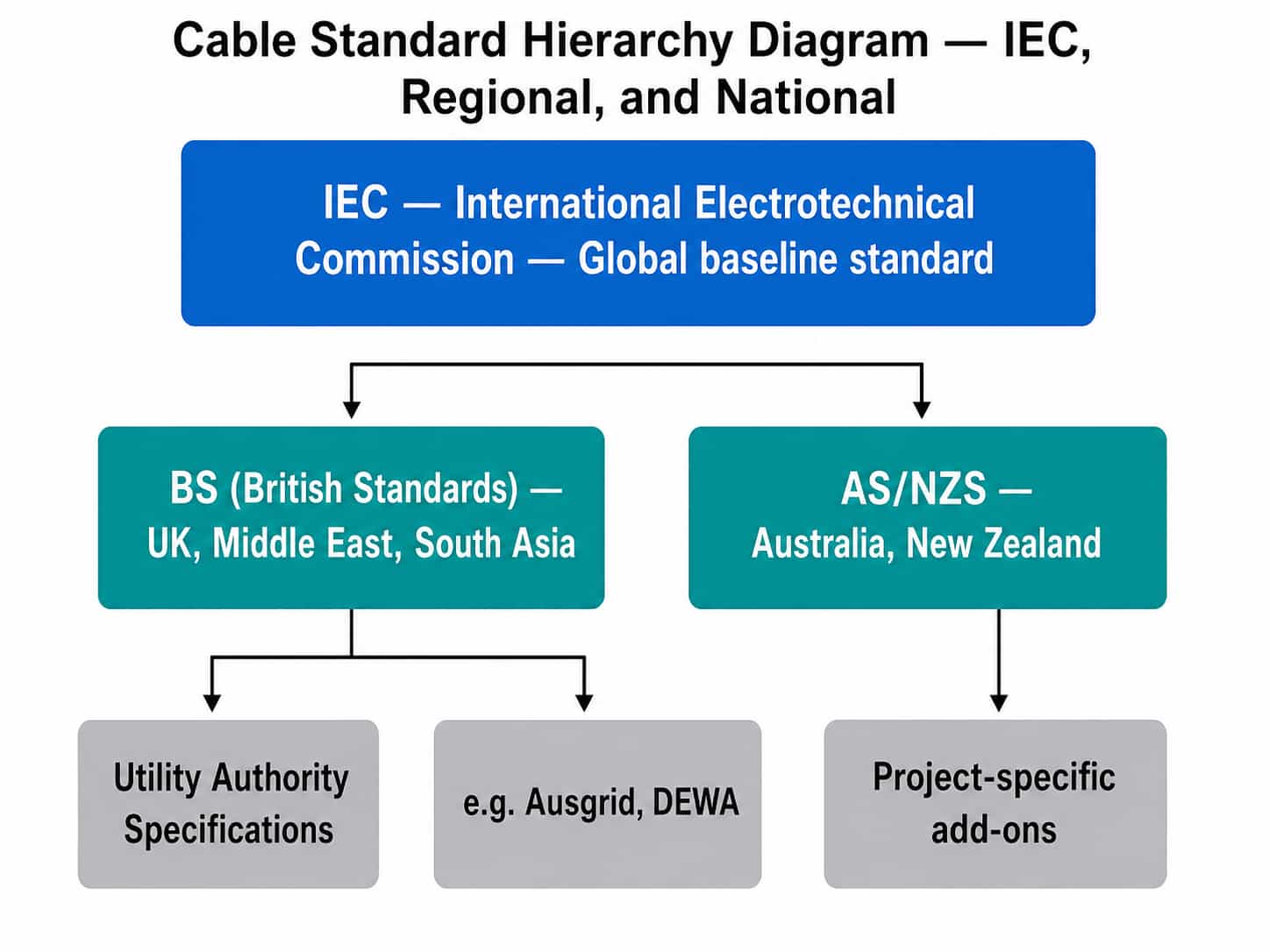
Key Point: Always include the full standard code on every cable inquiry and purchase order. ‘IEC cable’ is not a specification — ‘IEC 60502-1, 0.6/1kV, 4-core 95mm² Cu XLPE SWA PVC’ is a specification. The standard code is what the supplier’s QC team checks against in production.
IEC 60502: The International Default
IEC 60502 is published by the International Electrotechnical Commission and is the most widely accepted international standard for power cables in B2B export markets. It covers cables with extruded solid dielectric insulation from 1kV up to and including 30kV: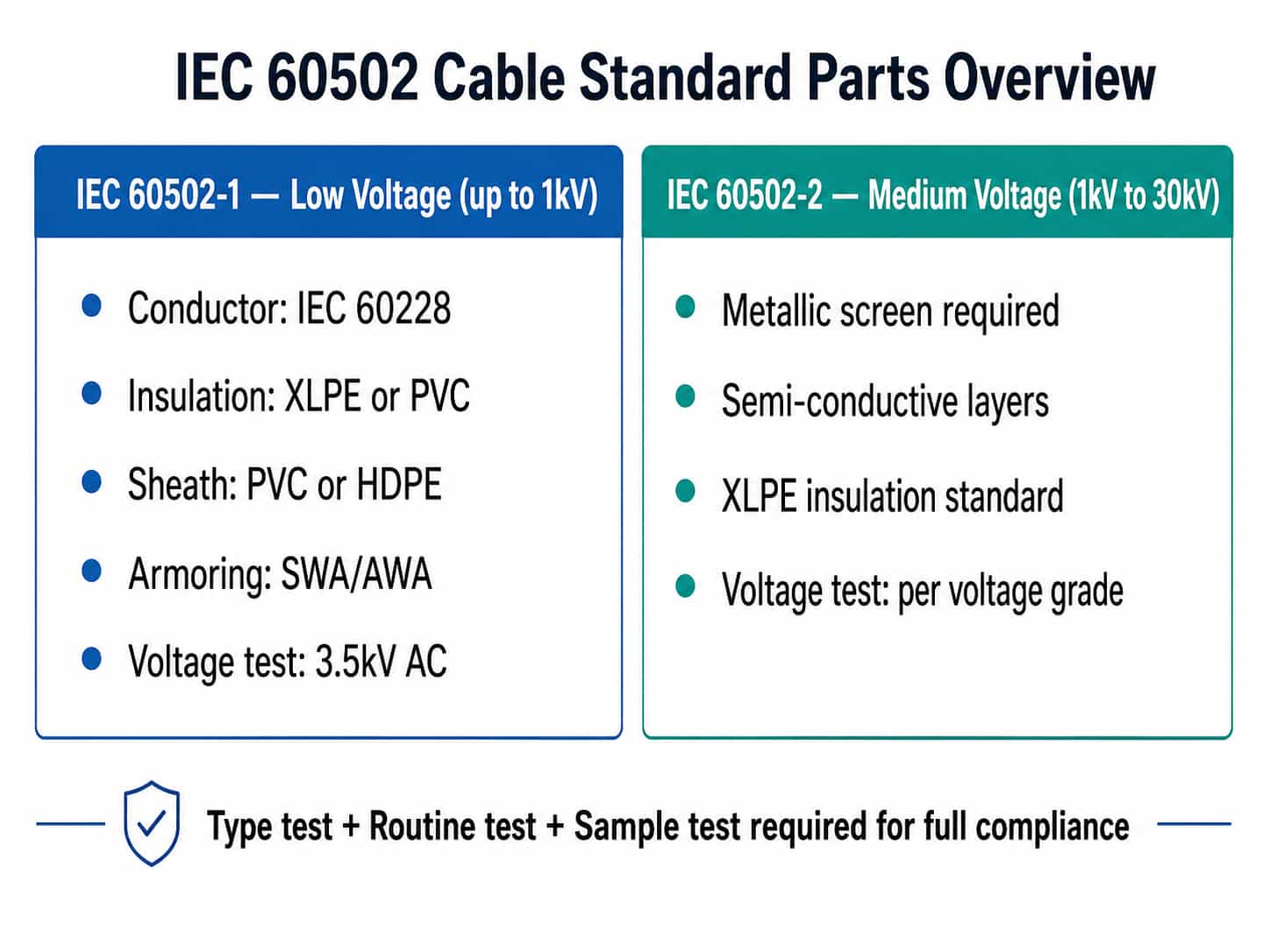
IEC 60502-1: Low Voltage Cables (up to 1kV)
Covers the construction, dimensions, test requirements, and marking for power cables with extruded insulation and associated sheathing rated up to 1kV. Key requirements:
- Conductor: to IEC 60228 — Class 1 (solid), Class 2 (stranded), or Class 5 (flexible) as specified
- Insulation: XLPE or PVC with defined minimum wall thicknesses per conductor cross-section
- Armoring: SWA (galvanized steel wire, defined wire diameter tolerances), AWA (aluminum wire), or STA (steel tape)
- Outer sheath: PVC compound ST2 (general purpose) or other compound types as specified
- Voltage test: 3,500V AC for 5 minutes on completed cable
- Routine tests: conductor resistance, voltage test, insulation resistance — on every drum
- Type tests: full suite of mechanical, thermal, and electrical tests on cable design — not per order
IEC 60502-2: Medium Voltage Cables (1kV to 30kV)
Covers MV cables from 3.6/6kV up to 18/30kV. Key additional requirements beyond Part 1:
- Conductor screen: semi-conductive layer bonded to conductor — mandatory
- Insulation screen: semi-conductive layer bonded to insulation outer surface — mandatory
- Metallic screen: copper tape, copper wire, or lead sheath — mandatory for field control
- Insulation wall thickness: defined per voltage grade — thicker than LV cable
- Type tests include: bending test, lightning impulse test, partial discharge test — more extensive than LV
Note: IEC 60502-2 does not cover cables above 30kV. High-voltage cables (above 30kV) fall under IEC 60840 (up to 150kV) and IEC 62067 (above 150kV). For most B2B industrial and infrastructure projects, IEC 60502-1 and -2 cover the full range of power cables required.
Why IEC Is the Default for Chinese Export
The Chinese national standard GB/T 12706 is structurally harmonized with IEC 60502 — it was developed using IEC as the reference. In practice, most Chinese cable manufacturers producing to GB/T 12706 can also produce to IEC 60502 on request, and the two standards share most technical requirements. However, they are not identical:
- Some insulation compound designations differ between GB/T and IEC
- Certain test method details and tolerances vary between the two standards
- IEC type test reports must reference the IEC standard specifically — a GB/T type test report does not substitute for an IEC type test report even when the construction is similar
For export procurement, always specify IEC 60502 explicitly. Do not accept GB/T as a substitute unless the project engineer has confirmed in writing that GB/T compliance is acceptable for the destination market.
BS Standards: The UK and Commonwealth Legacy
British Standards (BS) cable specifications predate IEC and remain mandatory or strongly preferred in several significant markets:
Key BS Cable Standards
- BS 6004: PVC-insulated cables for fixed wiring, up to 450/750V — UK internal building wiring
- BS 6346: PVC-insulated armored cables — LV distribution (being superseded by BS 5467 / IEC 60502-1 in many applications)
- BS 5467: XLPE-insulated armored cables up to 1kV — the LV armored cable standard widely used in UK and Commonwealth markets
- BS 6622: MV cables 6.6kV to 33kV — the primary MV cable standard for UK and Middle East markets
- BS 7835: MV cables for higher voltages — used alongside BS 6622 for 66kV and above
- BS 7889: polyethylene-insulated cables — older standard for some specialist applications
Where BS Standards Apply
BS cable standards are required or preferred in:
- United Kingdom — domestic infrastructure and utility projects typically require BS compliance
- Middle East — particularly Gulf Cooperation Council (GCC) countries where utility authorities (DEWA, SEC, ADDC, KAHRAMAA) specify BS standards in their project approval requirements
- South Asia — Pakistan, Bangladesh, and Sri Lanka retain BS as the primary cable standard
- Parts of Sub-Saharan Africa — Kenya, Ghana, Nigeria, and others with colonial-era utility infrastructure often retain BS-based specifications
- Hong Kong — BS-based specifications remain in use alongside IEC
Key Point: For the Middle East, particularly Saudi Arabia, UAE, Qatar, and Kuwait, the utility authority specification (not just the BS standard) typically governs cable procurement. DEWA (Dubai), SEC (Saudi Arabia), and KAHRAMAA (Qatar) each publish their own approved cable lists and specifications. A cable may be BS 6622-compliant but still require additional approval from the local utility authority before being used on a grid-connected project. Always confirm utility authority requirements with the project engineer before ordering.
IEC vs BS: Are They Compatible?
IEC 60502 and BS 5467/BS 6622 cover much of the same technical ground and were developed in parallel. However, there are differences that matter for procurement:
- Insulation wall thickness: BS specifies minimum thicknesses that in some cases differ slightly from IEC — a cable built to IEC minimum may not meet BS minimum in certain size ranges
- Conductor construction: some BS standards specify slightly different strand count and wire diameter requirements from IEC 60228
- Test requirements: BS and IEC share most routine and type tests but have differences in test sequence and acceptance criteria in some areas
- Cable designation: BS and IEC use different cable designation systems — a BS cable designation does not directly translate to an IEC designation
The practical implication: do not assume that IEC compliance automatically satisfies a BS requirement, or vice versa. If a project specifies BS 6622, ask for BS 6622 type test reports — not IEC 60502-2 reports. A competent Chinese manufacturer exporting to BS markets will have BS type test reports from an accredited laboratory.
AS/NZS Standards: Australia and New Zealand
Australia and New Zealand use their own national cable standards, developed and maintained jointly by Standards Australia and Standards New Zealand:
- AS/NZS 1125: conductors in insulated electric cables — Australian conductor standard (reference IEC 60228)
- AS/NZS 1429.1: electric cables — polymeric insulated — up to and including 19/33kV — LV and MV power cables
- AS/NZS 1429.2: electric cables — polymeric insulated — above 19/33kV — HV cables (less common in B2B industrial procurement)
- AS/NZS 3191: electric flexible cords — flexible cable standard for portable equipment
- AS/NZS 5000.1: electric cables — polymeric insulated cables for working voltages up to and including 0.6/1kV (domestic/commercial)
Utility Authority Requirements in Australia
Beyond the AS/NZS standards themselves, Australian electricity distribution networks impose additional requirements through their network standards:
- Ausgrid (NSW): Ausgrid’s Engineering Specification documents govern cables used on their network — cables must appear on the Ausgrid approved materials list
- Endeavour Energy (NSW): similar approval process with its own specification documents
- Western Power (WA): Western Power Material Specification (WPMS) documents govern materials
- AusNet (VIC): AusNet Network Asset Standards
For Chinese manufacturers supplying cable to Australian utility projects, simply meeting AS/NZS 1429 is not always sufficient — the cable may need to pass review against the specific network operator’s materials specification and in some cases be placed on the approved list before use on network assets.
Note: AS/NZS and IEC are broadly harmonized but not identical. AS/NZS 1429.1 references IEC 60502 as its technical basis but includes Australian-specific modifications and additional requirements. A cable with IEC 60502 type test reports is a good starting point but may require additional testing or documentation to be accepted on Australian utility projects. Confirm requirements with the project engineer and, if applicable, the network operator before ordering.
Other Regional Standards B2B Buyers Encounter
SANS (South Africa)
South Africa uses SANS (South African National Standards) for cable procurement:
- SANS 1507: electric cables with extruded solid dielectric insulation — LV and MV power cables, equivalent to IEC 60502
- Mining cables: SANS 1507 series has specific parts for mining applications requiring flame retardance and anti-static properties
- South African utility Eskom publishes its own cable specification requirements for grid-connected projects
NFC (France) and VDE (Germany)
Continental European markets generally use IEC-based standards, but France (NFC standards) and Germany (VDE standards) have historically maintained national specifications for domestic utility and industrial use. For most B2B export projects, IEC compliance is accepted in these markets, but utility-connected projects may require the specific national standard. Confirm with the project engineer if working on French or German utility infrastructure projects.
NEMA and UL (North America)
The United States and Canada use a completely different cable standards framework based on NEMA (National Electrical Manufacturers Association) and UL (Underwriters Laboratories) standards. North American cable specifications are structurally different from IEC — the conductor sizes (AWG-based, not mm²-based), insulation types, and test methods differ significantly. B2B buyers sourcing IEC-standard cables from China for North American projects should confirm with their project engineer whether IEC or UL/NEMA-listed cable is required — many private industrial projects accept IEC, while utility-connected and public infrastructure projects typically require UL listing.
Market-by-Market Standard Reference Guide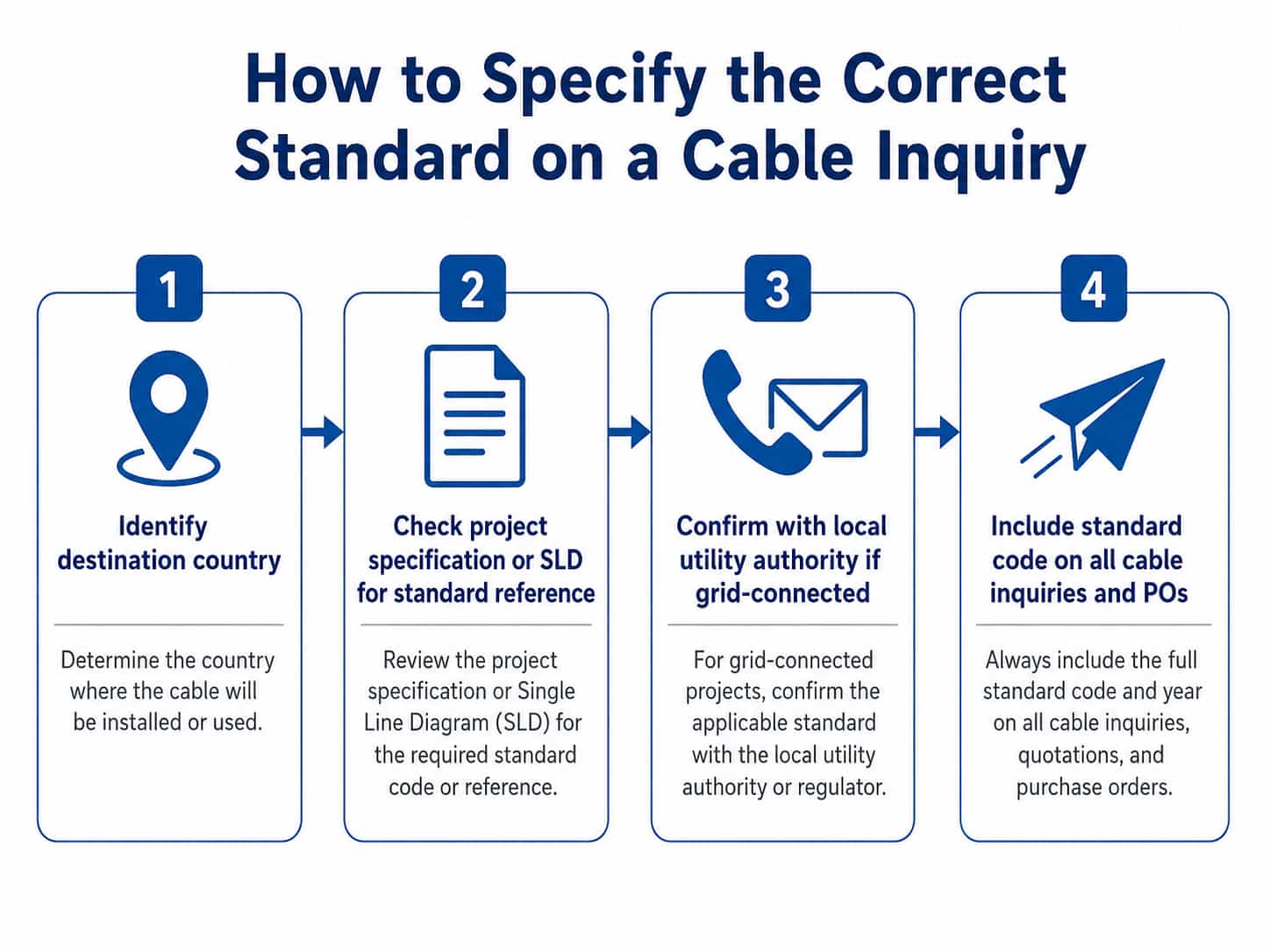
Most reputable Chinese cable manufacturers have dual certification: they produce to GB/T for the domestic market and have IEC type test reports from accredited laboratories (CNAS-accredited, ILAC member) for their export products. When sourcing from China:
- Ask specifically: ‘Do you have IEC 60502-1 type test reports from a CNAS or ILAC-accredited laboratory for this cable construction?’
- Do not accept a GB/T type test report as a substitute for an IEC type test report
- Confirm the type test report covers the specific cable construction (voltage grade, conductor size, insulation type) you are ordering — a type test for a 4-core 95mm² cable does not automatically cover a 3-core 240mm² cable of the same construction